\n
## Diagram: Tree-like Structure with Labeled Nodes
### Overview
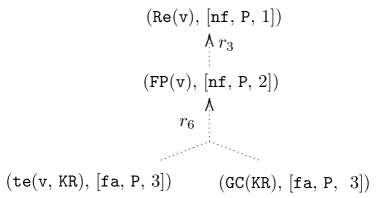
The image depicts a tree-like diagram with nodes connected by branches. Each node contains a set of information enclosed in parentheses and square brackets. The branches are labeled with symbols representing transformations. The diagram appears to represent a hierarchical process or a series of transformations applied to a variable 'v'.
### Components/Axes
The diagram consists of:
* **Nodes:** Each node contains a tuple of information. The first element is a function applied to 'v' (or KR). The second element is a label (nf, fa). The third element is 'P'. The fourth element is a number (1, 2, or 3).
* **Branches:** Branches are labeled with 'τ3' and 'τ6', representing transformations.
* **Root Node:** (Re(v), [nf, P, 1])
* **Intermediate Node:** (FP(v), [nf, P, 2])
* **Leaf Nodes:** (te(v, KR), [fa, P, 3]) and (GC(KR), [fa, P, 3])
### Detailed Analysis or Content Details
The diagram can be described as follows:
1. **Root Node:** (Re(v), [nf, P, 1])
2. **Branch 1:** Connected to the root node, labeled 'τ3', leads to the intermediate node.
3. **Intermediate Node:** (FP(v), [nf, P, 2])
4. **Branch 2:** Connected to the intermediate node, labeled 'τ6', splits into two leaf nodes.
5. **Leaf Node 1:** (te(v, KR), [fa, P, 3])
6. **Leaf Node 2:** (GC(KR), [fa, P, 3])
The labels within the nodes are consistent in structure:
* The first element is a function: Re, FP, te, GC.
* The second element is a label: nf, fa.
* The third element is always 'P'.
* The fourth element is a number: 1, 2, 3.
### Key Observations
* The diagram represents a branching process starting from 'v' and ending at 'te(v, KR)' and 'GC(KR)'.
* The labels 'nf' and 'fa' might represent different states or properties.
* The numbers 1, 2, and 3 could indicate steps or levels in the process.
* The transformation 'τ3' leads to 'FP(v)', while 'τ6' splits the process into two paths.
* Both leaf nodes share the same label [fa, P, 3].
### Interpretation
The diagram likely represents a computational process or a logical derivation. 'v' is the initial input, and the functions Re, FP, te, and GC represent transformations applied to it. The labels 'nf' and 'fa' could indicate whether a certain condition is met or a specific property holds. The numbers 1, 2, and 3 might represent the order of operations or the depth of the derivation. The diagram suggests that the initial variable 'v' is transformed through a series of steps, ultimately leading to two possible outcomes: 'te(v, KR)' and 'GC(KR)'. The shared label [fa, P, 3] for the leaf nodes suggests that both outcomes share a common property or state. Without further context, it's difficult to determine the specific meaning of the functions and labels, but the diagram clearly illustrates a structured process with branching possibilities. The diagram is a visual representation of a mathematical or logical transformation.