## Diagram: Hierarchical Logical Inference Tree
### Overview
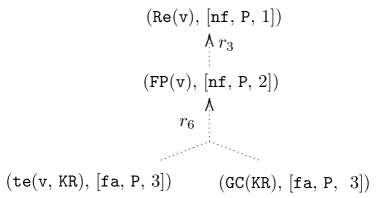
The image displays a hierarchical diagram resembling a logical inference or derivation tree. It consists of four nodes containing symbolic expressions, connected by labeled, dotted lines that indicate relationships or rules. The structure flows from a single top node down to two bottom nodes via an intermediate node.
### Components/Axes
* **Nodes:** Four distinct nodes, each containing a parenthetical expression followed by a bracketed list.
* **Connections:** Dotted lines connect the nodes, each labeled with a rule identifier (`r3`, `r6`).
* **Spatial Layout:**
* **Top Node:** Centered at the top of the diagram.
* **Middle Node:** Centered directly below the top node.
* **Bottom Nodes:** Two nodes positioned at the bottom-left and bottom-right, forming a fork from the middle node.
### Detailed Analysis
**Node Transcription (Top to Bottom, Left to Right):**
1. **Top Node (Position: Top Center):**
* Text: `(Re(v), [nf, P, 1])`
* Components: `Re(v)` and a list `[nf, P, 1]`.
2. **Middle Node (Position: Center):**
* Text: `(FP(v), [nf, P, 2])`
* Components: `FP(v)` and a list `[nf, P, 2]`.
* **Connection:** A dotted line labeled `r3` connects this node upward to the Top Node.
3. **Bottom-Left Node (Position: Bottom Left):**
* Text: `(te(v, KR), [fa, P, 3])`
* Components: `te(v, KR)` and a list `[fa, P, 3]`.
* **Connection:** A dotted line labeled `r6` connects this node upward to the Middle Node.
4. **Bottom-Right Node (Position: Bottom Right):**
* Text: `(GC(KR), [fa, P, 3])`
* Components: `GC(KR)` and a list `[fa, P, 3]`.
* **Connection:** A dotted line labeled `r6` connects this node upward to the Middle Node.
**Pattern Analysis:**
* **Bracketed Lists:** The lists follow a pattern: `[Status, P, Number]`.
* `Status`: Changes from `nf` (in top two nodes) to `fa` (in bottom two nodes).
* `P`: Constant across all nodes.
* `Number`: Increments sequentially from 1 (top) to 2 (middle) to 3 (both bottom nodes).
* **Parenthetical Expressions:** These appear to be predicates or functions with arguments (`v`, `KR`).
### Key Observations
1. **Hierarchical Flow:** The diagram shows a clear top-down derivation or inference path.
2. **Rule Application:** The labels `r3` and `r6` on the connecting lines suggest specific transformation rules are applied between levels.
3. **State Change:** The transition from `nf` to `fa` in the bracketed lists coincides with the application of rule `r6` and the branching into two nodes.
4. **Parallel Outcomes:** The two bottom nodes, while containing different primary expressions (`te(v, KR)` vs. `GC(KR)`), share the identical state `[fa, P, 3]`, indicating they are parallel results of the same process from the middle node.
### Interpretation
This diagram likely represents a step in a formal logical proof, a semantic network derivation, or a computational process within a specialized domain (e.g., knowledge representation, automated reasoning).
* **What it demonstrates:** It visualizes how a higher-level concept or state (`Re(v)`) is refined or decomposed into an intermediate form (`FP(v)`), which then, via a specific rule (`r6`), yields two distinct but related concrete outcomes or instances (`te(v, KR)` and `GC(KR)`).
* **Relationships:** The structure is a directed acyclic graph. The parent node (`FP(v)`) is a necessary precursor for generating its child nodes. The shared rule `r6` and identical final state `[fa, P, 3]` imply the two bottom nodes are sibling conclusions derived under the same conditions.
* **Notable Pattern:** The incrementing number in the bracketed list (1 → 2 → 3) strongly suggests a step counter or depth marker within the inference process. The change from `nf` to `fa` likely signifies a change in status, such as from "non-final" to "final" or from a "formula" to a "fact."
* **Uncertainty:** Without the surrounding context or key for the abbreviations (`Re`, `FP`, `te`, `GC`, `KR`, `nf`, `fa`), the specific semantic meaning of the transformation is inferred from the structural patterns. The diagram's primary information is the relational structure and the symbolic progression, not the real-world meaning of the symbols.