## Network Diagrams and Data Tables: Influence of Node States
### Overview
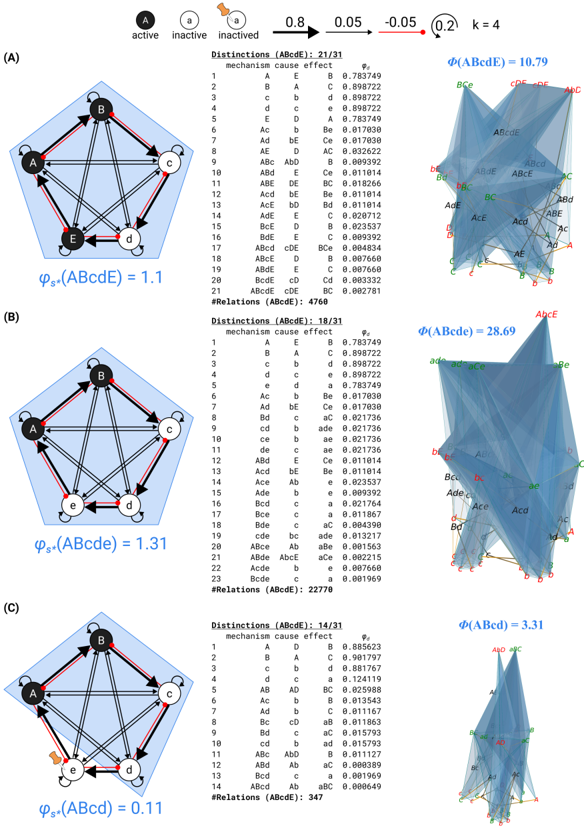
The image presents three sets of network diagrams, each accompanied by a data table and a radar plot. Each set (A, B, and C) illustrates a network of five nodes (A, B, C, d, and E) with varying states (active, inactive, or inactived). The diagrams show the influence between nodes, with arrows indicating the direction of influence. The data tables list distinctions, mechanisms, causes, effects, and associated φs values. The radar plots visualize the φ values for different combinations of nodes.
### Components/Axes
**General Elements:**
* **Nodes:** Labeled A, B, C, d, and E. Node states are indicated by color: black (active), white (inactive), and white with an orange outline (inactived).
* **Edges:** Arrows indicate the direction of influence between nodes. Black arrows represent positive influence, and red arrows represent negative influence.
* **Distinctions (ABcdE):** Indicates the number of distinctions out of 31.
* **Mechanism:** Lists the mechanism of influence.
* **Cause:** Lists the cause of the influence.
* **Effect:** Lists the effect of the influence.
* **φs:** A numerical value associated with each mechanism, cause, and effect.
* **#Relations (ABcdE):** The total number of relations in the network.
* **Φ(ABcdE):** A numerical value representing the overall influence in the network, visualized in the radar plot.
* **Radar Plots:** Show the φ values for different combinations of nodes. The axes of the radar plots are labeled with combinations of nodes (e.g., AB, AC, AE, BC, BE, etc.).
**Specific Elements for Each Set:**
* **(A):**
* Distinctions (ABcdE): 21/31
* φs*(ABcdE) = 1.1
* Φ(ABcdE) = 10.79
* #Relations (ABcdE): 4768
* **(B):**
* Distinctions (ABcdE): 18/31
* φs*(ABcdE) = 1.31
* Φ(ABcdE) = 28.69
* #Relations (ABcdE): 22778
* **(C):**
* Distinctions (ABcdE): 14/31
* φs*(ABcd) = 0.11
* Φ(ABcd) = 3.31
* #Relations (ABcdE): 347
**Top Legend:**
* **Active:** Black circle.
* **Inactive:** White circle.
* **Inactived:** White circle with an orange outline.
* **Parameters:** 0.8 (arrow), 0.05 (arrow), -0.05 (arrow), (0.2) k = 4
### Detailed Analysis or ### Content Details
**Network Diagrams:**
* **(A):** Nodes A and E are active (black), while B, C, and d are inactive (white).
* **(B):** Nodes A and B are active (black), while C, d, and e are inactive (white).
* **(C):** Nodes A and B are active (black), while C, d, and e are inactive (white). Node 'e' has an orange outline, indicating it is inactived.
**Data Tables:**
The data tables list the distinctions, mechanisms, causes, effects, and φs values for each network. Here's a summary of the first few rows from each table:
* **(A):**
* Row 1: A -> E, Cause: B, φs = 0.783749
* Row 2: B -> A, Cause: C, φs = 0.898722
* Row 3: C -> b, Cause: d, φs = 0.898722
* **(B):**
* Row 1: A -> E, Cause: B, φs = 0.783749
* Row 2: B -> A, Cause: C, φs = 0.898722
* Row 3: C -> b, Cause: d, φs = 0.898722
* **(C):**
* Row 1: A -> D, Cause: B, φs = 0.885623
* Row 2: B -> A, Cause: C, φs = 0.901797
* Row 3: C -> b, Cause: d, φs = 0.881767
**Radar Plots:**
The radar plots visualize the φ values for different combinations of nodes. The shape and size of the radar plots vary, indicating different levels of influence in each network.
* **(A):** The radar plot for Φ(ABcdE) = 10.79 shows a relatively balanced distribution of φ values across different node combinations.
* **(B):** The radar plot for Φ(ABcdE) = 28.69 shows a more pronounced distribution, with higher φ values for certain node combinations.
* **(C):** The radar plot for Φ(ABcd) = 3.31 shows a less pronounced distribution, with lower φ values overall.
### Key Observations
* The number of relations varies significantly across the three networks: 4768, 22778, and 347.
* The Φ(ABcdE) values also vary significantly: 10.79, 28.69, and 3.31.
* The node states (active, inactive, inactived) and the network structure influence the φs values and the overall influence in the network.
### Interpretation
The data suggests that the state of the nodes and the connections between them significantly impact the overall influence within the network. The higher the number of relations and the more balanced the distribution of influence, the higher the Φ(ABcdE) value. The inactived state of node 'e' in network (C) appears to reduce the overall influence, as indicated by the lower Φ(ABcd) value. The data demonstrates how different network configurations and node states can lead to varying levels of influence and interaction between the nodes. The distinctions value represents the number of unique states the system can take.