\n
## Diagram: Reasoning Process Comparison
### Overview
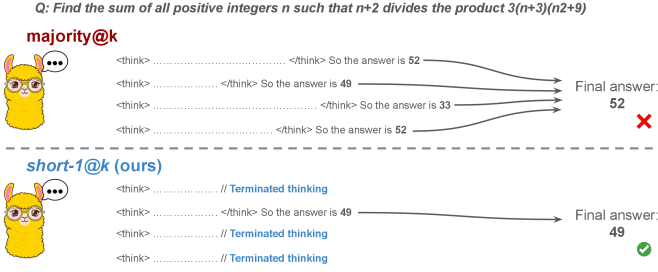
The image presents a comparison of the reasoning processes of two models, "majority@k" and "short-1@k", when attempting to solve a mathematical problem. The problem statement is "Find the sum of all positive integers n such that n+2 divides the product 3(n+3)(n+9)". The diagram visualizes the intermediate "thinking" steps of each model and their final answers, indicating whether the answer is correct or incorrect.
### Components/Axes
The diagram is divided into two main sections, one for each model. Each section contains:
* A model identifier ("majority@k" and "short-1@k") with a cartoon llama icon.
* A series of "thinking" steps, represented as `<think>` tags followed by a textual statement.
* Arrows connecting the thinking steps to a "Final answer" box.
* A visual indicator (red 'X' or green checkmark) next to the final answer, signifying correctness.
* A dashed horizontal line separating the two model sections.
### Detailed Analysis or Content Details
**1. majority@k:**
* **Thinking Steps:**
* `<think> So the answer is 52`
* `<think> So the answer is 49`
* `<think> So the answer is 33`
* `<think> So the answer is 52`
* **Final Answer:** 52 (marked with a red 'X', indicating incorrect)
**2. short-1@k:**
* **Thinking Steps:**
* `<think> // Terminated thinking`
* `<think> <think> So the answer is 49`
* `<think> // Terminated thinking`
* `<think> // Terminated thinking`
* **Final Answer:** 49 (marked with a green checkmark, indicating correct)
### Key Observations
* The "majority@k" model explores multiple potential answers (52, 49, 33, 52) before arriving at a final answer of 52, which is incorrect.
* The "short-1@k" model appears to terminate its reasoning process more quickly, with several steps labeled as "// Terminated thinking". It arrives at the correct answer of 49 after a single reasoning step.
* The "majority@k" model revisits the answer 52 twice, suggesting a potential oscillation or inability to converge on the correct solution.
* The "// Terminated thinking" label in "short-1@k" suggests a mechanism to stop further reasoning once a satisfactory answer is found.
### Interpretation
The diagram illustrates a comparison of two different reasoning strategies. "majority@k" seems to explore a wider range of possibilities but ultimately fails to find the correct answer, potentially due to a lack of a stopping criterion or an inability to evaluate the validity of its intermediate steps. "short-1@k", on the other hand, demonstrates a more concise and efficient reasoning process, arriving at the correct answer with fewer steps and a mechanism for terminating the search. This suggests that a balance between exploration and efficient termination is crucial for successful problem-solving. The use of "// Terminated thinking" indicates a potential pruning strategy within the "short-1@k" model, which prevents it from wasting resources on unproductive lines of reasoning. The diagram highlights the importance of not only generating potential solutions but also effectively evaluating and selecting the correct one. The cartoon llama icons are purely illustrative and do not contribute to the factual content of the diagram.