\n
## Diagram: Comparison of Two Problem-Solving Methods
### Overview
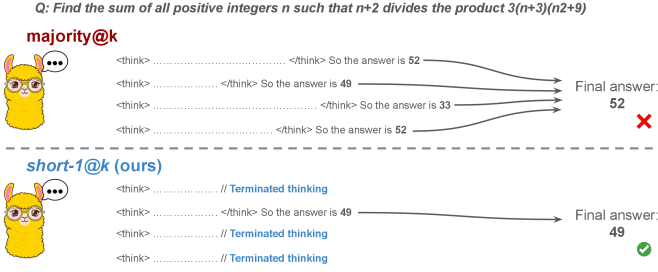
The image is a diagram comparing the outputs of two different methods, labeled "majority@k" and "short-1@k (ours)", when applied to the same mathematical problem. The diagram visually demonstrates that the "short-1@k" method yields the correct answer, while the "majority@k" method yields an incorrect one.
### Components/Axes
The diagram is structured into three main horizontal sections:
1. **Header/Problem Statement:** A single line of text at the top presenting the mathematical question.
2. **Method 1 (majority@k):** The upper section, featuring a cartoon character (a yellow, horned creature with glasses) on the left. To its right are four lines representing internal "thinking" processes, which converge via arrows to a final answer on the far right.
3. **Method 2 (short-1@k (ours)):** The lower section, separated by a dashed line. It features an identical cartoon character on the left. To its right are four lines representing its "thinking" processes, which also converge to a final answer on the far right.
**Labels and Text Elements:**
* **Problem Statement:** "Q: Find the sum of all positive integers n such that n+2 divides the product 3(n+3)(n²+9)"
* **Method 1 Label:** "majority@k" (in red text)
* **Method 2 Label:** "short-1@k (ours)" (in blue text)
* **Thinking Process Tags:** Lines begin with `<think>` or `// Terminated thinking`.
* **Answers within Thinking:** Phrases like "So the answer is 52", "So the answer is 49", "So the answer is 33".
* **Final Answer Blocks:** "Final answer:" followed by a number (52 or 49).
* **Outcome Indicators:** A red "X" (✗) next to the final answer for "majority@k", and a green checkmark (✓) next to the final answer for "short-1@k".
### Detailed Analysis
**Method 1: majority@k**
* **Process:** Four parallel thinking streams are shown.
1. `<think> So the answer is 52`
2. `<think> So the answer is 49`
3. `<think> So the answer is 33`
4. `<think> So the answer is 52`
* **Convergence:** All four streams have arrows pointing to a single "Final answer: 52" block.
* **Outcome:** The final answer "52" is marked with a red "X", indicating it is incorrect.
**Method 2: short-1@k (ours)**
* **Process:** Four parallel thinking streams are shown.
1. `<think> So the answer is 49`
2. `<think> So the answer is 49`
3. `<think>.................... // Terminated thinking`
4. `<think>.................... // Terminated thinking`
* **Convergence:** Only the second stream (which concluded "49") has an arrow pointing to the "Final answer: 49" block. The other three streams are marked as terminated and do not contribute.
* **Outcome:** The final answer "49" is marked with a green checkmark, indicating it is correct.
### Key Observations
1. **Divergent Outputs:** The two methods, when processing the same problem, produce different final answers (52 vs. 49).
2. **Process Difference:** The "majority@k" method aggregates results from all its thinking streams (including conflicting ones like 49 and 33) to arrive at a majority-based answer (52 appears twice). The "short-1@k" method appears to terminate most thinking streams early, allowing only one stream to complete and provide the final answer.
3. **Correctness:** The diagram explicitly labels the output of "majority@k" as wrong and the output of "short-1@k" as correct.
4. **Visual Metaphor:** The identical cartoon characters suggest the underlying "agent" or model is the same; the difference lies in the method or strategy ("@k") applied to its reasoning process.
### Interpretation
This diagram is a technical illustration likely from a research paper or report on AI reasoning or problem-solving strategies. It argues for the superiority of the "short-1@k" method over the "majority@k" method.
* **What it demonstrates:** It shows that a strategy of terminating most reasoning paths ("short-1") can prevent an AI system from being misled by incorrect intermediate conclusions and lead it to the correct answer. In contrast, a strategy that aggregates multiple reasoning paths ("majority") can be corrupted by incorrect intermediate outputs, leading to a wrong final answer.
* **Relationship between elements:** The problem statement is the constant input. The two methods are competing algorithms applied to that input. The "thinking" lines represent the internal reasoning traces of the AI. The final answers and their correctness markers are the evaluated outcomes. The arrows show the flow of information from reasoning to conclusion.
* **Underlying message:** The diagram suggests that for certain types of complex problems (like the given number theory problem), quality and correctness of reasoning are more important than quantity or consensus. A method that can identify and halt flawed reasoning paths ("short-1") is more reliable than one that simply tallies the results of multiple paths, some of which may be flawed ("majority"). The "(ours)" label indicates the authors are proposing the "short-1@k" method as their contribution.