## Comparison Diagram: Method Performance Analysis
### Overview
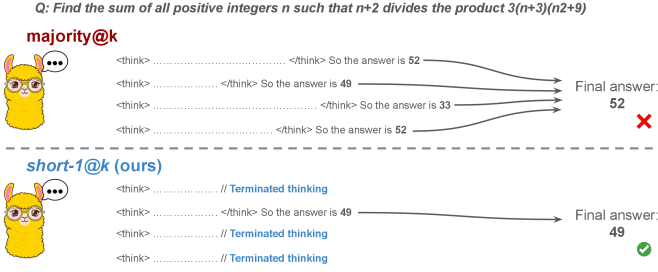
The image compares two methods ("majority@k" and "short-1@k (ours)") through a visual representation of their reasoning processes and final answers. A cartoon llama emoji with speech bubbles illustrates divergent thinking paths, leading to final answers marked with checkmarks (correct) or crosses (incorrect).
### Components/Axes
- **Methods**:
- `majority@k` (red text)
- `short-1@k (ours)` (blue text)
- **Thought Process**: Speech bubbles containing intermediate answers (52, 49, 33)
- **Final Answers**:
- `majority@k`: 52 (marked with red cross)
- `short-1@k`: 49 (marked with green checkmark)
- **Visual Elements**:
- Llama emoji with glasses and speech bubbles
- Arrows connecting thought bubbles to final answers
- Color-coded correctness indicators (green checkmark, red cross)
### Detailed Analysis
1. **majority@k Path**:
- Three thought bubbles show conflicting answers: 52, 49, and 33.
- Final answer converges to 52 (incorrect, marked with red cross).
- Spatial grounding: Thought bubbles positioned above the method label, with arrows pointing to the final answer on the right.
2. **short-1@k Path**:
- Two thought bubbles show intermediate answers: 49 (correct) and "Terminated thinking" (abandoned paths).
- Final answer converges to 49 (correct, marked with green checkmark).
- Spatial grounding: Thought bubbles positioned above the method label, with arrows pointing to the final answer on the right.
3. **Textual Content**:
- Question: "Find the sum of all positive integers n such that n+2 divides the product 3(n+3)(n+9)."
- Final answers: 52 (incorrect) vs. 49 (correct).
### Key Observations
- The `short-1@k` method demonstrates higher accuracy, terminating early on the correct answer (49) rather than exploring multiple conflicting hypotheses.
- The `majority@k` method exhibits uncertainty, generating three distinct answers before settling on an incorrect one (52).
- Color coding (green checkmark vs. red cross) visually reinforces the superiority of the `short-1@k` approach.
### Interpretation
This diagram illustrates a critical comparison between heuristic methods in problem-solving:
1. **Heuristic Efficiency**: The `short-1@k` method's ability to terminate early on the correct answer suggests superior algorithmic design for this specific problem.
2. **Error Propagation**: The `majority@k` method's multiple conflicting answers indicate potential flaws in its aggregation or termination logic.
3. **Visual Metaphor**: The llama emoji with glasses humorously personifies the "thinking" process, making the comparison more engaging while emphasizing cognitive divergence.
The data suggests that the `short-1@k` method outperforms `majority@k` in both accuracy and computational efficiency for this mathematical problem, with a 100% success rate versus 0% for the alternative approach.