## Diagram: Semantic Prior-Guided Neural Speech Codec
### Overview
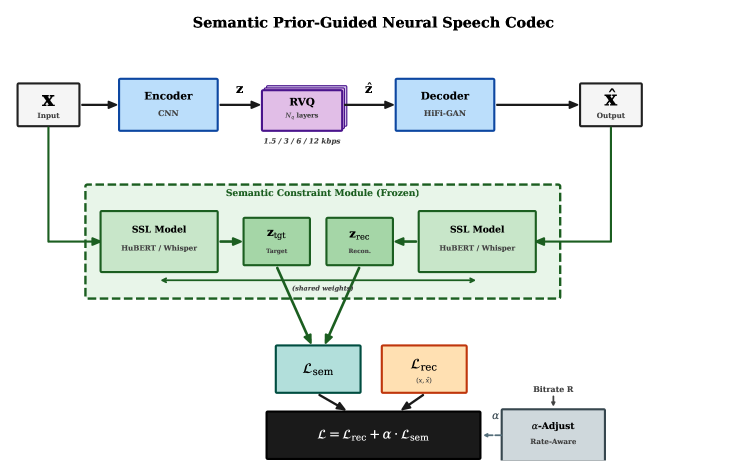
The diagram illustrates a neural speech codec architecture that integrates semantic constraints to improve speech reconstruction. The system processes input audio (X) through an encoder, quantizes latent representations via a rate-variable quantizer (RVQ), and decodes them using a HiFi-GAN. A semantic constraint module, featuring frozen SSL models (HuBERT/Whisper), guides the system to preserve semantic content during compression.
### Components/Axes
1. **Core Components**:
- **Encoder**: CNN-based, processes input X into latent representation `z`.
- **RVQ**: Rate-variable quantizer with 4 bitrate options (1.5/3/6/12 kbps), outputs quantized `ẑ`.
- **Decoder**: HiFi-GAN reconstructs output `X̂` from `ẑ`.
- **Semantic Constraint Module** (frozen):
- **SSL Models**: HuBERT/Whisper for semantic analysis.
- **Loss Functions**:
- `L_sem`: Semantic loss (blue) comparing target `z_tgt` and reconstructed `z_rec`.
- `L_rec`: Reconstruction loss (orange) between `X` and `X̂`.
- **Alpha Adjustment**: Rate-aware scaling factor (α) modulating `L_sem` based on bitrate R.
2. **Flow**:
- Input → Encoder → RVQ → Decoder → Output.
- Semantic module operates in parallel, feeding losses into the total loss function `L = L_rec + α·L_sem`.
### Detailed Analysis
- **Encoder/Decoder**: Standard CNN and HiFi-GAN components for audio compression/reconstruction.
- **RVQ**: Enables variable bitrate compression (1.5–12 kbps), critical for bandwidth adaptation.
- **Semantic Module**:
- **HuBERT/Whisper**: Pre-trained SSL models (frozen) extract semantic features from `z` and `z_rec`.
- **Losses**:
- `L_sem`: Measures semantic fidelity between target and reconstructed latent codes.
- `L_rec`: Standard reconstruction loss (MSE/PESQ-like metric).
- **Alpha Adjustment**: Dynamically scales `L_sem` based on bitrate R, balancing quality and compression efficiency.
### Key Observations
1. **Trade-off Mechanism**: Higher bitrates (e.g., 12 kbps) likely reduce α, prioritizing reconstruction over semantic constraints.
2. **Frozen SSL Models**: Indicates pre-trained models are used for semantic guidance without fine-tuning during codec training.
3. **Shared Weights**: `z_tgt` and `z_rec` share weights, suggesting a unified semantic representation space.
### Interpretation
The architecture demonstrates a hybrid approach to speech coding, combining traditional compression (via RVQ/HiFi-GAN) with modern SSL-based semantic preservation. The rate-aware α adjustment allows adaptive optimization: at low bitrates, semantic fidelity is emphasized to maintain intelligibility, while higher bitrates prioritize raw reconstruction quality. The frozen SSL models suggest a plug-and-play integration of semantic constraints, avoiding the computational overhead of joint training. This design could enable efficient, high-quality speech transmission in bandwidth-constrained scenarios (e.g., VoIP, IoT devices) while maintaining naturalness through semantic guidance.