\n
## Bar Chart: Overall Accuracy Comparison
### Overview
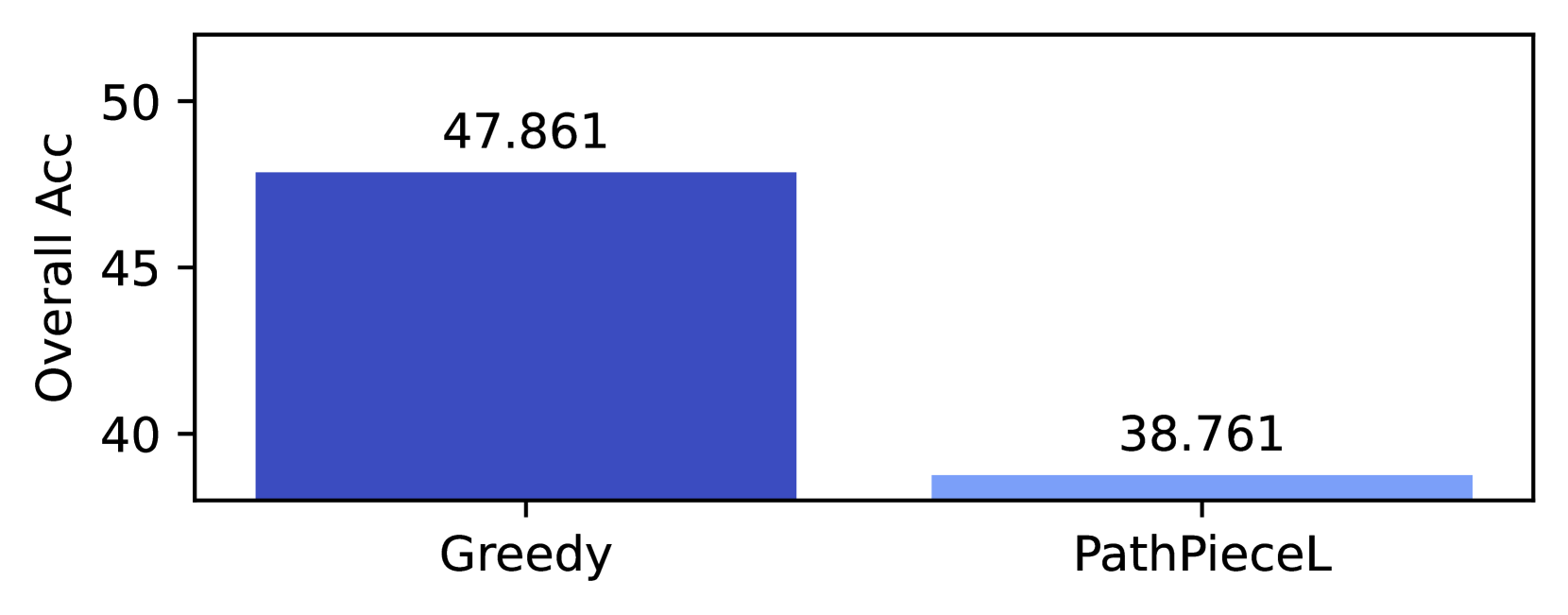
This image presents a bar chart comparing the "Overall Acc" (Overall Accuracy) of two methods: "Greedy" and "PathPieceL". The chart visually represents the accuracy scores for each method using bar heights.
### Components/Axes
* **X-axis:** Represents the methods being compared: "Greedy" and "PathPieceL".
* **Y-axis:** Labeled "Overall Acc", representing the Overall Accuracy. The scale ranges from approximately 35 to 50, with markings at 40, 45, and 50.
* **Bars:** Two bars, one for each method, indicating their respective accuracy scores.
* **Data Labels:** Numerical values are displayed above each bar, representing the accuracy score.
### Detailed Analysis
* **Greedy:** The bar for "Greedy" is a dark blue color. The bar height corresponds to an Overall Accuracy of approximately 47.861.
* **PathPieceL:** The bar for "PathPieceL" is a light blue color. The bar height corresponds to an Overall Accuracy of approximately 38.761.
The "Greedy" bar is significantly taller than the "PathPieceL" bar, indicating a higher accuracy score.
### Key Observations
* "Greedy" demonstrates a substantially higher Overall Accuracy compared to "PathPieceL".
* The difference in accuracy between the two methods is visually apparent and significant.
### Interpretation
The data suggests that the "Greedy" method outperforms the "PathPieceL" method in terms of Overall Accuracy. The difference of approximately 9.1 (47.861 - 38.761) suggests a meaningful advantage for the "Greedy" approach. This could indicate that the "Greedy" method is more effective at achieving accurate results in the context of the task being evaluated. Further investigation would be needed to understand *why* "Greedy" performs better, potentially examining the underlying algorithms or data characteristics. The chart provides a clear, quantitative comparison, allowing for a straightforward assessment of the relative performance of the two methods.