## Bar Chart: Overall Accuracy Comparison of Greedy and PathPieceL Algorithms
### Overview
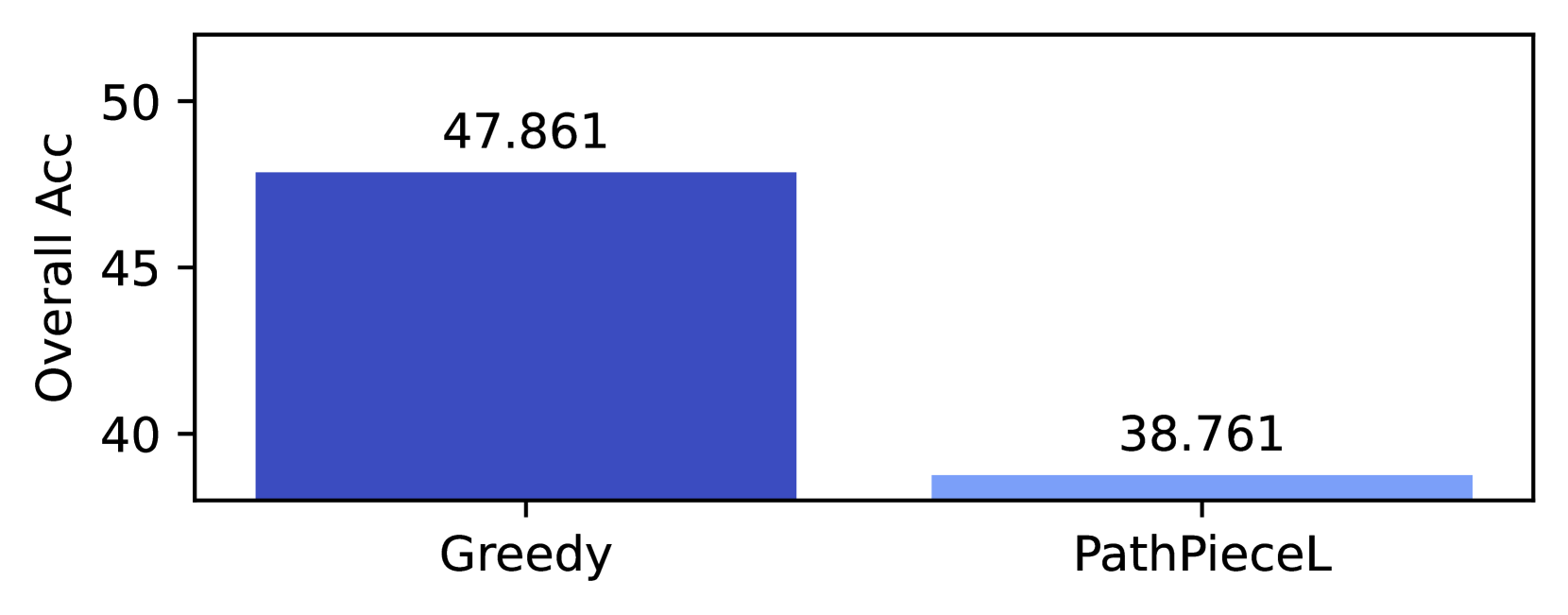
The chart compares the **Overall Accuracy** of two algorithms: **Greedy** and **PathPieceL**. The y-axis represents accuracy as a percentage, while the x-axis lists the algorithms. Two bars are displayed: a dark blue bar for Greedy and a light blue bar for PathPieceL.
### Components/Axes
- **Y-Axis**: Labeled "Overall Acc" (Overall Accuracy), scaled from 40 to 50 in increments of 5.
- **X-Axis**: Categories labeled "Greedy" (left) and "PathPieceL" (right).
- **Legend**: Located on the right side of the chart, associating:
- Dark blue with "Greedy"
- Light blue with "PathPieceL"
- **Bars**:
- Greedy: Dark blue bar reaching **47.861%** (centered above the bar).
- PathPieceL: Light blue bar reaching **38.761%** (centered above the bar).
### Detailed Analysis
- **Greedy**:
- Positioned on the left.
- Dark blue color matches the legend.
- Value: **47.861%** (exact numerical label).
- **PathPieceL**:
- Positioned on the right.
- Light blue color matches the legend.
- Value: **38.761%** (exact numerical label).
- **Spatial Relationships**:
- Greedy’s bar is taller than PathPieceL’s, indicating higher accuracy.
- Bars are separated by a small gap, emphasizing distinct performance.
### Key Observations
1. **Greedy** achieves **47.861% Overall Accuracy**, significantly outperforming **PathPieceL** at **38.761%**.
2. The difference between the two algorithms is **9.1%** (47.861 - 38.761).
3. No overlapping or intermediate values are present; the chart focuses on direct comparison.
### Interpretation
The data suggests that the **Greedy algorithm** is more effective than **PathPieceL** in terms of Overall Accuracy. The stark contrast in bar heights visually reinforces this conclusion. The use of distinct colors (dark blue vs. light blue) and precise numerical labels ensures clarity in distinguishing the two algorithms. The absence of error bars or confidence intervals implies the values represent deterministic results rather than probabilistic estimates. This comparison could guide algorithm selection in scenarios prioritizing accuracy, though further analysis (e.g., computational efficiency, scalability) would be needed for a holistic evaluation.