\n
## Document: Best Practices for Conflict Documentation
### Overview
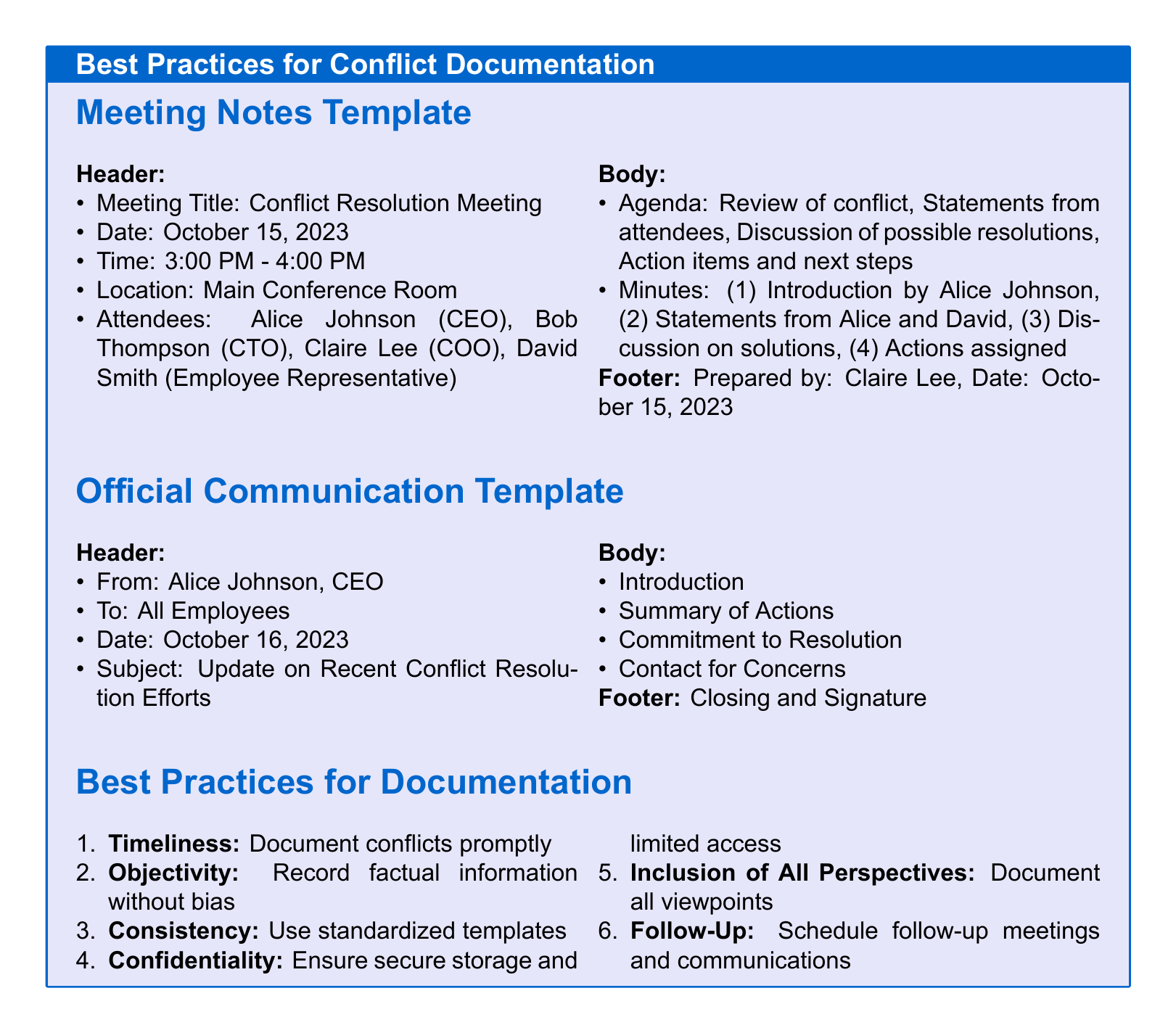
This document outlines best practices and templates for conflict documentation, including meeting notes and official communications. It is divided into three main sections: Meeting Notes Template, Official Communication Template, and Best Practices for Documentation.
### Components/Axes
The document is structured into three distinct sections, each with a "Header," "Body," and "Footer" designation. The "Best Practices for Documentation" section is presented as a numbered list.
### Detailed Analysis or Content Details
**1. Meeting Notes Template**
* **Header:**
* Meeting Title: Conflict Resolution Meeting
* Date: October 15, 2023
* Time: 3:00 PM - 4:00 PM
* Location: Main Conference Room
* Attendees: Alice Johnson (CEO), Bob Thompson (CTO), Claire Lee (COO), David Smith (Employee Representative)
* **Body:**
* Agenda: Review of conflict, Statements from attendees, Discussion of possible resolutions, Action items and next steps
* Minutes: (1) Introduction by Alice Johnson, (2) Statements from Alice and David, (3) Discussion on solutions, (4) Actions assigned
* **Footer:** Prepared by: Claire Lee, Date: October 15, 2023
**2. Official Communication Template**
* **Header:**
* From: Alice Johnson, CEO
* To: All Employees
* Date: October 16, 2023
* Subject: Update on Recent Conflict Resolution Efforts
* **Body:**
* Introduction
* Summary of Actions
* Commitment to Resolution
* Contact for Concerns
* **Footer:** Closing and Signature
**3. Best Practices for Documentation**
1. Timeliness: Document conflicts promptly without bias
2. Objectivity: Record factual information
3. Consistency: Use standardized templates
4. Confidentiality: Ensure secure storage and limited access
5. Inclusion of All Perspectives: Document all viewpoints
6. Follow-Up: Schedule follow-up meetings and communications
### Key Observations
The document emphasizes the importance of prompt, objective, and consistent documentation of conflicts. It provides specific templates for meeting notes and official communications, as well as a list of best practices to ensure thorough and fair documentation. The templates are designed to capture key information such as meeting details, agenda items, action items, and communication recipients.
### Interpretation
This document serves as a guide for organizations seeking to improve their conflict resolution processes. The templates and best practices are intended to promote transparency, accountability, and fairness in handling conflicts. The emphasis on timeliness and objectivity suggests a desire to prevent conflicts from escalating and to ensure that all perspectives are considered. The inclusion of confidentiality as a best practice highlights the importance of protecting sensitive information. The document demonstrates a proactive approach to conflict management, aiming to resolve issues effectively and maintain a positive work environment. The templates are designed to be easily adaptable to different conflict situations, providing a standardized framework for documentation.