## Document Template: Conflict Resolution Documentation Framework
### Overview
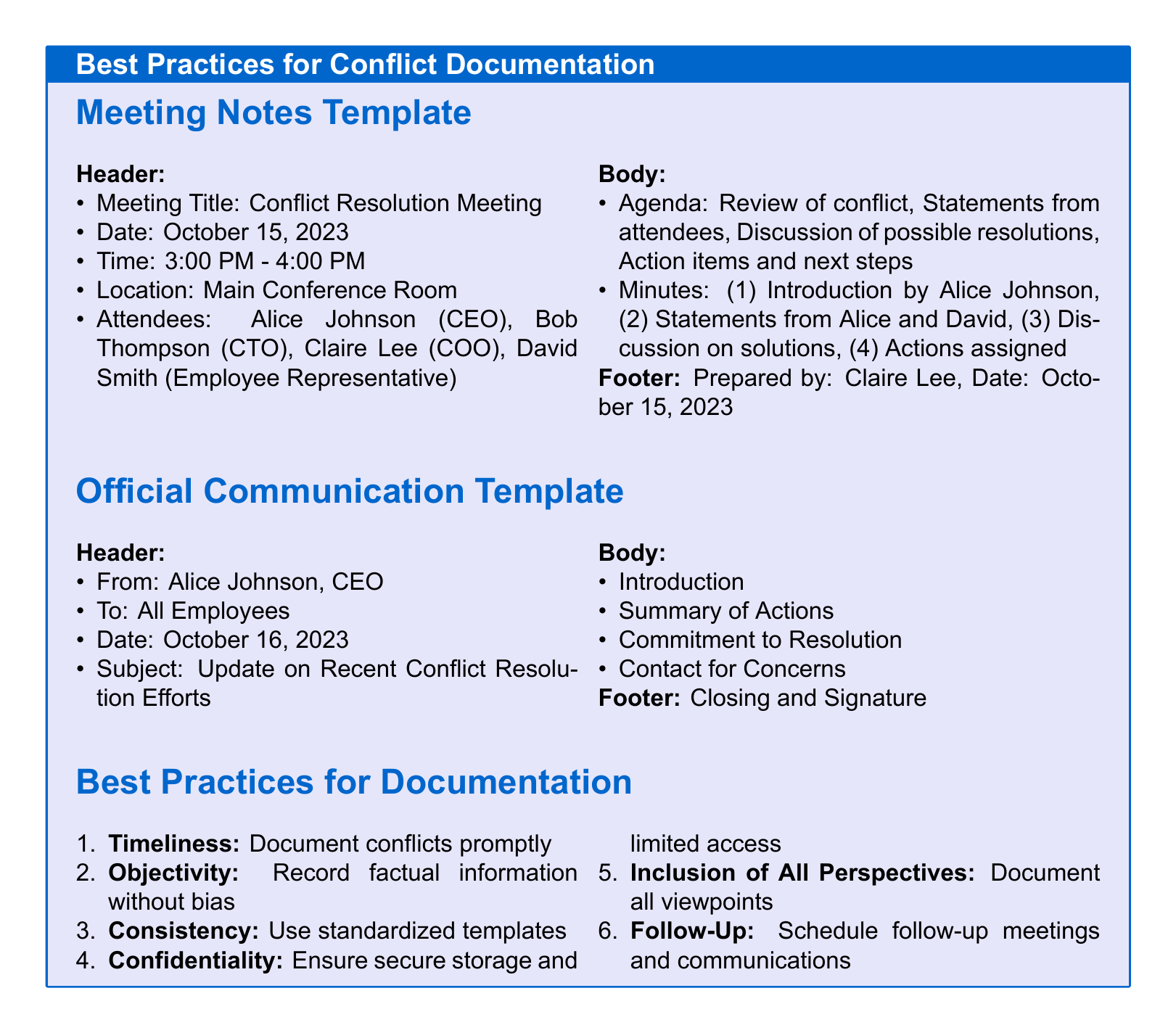
The image depicts a structured template for documenting and communicating conflict resolution processes within an organization. It includes sections for meeting notes, official communications, and best practices for documentation.
---
### Components/Axes
#### Header Sections
1. **Best Practices for Conflict Documentation**
- Header: Blue banner with white text.
- Subsections:
- **Meeting Notes Template**
- **Official Communication Template**
- **Best Practices for Documentation**
2. **Meeting Notes Template**
- Header:
- Meeting Title: *Conflict Resolution Meeting*
- Date: *October 15, 2023*
- Time: *3:00 PM - 4:00 PM*
- Location: *Main Conference Room*
- Attendees:
- Alice Johnson (CEO)
- Bob Thompson (CTO)
- Claire Lee (COO)
- David Smith (Employee Representative)
- Body:
- Agenda: Review of conflict, Statements from attendees, Discussion of possible resolutions, Action items and next steps.
- Minutes:
1. Introduction by Alice Johnson
2. Statements from Alice and David
3. Discussion on solutions
4. Actions assigned
- Footer:
- Prepared by: *Claire Lee*
- Date: *October 15, 2023*
3. **Official Communication Template**
- Header:
- From: *Alice Johnson, CEO*
- To: *All Employees*
- Date: *October 16, 2023*
- Subject: *Update on Recent Conflict Resolution Efforts*
- Body:
- Introduction
- Summary of Actions
- Commitment to Resolution
- Contact for Concerns
- Footer:
- Closing and Signature
4. **Best Practices for Documentation**
- Listed as six principles:
1. **Timeliness**: Document conflicts promptly.
2. **Objectivity**: Record factual information without bias.
3. **Consistency**: Use standardized templates.
4. **Confidentiality**: Ensure secure storage and limited access.
5. **Inclusion of All Perspectives**: Document all viewpoints.
6. **Follow-Up**: Schedule follow-up meetings and communications.
---
### Detailed Analysis
#### Meeting Notes Template
- **Attendees**: Cross-functional leadership (CEO, CTO, COO) and an employee representative, ensuring diverse input.
- **Agenda Items**: Structured to address conflict review, attendee statements, resolution discussions, and actionable next steps.
- **Minutes**: Explicitly lists discussion phases, emphasizing accountability through assigned actions.
#### Official Communication Template
- **Purpose**: Transparent internal communication to all employees, summarizing conflict resolution progress and inviting feedback.
- **Structure**: Balances brevity (introduction/summary) with actionable steps (commitment, contact details).
#### Best Practices for Documentation
- **Key Principles**:
- **Timeliness** and **Objectivity** prioritize accuracy and immediacy.
- **Consistency** and **Confidentiality** ensure reliability and privacy.
- **Inclusion of All Perspectives** and **Follow-Up** emphasize thoroughness and accountability.
---
### Key Observations
1. **Hierarchical Structure**: Templates are designed for clarity, with headers, bodies, and footers for easy navigation.
2. **Stakeholder Inclusion**: Attendees span leadership and employee representation, ensuring balanced decision-making.
3. **Action-Oriented**: Both templates emphasize concrete outcomes (e.g., assigned actions, follow-up schedules).
---
### Interpretation
This framework underscores the importance of systematic conflict resolution in organizations. By standardizing documentation (e.g., meeting notes, communications) and adhering to best practices (e.g., objectivity, confidentiality), it aims to mitigate bias, ensure transparency, and foster trust. The inclusion of employee representatives and follow-up mechanisms highlights a commitment to collaborative problem-solving. The repetition of "Best Practices" suggests a layered approach, with foundational principles (e.g., timeliness) reinforced across contexts.