\n
## Diagram: FrontierMath Problem Solving Flow
### Overview
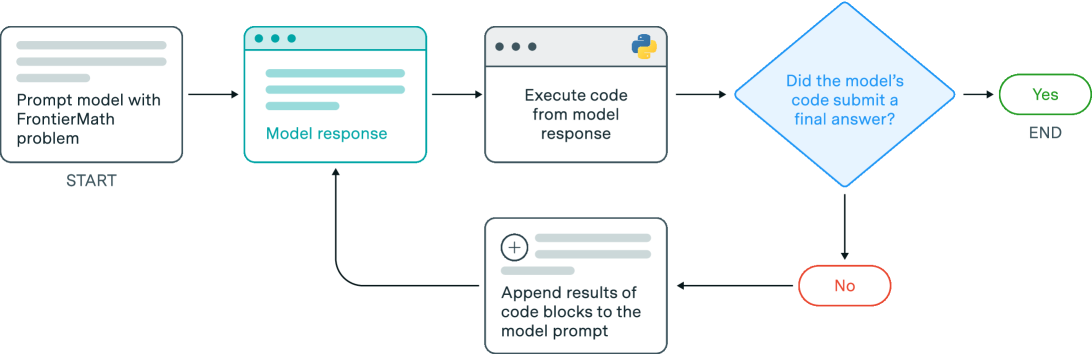
The image depicts a flowchart illustrating the process of solving a FrontierMath problem using a model. The process involves prompting the model, receiving a response, executing code from the response, and checking if the code submits a final answer. If not, the results of the code execution are appended to the prompt, and the process repeats.
### Components/Axes
The diagram consists of rectangular blocks representing steps in the process, connected by arrows indicating the flow. Key components include:
* **START:** The initial point of the process.
* **Prompt model with FrontierMath problem:** The first step, involving providing a problem to the model.
* **Model response:** The output generated by the model in response to the prompt.
* **Execute code from model response:** The step where code contained within the model's response is executed. A Python logo is present within this block.
* **Did the model's code submit a final answer?:** A decision point, represented by a diamond shape.
* **Yes:** Leads to the "END" block.
* **No:** Leads to the "Append results of code blocks to the model prompt" block.
* **Append results of code blocks to the model prompt:** The step where the output of the code execution is added to the original prompt.
* **END:** The final point of the process.
### Detailed Analysis or Content Details
The diagram illustrates a loop. The process begins with a prompt, and continues to iterate until the model's code produces a final answer. The Python logo within the "Execute code from model response" block suggests that the code being executed is Python code. The decision diamond asks a binary question: "Did the model's code submit a final answer?". The "Yes" path leads to the end, while the "No" path loops back to refine the prompt.
### Key Observations
The diagram highlights an iterative problem-solving approach. The process is not a single pass but involves repeated refinement of the prompt based on the results of code execution. This suggests a strategy for handling complex problems that require multiple steps or corrections.
### Interpretation
This diagram demonstrates a feedback loop designed to improve the accuracy and completeness of a model's response to a FrontierMath problem. The iterative process of executing code, evaluating the results, and refining the prompt is a common technique in machine learning and artificial intelligence. The inclusion of code execution suggests that the model is capable of generating and running code to solve mathematical problems. The loop continues until a satisfactory answer is obtained, indicating a commitment to finding a correct solution. The diagram implies that the model may not always provide a complete answer on the first attempt, but can improve its performance through iterative refinement. This is a form of reinforcement learning or active learning, where the model learns from its mistakes and adjusts its approach accordingly.