## Flowchart: Automated Code Execution and Model Response Process
### Overview
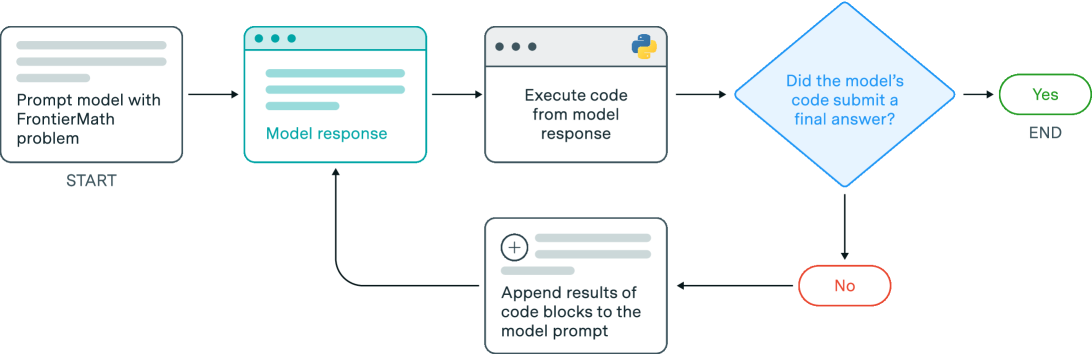
This flowchart illustrates a cyclical process for interacting with a language model (likely an AI system) to solve mathematical problems using code execution. The process begins with a prompt, iterates through code execution and response evaluation, and terminates when a final answer is submitted.
### Components/Axes
1. **START Node**:
- Position: Top-left corner
- Label: "START"
- Content: "Prompt model with FrontierMath problem"
2. **Model Response Node**:
- Position: Center-left
- Visual: Browser-like interface with three blue horizontal bars
- Label: "Model response"
3. **Code Execution Node**:
- Position: Center-right
- Visual: Python logo (blue/yellow) in top-right corner
- Label: "Execute code from model response"
4. **Decision Diamond**:
- Position: Middle-right
- Color: Light blue
- Label: "Did the model's code submit a final answer?"
- Branches:
- **Yes** (Green oval): Leads to END
- **No** (Red oval): Loops back to "Append results..."
5. **Append Results Node**:
- Position: Bottom-center
- Visual: Plus sign (+) icon
- Label: "Append results of code blocks to the model prompt"
6. **END Node**:
- Position: Top-right
- Color: Green oval
- Label: "END"
### Detailed Analysis
- **Flow Direction**:
- Primary flow: START → Model Response → Code Execution → Decision
- Secondary loop: Decision (No) → Append Results → Model Response (repeats until Yes)
- **Key Elements**:
- **START Node**: Initiates the process with a math problem prompt
- **Model Response Node**: Represents the AI's initial code generation
- **Code Execution Node**: Simulates running the generated code (Python environment implied)
- **Decision Node**: Evaluates whether the code provided a complete solution
- **Append Results Node**: Feeds execution outcomes back into the prompt for refinement
- **Color Coding**:
- Green (#4CAF50): Positive outcome (final answer submitted)
- Red (#F44336): Negative outcome (requires iteration)
- Blue (#2196F3): Process steps (model interaction)
- Gray: Neutral elements (START/END labels)
### Key Observations
1. **Iterative Refinement**: The process loops until the model generates code that submits a final answer, suggesting a self-improving mechanism.
2. **Code-Centric Workflow**: Python execution is central to validating model responses.
3. **State Management**: The "Append results" step implies persistent context tracking between iterations.
4. **Termination Condition**: Strict dependency on model output quality for process completion.
### Interpretation
This flowchart represents an automated problem-solving pipeline where:
1. **Model Capability**: The AI's ability to generate executable code determines process efficiency
2. **Execution Environment**: Python is the mandated language for code validation
3. **Quality Control**: The decision node acts as a gatekeeper for solution acceptance
4. **Learning Mechanism**: By appending results to the prompt, the system enables context-aware iteration, potentially improving future responses through accumulated information.
The process highlights the interplay between natural language understanding (prompt engineering) and computational verification (code execution), creating a hybrid system for mathematical problem-solving that combines AI generation with systematic validation.