## Diagram: Solution Refinement and CoT Reconstruction
### Overview
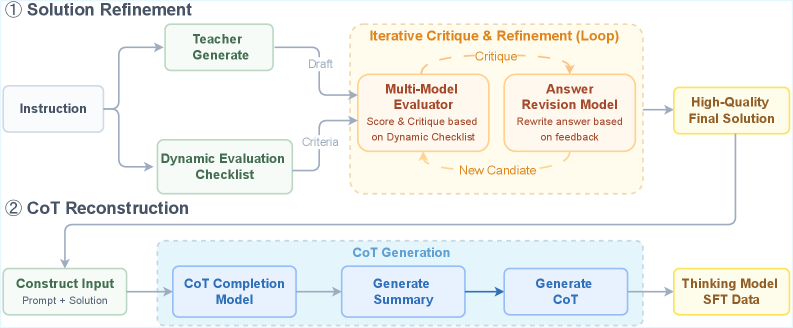
The image presents a diagram illustrating two distinct processes: Solution Refinement and Chain-of-Thought (CoT) Reconstruction. Solution Refinement involves iterative critique and refinement of a solution, while CoT Reconstruction focuses on generating a chain of thought from an input.
### Components/Axes
**1. Solution Refinement (Top Section):**
* **Instruction:** A starting point, represented by a light-blue rounded rectangle.
* **Teacher Generate:** A process where a teacher generates something (presumably a solution draft), represented by a light-green rounded rectangle.
* **Dynamic Evaluation Checklist:** A process involving a checklist, represented by a light-green rounded rectangle.
* **Iterative Critique & Refinement (Loop):** An iterative process enclosed in a dashed light-orange rounded rectangle.
* **Multi-Model Evaluator:** A component that scores and critiques based on a Dynamic Checklist, represented by a light-orange rounded rectangle.
* **Answer Revision Model:** A component that rewrites an answer based on feedback, represented by a light-orange rounded rectangle.
* **High-Quality Final Solution:** The desired outcome, represented by a light-yellow rounded rectangle.
**2. CoT Reconstruction (Bottom Section):**
* **Construct Input:** A process that combines a prompt and a solution, represented by a light-green rounded rectangle.
* **CoT Generation:** A process enclosed in a dashed light-blue rounded rectangle.
* **CoT Completion Model:** A model that completes the chain of thought, represented by a light-blue rounded rectangle.
* **Generate Summary:** A process that generates a summary, represented by a light-blue rounded rectangle.
* **Generate CoT:** A process that generates the chain of thought, represented by a light-blue rounded rectangle.
* **Thinking Model SFT Data:** The final output, represented by a light-yellow rounded rectangle.
**Arrows and Labels:**
* Arrows indicate the flow of information or processes.
* Labels on arrows specify the type of information being passed (e.g., "Draft," "Criteria," "Critique," "New Candidate").
### Detailed Analysis
**Solution Refinement:**
1. The process begins with "Instruction."
2. "Instruction" leads to two parallel processes: "Teacher Generate" and "Dynamic Evaluation Checklist."
3. "Teacher Generate" produces a "Draft" that feeds into the "Multi-Model Evaluator."
4. "Dynamic Evaluation Checklist" provides "Criteria" to the "Multi-Model Evaluator."
5. The "Multi-Model Evaluator" scores and critiques based on the "Dynamic Checklist."
6. The "Multi-Model Evaluator" provides "Critique" to the "Answer Revision Model."
7. The "Answer Revision Model" rewrites the answer based on feedback.
8. The "Answer Revision Model" generates a "New Candidate" that loops back to the "Multi-Model Evaluator," creating an iterative refinement process.
9. The iterative process continues until a "High-Quality Final Solution" is achieved.
**CoT Reconstruction:**
1. The process begins with "Construct Input (Prompt + Solution)."
2. "Construct Input" feeds into the "CoT Completion Model."
3. The "CoT Completion Model" passes information to "Generate Summary."
4. "Generate Summary" passes information to "Generate CoT."
5. "Generate CoT" leads to "Thinking Model SFT Data."
### Key Observations
* The diagram highlights two distinct approaches to solution generation: one based on iterative refinement and the other on chain-of-thought reconstruction.
* The Solution Refinement process involves a loop, indicating continuous improvement based on feedback.
* The CoT Reconstruction process is more linear, focusing on generating a chain of thought from a given input.
### Interpretation
The diagram illustrates two different methodologies for achieving a desired outcome. Solution Refinement emphasizes iterative improvement through critique and revision, leveraging both teacher input and dynamic evaluation. This approach is suitable for scenarios where continuous feedback and refinement are possible.
CoT Reconstruction, on the other hand, focuses on generating a chain of thought to arrive at a solution. This approach is useful when understanding the reasoning process is crucial, such as in explainable AI or educational contexts.
The diagram suggests that the choice between these two approaches depends on the specific requirements of the task. If a high-quality solution is the primary goal, Solution Refinement may be more effective. If understanding the reasoning process is also important, CoT Reconstruction may be preferred.