\n
## Diagram: Solution Refinement and CoT Reconstruction
### Overview
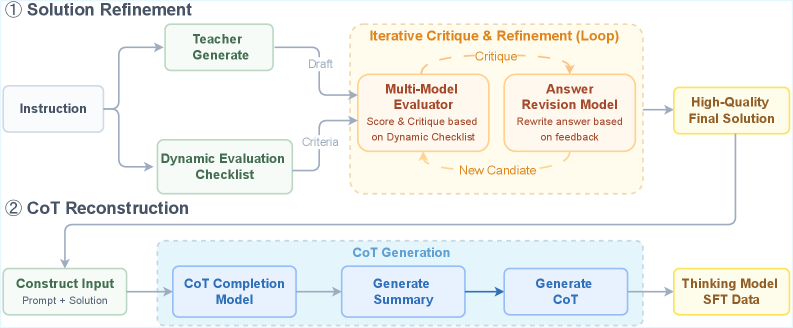
The image presents a diagram illustrating two interconnected processes: Solution Refinement and Chain-of-Thought (CoT) Reconstruction. The diagram uses a flowchart style to depict the flow of information and iterative loops within each process. The overall purpose appears to be to demonstrate a methodology for improving the quality of solutions, potentially in the context of large language models or AI systems.
### Components/Axes
The diagram is divided into two main sections, labeled "① Solution Refinement" and "② CoT Reconstruction". Each section contains several rectangular boxes representing different stages or components. Arrows indicate the direction of flow between these components. Key components include:
* **Instruction:** The starting point for Solution Refinement.
* **Teacher Generate:** Generates a draft solution based on the instruction.
* **Dynamic Evaluation Checklist:** Provides criteria for evaluating the draft.
* **Multi-Model Evaluator:** Scores and critiques the draft based on the checklist.
* **Answer Revision Model:** Rewrites the answer based on the critique.
* **High-Quality Final Solution:** The output of the refinement process.
* **Construct Input:** Combines prompt and solution for CoT reconstruction.
* **CoT Completion Model:** Completes the chain of thought.
* **Generate Summary:** Creates a summary of the CoT.
* **Generate CoT:** Generates the full chain of thought.
* **Thinking Model SFT Data:** The output of the CoT reconstruction process.
The diagram also includes labels for the flow of information: "Draft", "Criteria", "Critique", and "New Candidate". The iterative loop in Solution Refinement is explicitly labeled "Iterative Critique & Refinement (Loop)".
### Detailed Analysis or Content Details
The diagram illustrates a cyclical process for Solution Refinement. An "Instruction" initiates the process, leading to a "Teacher Generate" component producing a "Draft". This draft is then evaluated by a "Multi-Model Evaluator" using a "Dynamic Evaluation Checklist". The evaluator provides a "Critique" which is fed to an "Answer Revision Model" to produce a "New Candidate". This loop continues iteratively until a "High-Quality Final Solution" is achieved.
The CoT Reconstruction process begins with "Construct Input" (Prompt + Solution). This input is processed by a "CoT Completion Model", followed by "Generate Summary" and finally "Generate CoT", resulting in "Thinking Model SFT Data".
The two processes are connected. The "Dynamic Evaluation Checklist" feeds into the CoT Reconstruction process, suggesting that the criteria used for refining the solution also inform the construction of the chain of thought.
### Key Observations
* The Solution Refinement process is explicitly iterative, indicated by the labeled loop.
* The CoT Reconstruction process appears to be a linear flow of steps.
* The diagram emphasizes the importance of evaluation and feedback in both processes.
* The connection between the two processes suggests a synergistic relationship, where refining the solution also enhances the understanding of the reasoning behind it.
* The diagram does not contain any numerical data or specific values. It is a conceptual representation of a process.
### Interpretation
The diagram illustrates a sophisticated approach to improving the quality of AI-generated solutions. The Solution Refinement process, with its iterative critique and revision loop, suggests a commitment to rigorous evaluation and continuous improvement. The inclusion of a "Dynamic Evaluation Checklist" indicates that the evaluation criteria are not fixed but can be adapted based on the specific task or context.
The CoT Reconstruction process highlights the importance of understanding the reasoning behind a solution. By generating a chain of thought, the system can provide transparency and explainability, which are crucial for building trust and identifying potential errors.
The connection between the two processes suggests that refining the solution and understanding the reasoning behind it are mutually reinforcing activities. A well-refined solution is more likely to be based on sound reasoning, and a clear chain of thought can help to identify areas where the solution needs improvement.
The diagram is likely intended for an audience familiar with machine learning concepts, such as large language models, evaluation metrics, and chain-of-thought prompting. It represents a high-level overview of a complex system and does not delve into the technical details of each component. The diagram's focus on iterative refinement and explainability suggests a commitment to responsible AI development.