## Flowchart: Technical Workflow for Solution Refinement and Chain-of-Thought (CoT) Reconstruction
### Overview
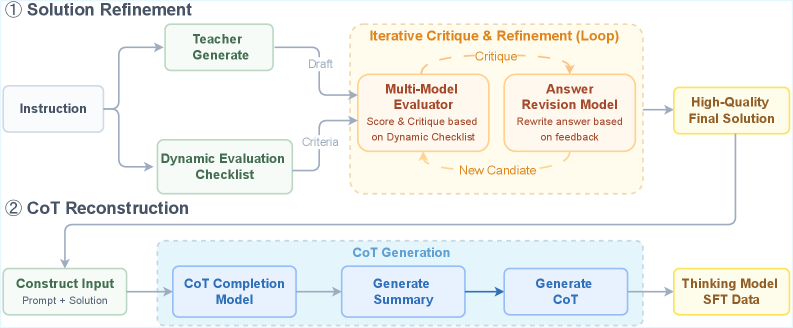
The image depicts a two-phase technical workflow for improving solution quality and reconstructing reasoning processes. It combines human-AI collaboration (Solution Refinement) with automated reasoning reconstruction (CoT Reconstruction), using color-coded components (green/orange for refinement, blue/yellow for reconstruction).
### Components/Axes
**Solution Refinement (Top Section):**
1. **Instruction** (Gray box, left)
- Input source for the process
2. **Teacher Generate** (Green box, top-center)
- Generates initial draft solutions
3. **Dynamic Evaluation Checklist** (Green box, bottom-left)
- Criteria for solution assessment
4. **Multi-Model Evaluator** (Orange box, center)
- Scores and critiques solutions using dynamic criteria
5. **Answer Revision Model** (Orange box, right-center)
- Rewrites answers based on feedback
6. **High-Quality Final Solution** (Yellow box, far right)
- Output of refined solutions
**CoT Reconstruction (Bottom Section):**
1. **Construct Input** (Green box, bottom-left)
- Combines prompt + solution
2. **CoT Completion Model** (Blue box, center-left)
- Generates reasoning traces
3. **Generate Summary** (Blue box, center)
- Creates condensed reasoning summaries
4. **Generate CoT** (Blue box, center-right)
- Produces full chain-of-thought reasoning
5. **Thinking Model SFT Data** (Yellow box, far right)
- Output for supervised fine-tuning
**Flow Connections:**
- Solid arrows: Primary workflow progression
- Dashed arrows: Iterative refinement loops
- Color coding: Green/orange (refinement), blue/yellow (reconstruction)
### Detailed Analysis
**Solution Refinement Workflow:**
1. Starts with **Instruction** → **Teacher Generate** (draft solutions)
2. Solutions flow to **Dynamic Evaluation Checklist** and **Multi-Model Evaluator**
3. **Multi-Model Evaluator** provides critique → **Answer Revision Model**
4. Iterative loop between evaluator and revision model until **High-Quality Final Solution** is achieved
**CoT Reconstruction Workflow:**
1. **Construct Input** combines prompt + solution
2. **CoT Completion Model** generates raw reasoning traces
3. **Generate Summary** condenses reasoning
4. **Generate CoT** produces complete reasoning chains
5. Final output: **Thinking Model SFT Data** for model training
### Key Observations
1. **Iterative Refinement:** The orange dashed arrows indicate continuous improvement between evaluation and revision
2. **Dual Workflows:** Separation of solution refinement (human-AI collaboration) and reasoning reconstruction (automated processing)
3. **Color-Coded Logic:** Green components represent initial generation/evaluation, orange represents refinement, blue represents reconstruction, yellow represents final outputs
4. **Bidirectional Flow:** Feedback loops exist between evaluation and revision stages
5. **Data Pipeline:** CoT reconstruction feeds into SFT data generation for model improvement
### Interpretation
This diagram illustrates a sophisticated AI system architecture that combines:
1. **Human-in-the-loop refinement:** Where human instructions guide AI solution generation through iterative evaluation
2. **Automated reasoning reconstruction:** Where chain-of-thought processes are systematically extracted and structured
3. **Model improvement pipeline:** The SFT data output suggests continuous learning from reconstructed reasoning
The separation of refinement and reconstruction workflows implies a modular system design where solution quality and reasoning transparency are addressed through different but complementary processes. The iterative refinement loop highlights the importance of continuous feedback in achieving high-quality outputs, while the CoT reconstruction component emphasizes the value of understanding model reasoning for both transparency and model improvement purposes.