## Visual Comparison Chart: Gamma Correction Effects on Image Processing Methods
### Overview
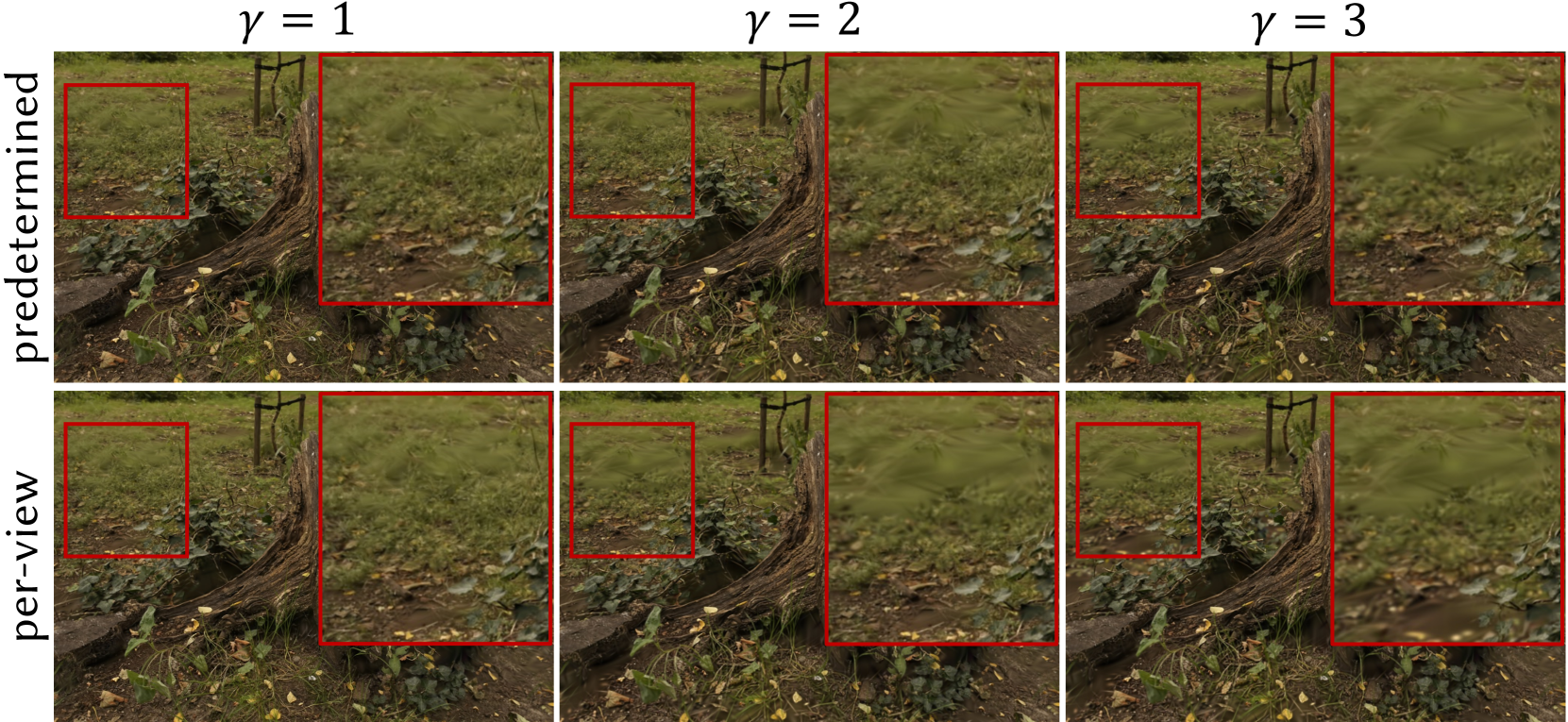
This image is a technical comparison chart, likely from a research paper or technical report in computer vision or image processing. It visually demonstrates the effects of varying a gamma parameter (γ) on two different image processing or rendering methods, labeled "predetermined" and "per-view." The chart is organized as a 2x3 grid of image panels.
### Components/Axes
* **Grid Structure:** The chart is a matrix with two rows and three columns.
* **Row Labels (Left Side):**
* Top Row: `predetermined` (written vertically, reading from bottom to top).
* Bottom Row: `per-view` (written vertically, reading from bottom to top).
* **Column Labels (Top):**
* Left Column: `γ = 1`
* Middle Column: `γ = 2`
* Right Column: `γ = 3`
* **Image Content:** Each of the six panels displays the same base scene: a close-up view of a garden or forest floor with soil, green plants, fallen leaves, and a curved, textured wooden log or root structure in the foreground.
* **Annotations:** Each panel contains two red rectangular boxes, highlighting specific regions of interest within the scene for comparison.
* **Box 1 (Left):** A smaller square box positioned in the upper-left quadrant of the image, focusing on a patch of ground and low-lying vegetation.
* **Box 2 (Right):** A larger square box positioned in the right half of the image, focusing on the area where the wooden structure meets the ground and surrounding plants.
### Detailed Analysis
The chart compares visual output across two methods and three gamma settings. The primary variable is the gamma value (γ), which typically controls luminance or color intensity in image processing.
**Row 1: "predetermined" Method**
* **γ = 1 (Top-Left Panel):** The image appears with natural, balanced contrast. Details in both the shadowed soil (highlighted by the left red box) and the textured wood/plants (highlighted by the right red box) are clearly visible.
* **γ = 2 (Top-Middle Panel):** The image shows increased contrast and saturation. The greens in the vegetation appear more vivid, and the shadows in the soil patch (left box) become slightly darker. The texture on the wood (right box) appears more pronounced.
* **γ = 3 (Top-Right Panel):** The effect is intensified. Contrast is high, with very dark shadows and bright highlights. The soil area (left box) is quite dark, potentially losing some detail. The vegetation and wood textures (right box) appear overly sharp and saturated, with a slight yellowish/greenish color cast.
**Row 2: "per-view" Method**
* **γ = 1 (Bottom-Left Panel):** The image is noticeably darker and has lower contrast compared to the "predetermined" γ=1 image. The soil patch (left box) is very dark, and overall scene illumination appears reduced.
* **γ = 2 (Bottom-Middle Panel):** The image brightens significantly compared to its γ=1 counterpart. Contrast increases, revealing more detail in the soil (left box) and making the vegetation appear more vibrant. It visually resembles the "predetermined" γ=1 image more than its own γ=1 state.
* **γ = 3 (Bottom-Right Panel):** The image becomes very bright, with high contrast and strong saturation. The soil area (left box) is now well-lit but may appear washed out. The vegetation and wood (right box) are highly saturated, with a strong yellow-green tint, similar to but potentially brighter than the "predetermined" γ=3 image.
### Key Observations
1. **Gamma Impact:** For both methods, increasing the gamma value (γ) from 1 to 3 systematically increases image contrast, brightness, and color saturation.
2. **Method Divergence:** The two methods respond differently to the same gamma value.
* At **γ=1**, the "predetermined" method produces a well-exposed image, while the "per-view" method produces a significantly underexposed (dark) image.
* At **γ=2**, the "per-view" method's output visually converges toward the "predetermined" method's output at γ=1.
* At **γ=3**, both methods produce highly saturated, high-contrast images, though the "per-view" version may be slightly brighter.
3. **Visual Trend:** The "per-view" method shows a more dramatic *relative change* in appearance across the gamma range, starting very dark and becoming very bright. The "predetermined" method shows a more consistent, progressive enhancement from a balanced starting point.
### Interpretation
This chart likely illustrates a core finding from a technical study on image-based rendering, view synthesis, or neural radiance fields (NeRFs). The parameter `γ` is probably a control within a rendering equation or a tone-mapping function.
* **What the Data Suggests:** The "predetermined" method appears to have a more robust or pre-calibrated response to gamma, producing acceptable results at the baseline (γ=1). The "per-view" method seems to require gamma adjustment (specifically, a value around 2) to achieve a comparable visual quality to the baseline "predetermined" output. This implies the "per-view" method may have an inherent bias or different internal scaling that necessitates this correction.
* **Relationship Between Elements:** The direct visual comparison across the grid allows researchers to quickly assess the perceptual impact of the gamma parameter and to identify the optimal setting for each method. The red boxes focus attention on challenging regions (dark soil, complex textures) where differences in exposure and detail preservation are most critical.
* **Notable Anomalies/Patterns:** The most striking pattern is the inversion of relative brightness between the two methods at γ=1 versus γ=3. This suggests the gamma parameter interacts fundamentally differently with the underlying algorithms of each method. The chart effectively argues that a "one-size-fits-all" gamma setting is inappropriate and that the parameter must be tuned per method.