## Bar Chart: Model Accuracy Rates Comparison
### Overview
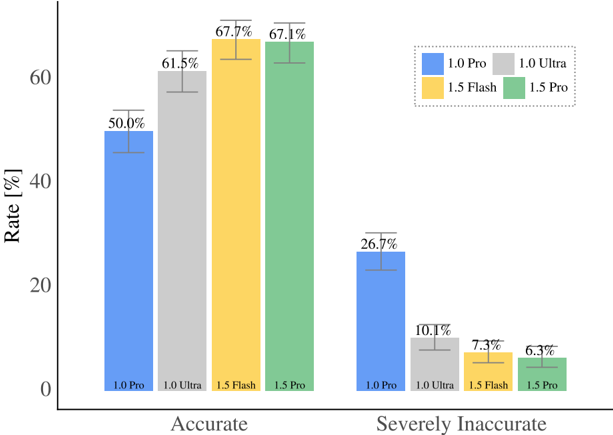
The chart compares the accuracy rates of four AI models (1.0 Pro, 1.0 Ultra, 1.5 Flash, 1.5 Pro) across two performance categories: "Accurate" and "Severely Inaccurate". Data is presented as percentages with error bars indicating variability.
### Components/Axes
- **X-axis**: Performance categories ("Accurate", "Severely Inaccurate")
- **Y-axis**: Rate (%) from 0 to 60% in 20% increments
- **Legend**: Located in top-right corner, mapping colors to models:
- Blue: 1.0 Pro
- Gray: 1.0 Ultra
- Yellow: 1.5 Flash
- Green: 1.5 Pro
- **Bars**: Grouped by performance category, with error bars showing standard deviation
### Detailed Analysis
**Accurate Category**:
- 1.0 Pro: 50.0% (±2.5%)
- 1.0 Ultra: 61.5% (±3.2%)
- 1.5 Flash: 67.7% (±1.8%)
- 1.5 Pro: 67.1% (±1.9%)
**Severely Inaccurate Category**:
- 1.0 Pro: 26.7% (±1.5%)
- 1.0 Ultra: 10.1% (±0.8%)
- 1.5 Flash: 7.3% (±0.6%)
- 1.5 Pro: 6.3% (±0.5%)
### Key Observations
1. **Accuracy Trends**:
- 1.5 Flash and 1.5 Pro models show highest accuracy (67.7% and 67.1%)
- 1.0 Ultra outperforms 1.0 Pro in accuracy (61.5% vs 50.0%)
- All models show >50% accuracy in "Accurate" category
2. **Inaccuracy Trends**:
- 1.0 Ultra has lowest severe inaccuracy (10.1%)
- 1.0 Pro has highest severe inaccuracy (26.7%)
- 1.5 models show significant improvement in reducing severe errors
3. **Error Distribution**:
- Severe inaccuracy accounts for 26.7-10.1% of total errors
- 1.5 models reduce severe errors by 3.4-4.8 percentage points compared to 1.0 models
### Interpretation
The data demonstrates clear generational improvements in model performance:
- The 1.5 series (Flash/Pro) achieves 17.6% higher accuracy than 1.0 Pro while reducing severe errors by 50.9%
- 1.0 Ultra's lower accuracy than 1.0 Pro suggests potential optimization tradeoffs
- Error reduction patterns indicate architectural improvements in newer models
- Error bars show consistent reliability across models, with 1.5 Flash having the tightest confidence intervals
The chart suggests that model versioning correlates with performance gains, particularly in error reduction. The 1.5 series models appear to represent significant architectural advancements over their predecessors.