## Line Chart: Success Rate vs. Number of Actions
### Overview
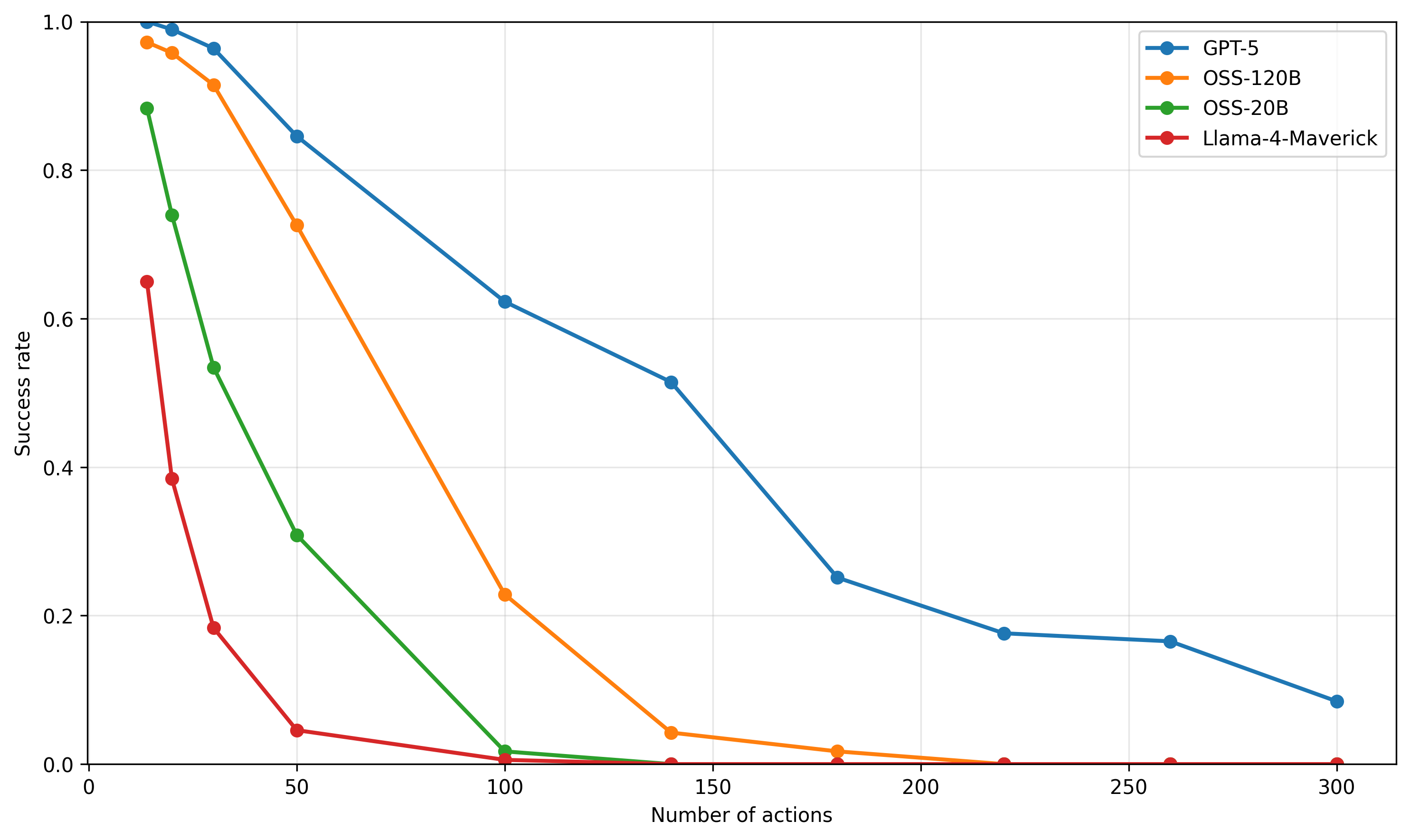
This image displays a 2D line chart illustrating the relationship between "Success rate" (Y-axis) and "Number of actions" (X-axis) for four different models or systems: GPT-5, OSS-120B, OSS-20B, and Llama-4-Maverick. Each line represents a different model, showing how its success rate decreases as the number of actions increases. The chart uses a white background with a light grey grid for readability.
### Components/Axes
The chart is structured with a horizontal X-axis at the bottom and a vertical Y-axis on the left.
* **X-axis (Horizontal)**: Labeled "Number of actions".
* Range: From 0 to 300.
* Major ticks are marked at 0, 50, 100, 150, 200, 250, and 300.
* Minor grid lines are visible, suggesting intervals of 25 units.
* **Y-axis (Vertical)**: Labeled "Success rate".
* Range: From 0.0 to 1.0.
* Major ticks are marked at 0.0, 0.2, 0.4, 0.6, 0.8, and 1.0.
* Minor grid lines are visible, suggesting intervals of 0.1 units.
* **Grid**: Light grey horizontal and vertical grid lines extend across the plotting area, aiding in data point estimation.
* **Legend**: Located in the top-right corner of the chart. It identifies the four data series by color and marker type (all using circular markers).
* **Blue line with circle marker**: GPT-5
* **Orange line with circle marker**: OSS-120B
* **Green line with circle marker**: OSS-20B
* **Red line with circle marker**: Llama-4-Maverick
### Detailed Analysis
The chart presents four distinct data series, each showing a generally decreasing trend in success rate as the number of actions increases.
1. **GPT-5 (Blue Line with Circle Markers)**:
* **Trend**: This line starts with the highest success rate and shows the most gradual decline among all models. It maintains a relatively high success rate for a larger number of actions before its decline steepens slightly and then flattens out at lower success rates.
* **Data Points**:
* At approximately 10 actions, the success rate is 1.0.
* At approximately 25 actions, the success rate is around 0.95.
* At 50 actions, the success rate is approximately 0.85.
* At 100 actions, the success rate is around 0.62.
* At approximately 140 actions, the success rate is about 0.52.
* At approximately 180 actions, the success rate is around 0.25.
* At approximately 220 actions, the success rate is about 0.18.
* At approximately 260 actions, the success rate is around 0.17.
* At 300 actions, the success rate is approximately 0.08.
2. **OSS-120B (Orange Line with Circle Markers)**:
* **Trend**: This line starts with a high success rate, slightly below GPT-5, and exhibits a steeper initial decline. Its success rate drops significantly faster than GPT-5, approaching zero around 200 actions.
* **Data Points**:
* At approximately 10 actions, the success rate is around 0.95.
* At approximately 25 actions, the success rate is about 0.90.
* At 50 actions, the success rate is approximately 0.72.
* At 100 actions, the success rate is around 0.23.
* At approximately 140 actions, the success rate is about 0.05.
* At approximately 180 actions, the success rate is around 0.01.
* From approximately 220 actions onwards, the success rate is effectively 0.00.
3. **OSS-20B (Green Line with Circle Markers)**:
* **Trend**: This line starts with a lower success rate compared to GPT-5 and OSS-120B and shows a very rapid decline. Its success rate drops to near zero much faster than the previous two models, reaching this point before 150 actions.
* **Data Points**:
* At approximately 10 actions, the success rate is around 0.88.
* At approximately 25 actions, the success rate is about 0.75.
* At approximately 40 actions, the success rate is around 0.55.
* At 50 actions, the success rate is approximately 0.31.
* At 100 actions, the success rate is around 0.01.
* From approximately 140 actions onwards, the success rate is effectively 0.00.
4. **Llama-4-Maverick (Red Line with Circle Markers)**:
* **Trend**: This line starts with the lowest initial success rate among all models and demonstrates the steepest and fastest decline. Its success rate plummets to near zero very quickly, reaching this point well before 100 actions.
* **Data Points**:
* At approximately 10 actions, the success rate is around 0.65.
* At approximately 25 actions, the success rate is about 0.38.
* At approximately 40 actions, the success rate is around 0.18.
* At 50 actions, the success rate is approximately 0.05.
* At 100 actions, the success rate is around 0.01.
* From approximately 140 actions onwards, the success rate is effectively 0.00.
### Key Observations
* **Performance Hierarchy**: GPT-5 consistently outperforms all other models across the entire range of "Number of actions," maintaining the highest success rate.
* **Rate of Decline**: Llama-4-Maverick shows the most rapid degradation in success rate, followed by OSS-20B, then OSS-120B, and finally GPT-5, which has the most resilient performance.
* **Threshold for Zero Success**:
* Llama-4-Maverick's success rate drops to near zero (below 0.05) by 50 actions and effectively 0.00 by 140 actions.
* OSS-20B's success rate drops to near zero by 100 actions and effectively 0.00 by 140 actions.
* OSS-120B's success rate drops to near zero by 180 actions and effectively 0.00 by 220 actions.
* GPT-5's success rate remains above 0.05 even at 300 actions, indicating superior robustness.
* **Initial Performance**: While GPT-5 starts at a perfect 1.0 success rate, OSS-120B is very close at 0.95, and OSS-20B is also strong at 0.88 for 10 actions. Llama-4-Maverick starts significantly lower at 0.65.
### Interpretation
This chart likely demonstrates the robustness or capability of different models (GPT-5, OSS-120B, OSS-20B, Llama-4-Maverick) in performing a task as the complexity or length of the task (represented by "Number of actions") increases. The "Success rate" can be interpreted as the probability or percentage of successfully completing the task.
The data suggests that:
* **GPT-5 is the most capable and robust model** among those tested. It maintains a high success rate even when faced with a large number of actions, indicating superior long-term coherence, memory, or planning abilities for complex tasks.
* **Model size or architecture (implied by names like 120B, 20B, Llama-4)** appears to correlate with performance. OSS-120B (presumably a larger model than OSS-20B) performs better and degrades more slowly than OSS-20B. This aligns with common observations in AI where larger models often exhibit better performance and generalization.
* **Llama-4-Maverick is the least effective** for tasks involving a higher number of actions, with its performance rapidly deteriorating. This could imply limitations in its ability to handle sequential dependencies, maintain context, or plan over extended sequences.
* The steepness of the curves indicates how quickly a model's performance degrades under increasing task complexity. A flatter curve (like GPT-5) signifies greater resilience.
* The point at which each curve approaches zero success rate can be considered a practical limit for that model's utility in tasks requiring that many actions. For instance, Llama-4-Maverick is practically unusable for tasks exceeding 100 actions, whereas GPT-5 still offers a non-trivial success rate even at 300 actions.
In essence, the chart provides a comparative benchmark of these models' ability to sustain performance under increasing operational demands, highlighting GPT-5's significant advantage in handling complex, multi-step tasks.