## Diagram: Communication Protocol Comparison
### Overview
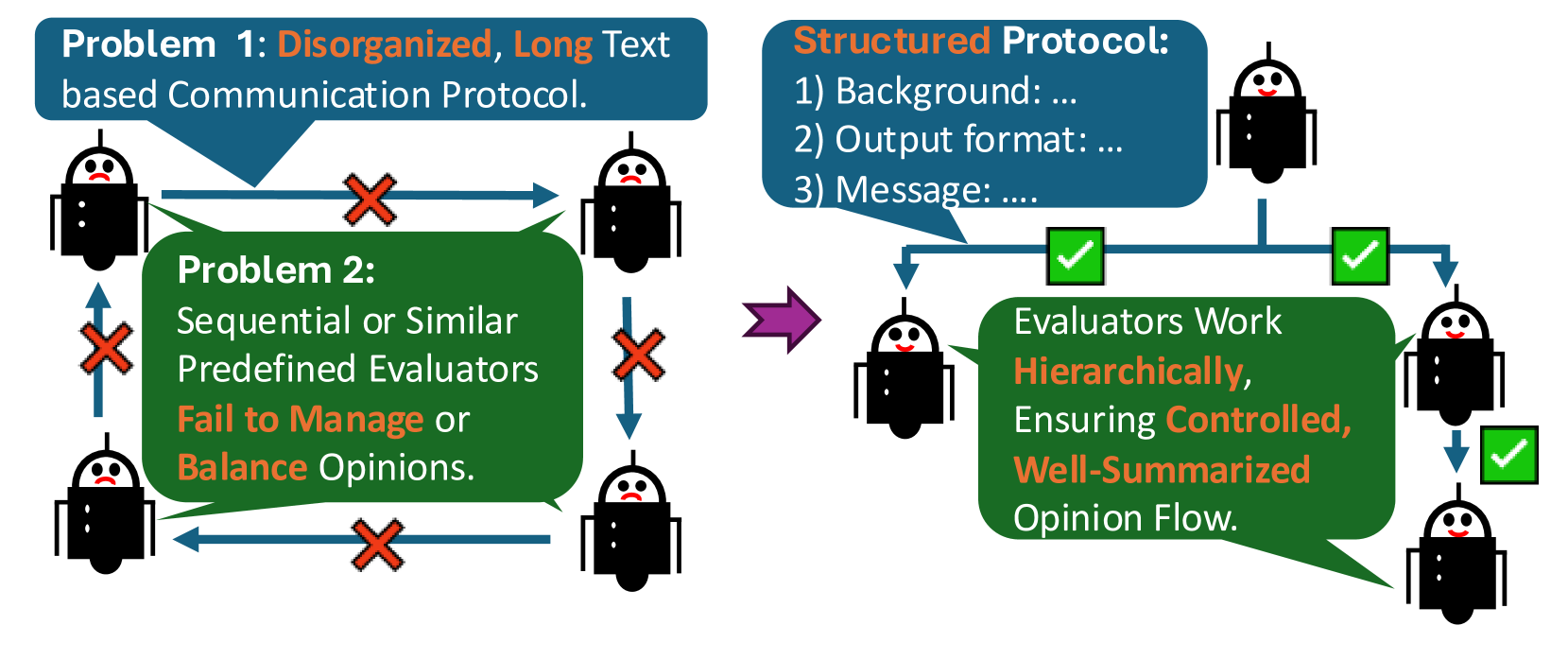
The image presents a diagram comparing two communication protocols: one described as disorganized and text-based, and another as structured. The diagram illustrates the flow of information and the role of evaluators in each protocol. The left side depicts a problematic scenario, while the right side shows an improved, structured approach.
### Components/Axes
* **Title:** The image does not have an overall title, but the two sides are implicitly compared.
* **Left Side:** Represents "Problem 1: Disorganized, Long Text based Communication Protocol" and "Problem 2: Sequential or Similar Predefined Evaluators Fail to Manage or Balance Opinions."
* **Right Side:** Represents "Structured Protocol" with the following elements:
* "1) Background: ..."
* "2) Output format: ..."
* "3) Message: ..."
* **Evaluators:** Represented by robot-like figures with different facial expressions (sad on the left, happy on the right).
* **Arrows:** Indicate the flow of information. Blue arrows indicate the flow of information in the disorganized protocol, and purple arrows indicate the transition to the structured protocol.
* **Red "X" Marks:** Indicate failures or problems in the disorganized protocol.
* **Green Check Marks:** Indicate successful evaluation or control in the structured protocol.
### Detailed Analysis
**Left Side (Disorganized Protocol):**
* A robot-like figure with a sad face is at the top-left. A blue speech bubble above it contains the text: "Problem 1: Disorganized, Long Text based Communication Protocol."
* A blue arrow points from the top-left robot to a top-right robot, but the arrow is crossed out with a red "X".
* A robot-like figure with a sad face is at the top-right.
* A green speech bubble below the top-right robot contains the text: "Problem 2: Sequential or Similar Predefined Evaluators Fail to Manage or Balance Opinions."
* A blue arrow points from the top-right robot to a bottom-right robot, but the arrow is crossed out with a red "X".
* A robot-like figure with a sad face is at the bottom-right.
* A blue arrow points from the bottom-right robot to a bottom-left robot, but the arrow is crossed out with a red "X".
* A robot-like figure with a sad face is at the bottom-left.
* A blue arrow points from the bottom-left robot to the top-left robot, but the arrow is crossed out with a red "X".
**Right Side (Structured Protocol):**
* A purple arrow points from the left side to the right side, indicating a transition from the disorganized protocol to the structured protocol.
* A blue speech bubble at the top-right contains the text: "Structured Protocol: 1) Background: ... 2) Output format: ... 3) Message: ...."
* A robot-like figure with a happy face is below the "Structured Protocol" speech bubble.
* A blue arrow points from the top-right robot to a middle-right robot. A green check mark is placed on the arrow.
* A robot-like figure with a happy face is in the middle-right.
* A blue arrow points from the middle-right robot to a bottom-right robot. A green check mark is placed on the arrow.
* A robot-like figure with a happy face is at the bottom-right.
* A green speech bubble below the middle-right robot contains the text: "Evaluators Work Hierarchically, Ensuring Controlled, Well-Summarized Opinion Flow."
* A green check mark is placed on the arrow.
### Key Observations
* The left side represents a flawed communication protocol where information flow is disrupted, indicated by the red "X" marks. The evaluators (robots) are depicted with sad faces.
* The right side represents an improved, structured protocol where information flows smoothly, indicated by the green check marks. The evaluators are depicted with happy faces.
* The purple arrow signifies a transition or improvement from the disorganized to the structured protocol.
### Interpretation
The diagram illustrates the benefits of a structured communication protocol over a disorganized one. The disorganized protocol suffers from failures in information flow, leading to an inability to manage or balance opinions. The structured protocol, on the other hand, ensures controlled and well-summarized opinion flow through hierarchical evaluators. The use of robot-like figures with different facial expressions effectively conveys the positive and negative aspects of each protocol. The green check marks and red "X" marks provide a clear visual representation of success and failure, respectively. The diagram suggests that a well-defined structure, including background information, output format, and message structure, is crucial for effective communication and opinion management.