\n
## Diagram: Communication Protocol Problems and Solution
### Overview
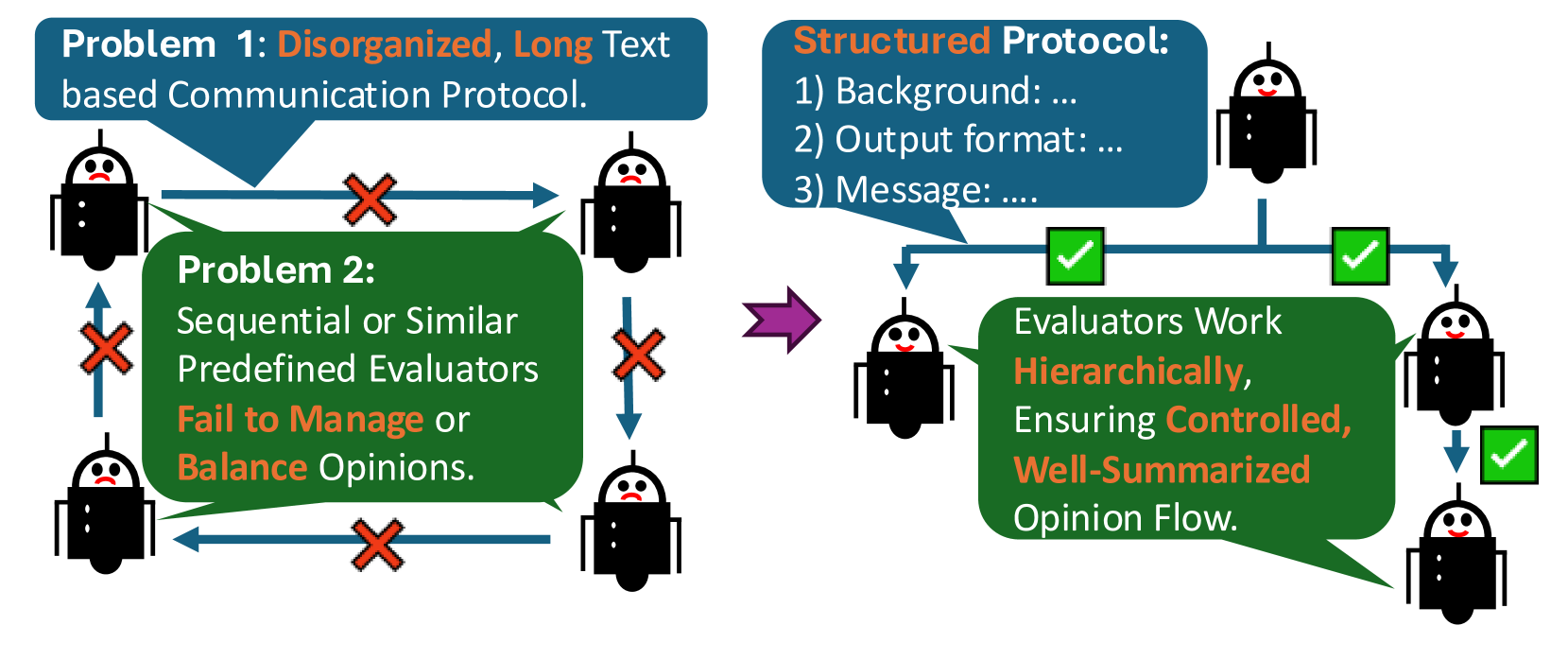
The image is a conceptual diagram contrasting two problematic communication protocols (left side) with a proposed structured solution (right side). It uses robot icons, speech bubbles, directional arrows, and symbolic markers (red X's and green checkmarks) to illustrate the flow and effectiveness of communication between multiple agents.
### Components/Axes
The diagram is divided into two main panels connected by a central purple arrow pointing from left (problems) to right (solution).
**Left Panel (Problematic Protocols):**
* **Top Blue Speech Bubble:** Contains the text "Problem 1: Disorganized, Long Text based Communication Protocol."
* **Central Green Speech Bubble:** Contains the text "Problem 2: Sequential or Similar Predefined Evaluators Fail to Manage or Balance Opinions."
* **Icons & Flow:** Four robot icons with sad/neutral faces are arranged in a square. Blue arrows indicate bidirectional communication between them. Each arrow is overlaid with a large red "X," indicating failed or problematic communication.
* **Spatial Layout:** The blue bubble is at the top-left. The green bubble is centrally located, overlapping the robot icons. The robots are positioned at the four corners of an implied square.
**Right Panel (Structured Solution):**
* **Top Blue Speech Bubble:** Contains the text "Structured Protocol:" followed by a numbered list:
1. Background: ...
2. Output format: ...
3. Message: ....
* **Central Green Speech Bubble:** Contains the text "Evaluators Work Hierarchically, Ensuring Controlled, Well-Summarized Opinion Flow."
* **Icons & Flow:** Four robot icons with happy faces are arranged in a hierarchical tree structure. A single top robot connects via blue arrows to two middle-tier robots, which in turn connect to a single bottom-tier robot. Each connection point is marked with a green checkmark inside a square, indicating successful, validated communication.
* **Spatial Layout:** The blue "Structured Protocol" bubble is at the top-right. The green bubble is centrally located on the right side. The robot hierarchy flows vertically from top to bottom.
### Detailed Analysis
The diagram explicitly labels two core problems with unstructured multi-agent communication:
1. **Problem 1:** Communication is based on "Disorganized, Long Text," which is inefficient.
2. **Problem 2:** Using "Sequential or Similar Predefined Evaluators" leads to a failure to "Manage or Balance Opinions."
The proposed solution is a "Structured Protocol" with three defined components (Background, Output format, Message). This protocol enables evaluators to work "Hierarchically," which results in "Controlled, Well-Summarized Opinion Flow."
The visual metaphor reinforces the text:
* **Problem State (Left):** Sad robots, circular/peer-to-peer communication arrows, red X's denoting failure.
* **Solution State (Right):** Happy robots, a clear top-down hierarchical flow, green checkmarks denoting success and validation at each step.
### Key Observations
* The transition from a disorganized network (left) to a structured hierarchy (right) is the central visual argument.
* The color coding is consistent: blue for protocol descriptions, green for outcomes/evaluator states.
* The change in the robots' facial expressions (sad to happy) is a direct visual indicator of the proposed solution's benefit.
* The "Structured Protocol" bubble on the right uses ellipses ("..."), indicating it is a template or example format to be filled in.
### Interpretation
This diagram argues that for effective communication and decision-making among multiple AI agents or evaluators, structure is paramount. The "problems" represent common pitfalls in decentralized or flat communication systems: inefficiency and an inability to synthesize diverse opinions.
The "solution" advocates for a top-down, hierarchical protocol with a strict message format. This structure is presented as the mechanism to transform chaotic, unmanageable discourse into a controlled, efficient, and well-summarized flow of information. The green checkmarks suggest that this structure provides built-in validation or approval steps, ensuring quality and consensus as information moves through the hierarchy. The core message is that imposing a clear protocol and hierarchy is essential for balancing opinions and achieving a coherent outcome in multi-agent systems.