\n
## Diagram: Molecular Structure Representation
### Overview
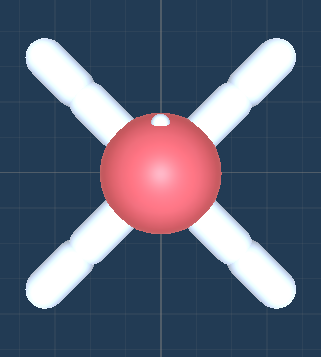
The image depicts a 3D representation of a molecular structure. A central, larger sphere is surrounded by four smaller, elongated cylindrical structures arranged in a roughly tetrahedral configuration. The background is a dark blue grid. This appears to be a simplified model of a molecule, likely for educational or illustrative purposes.
### Components/Axes
There are no explicit axes or labels present in the image. The components are:
* **Central Atom:** A large, reddish-pink sphere.
* **Ligands/Bonding Atoms:** Four white, cylindrical structures extending outwards from the central atom.
* **Background:** A dark blue grid.
### Detailed Analysis or Content Details
The central atom is positioned approximately in the center of the image. The four cylindrical structures are arranged symmetrically around the central atom, extending horizontally and vertically. Each cylindrical structure appears to be connected to the central atom at a single point. The cylindrical structures are approximately equal in length. The central atom has a small, lighter-colored highlight on its upper surface. The background grid is regular and provides a sense of depth and spatial orientation.
### Key Observations
The arrangement of the four cylindrical structures around the central atom suggests a tetrahedral geometry. This is a common molecular geometry observed in molecules with four bonding pairs and no lone pairs of electrons around the central atom. The color contrast between the central atom and the ligands is significant, making the structure easily discernible.
### Interpretation
The diagram likely represents a molecule with a central atom bonded to four other atoms. Based on the tetrahedral geometry, it could be a molecule like methane (CH₄) or ammonium (NH₄⁺). The simplified representation suggests that the diagram is intended to illustrate the basic shape and connectivity of the molecule, rather than providing detailed information about bond lengths, angles, or atomic identities. The absence of labels or a legend means the specific molecule cannot be determined from the image alone. The diagram is a visual aid for understanding molecular geometry and bonding. It is a conceptual model, not a precise depiction of atomic dimensions or electron distribution.