## Diagram: Symmetrical 3D Molecular or Mechanical Structure
### Overview
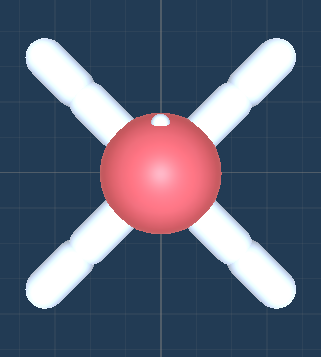
The image displays a computer-generated 3D model of a symmetrical structure against a dark blue grid background. The structure consists of a central red sphere with four white, cylindrical arms extending outward in a perfect "X" or cross formation. There is no textual information, labels, axes, legends, or data points present in the image.
### Components/Axes
* **Central Component:** A glossy, red sphere positioned at the geometric center of the image. It has a specular highlight (a small white spot) on its upper surface, indicating a light source from above.
* **Radial Components:** Four identical white cylinders. Each cylinder is attached to the central sphere and extends diagonally outward toward the corners of the frame. They are arranged with 90-degree rotational symmetry.
* **Background:** A dark blue field overlaid with a faint, lighter blue grid of horizontal and vertical lines, suggesting a 3D modeling workspace or a coordinate system. The grid lines are evenly spaced.
* **Spatial Grounding:** The entire structure is centered within the frame. The arms terminate near the top-left, top-right, bottom-left, and bottom-right corners of the image.
### Detailed Analysis
* **No Quantitative Data:** The image contains no numerical values, measurements, scales, or textual annotations. It is a purely visual representation.
* **Visual Properties:**
* **Color:** Central sphere is a solid, medium red (#E06070 approx.). Arms are solid white (#FFFFFF). Background is dark blue (#1A2639 approx.) with grid lines in a lighter blue (#2A3A59 approx.).
* **Form:** The model uses simple geometric primitives (sphere and cylinders). The surfaces appear smooth with basic shading to imply volume and a single light source.
* **Symmetry:** The structure exhibits perfect four-fold rotational symmetry around an axis perpendicular to the viewing plane.
### Key Observations
1. **Complete Absence of Text:** The image is devoid of any labels, titles, legends, or annotations that would define its purpose, scale, or the identity of its components.
2. **High Symmetry:** The precise, identical arrangement of the four arms is the most prominent visual feature.
3. **Contextual Ambiguity:** The grid background implies a technical or design context (e.g., CAD software, molecular modeling), but the structure itself is generic.
### Interpretation
The image presents a conceptual or illustrative model rather than a technical document containing extractable facts or data. Its meaning is entirely dependent on external context not provided within the frame.
* **Possible Representations:** Without labels, the structure could represent:
* A simplified molecular model (e.g., a central atom with four identical bonded atoms in a tetrahedral or square planar arrangement, though the 2D projection flattens the 3D geometry).
* A mechanical component, such as a rotor, a connector, or a universal joint.
* An abstract symbol or logo.
* A basic test object for 3D rendering or physics simulation.
* **Function of the Grid:** The background grid serves to ground the object in a virtual space, providing a sense of scale and orientation, but no specific units are given.
* **Primary Information Conveyed:** The image communicates **form, symmetry, and spatial relationship** between a central node and four identical radial elements. Any deeper meaning—chemical identity, mechanical function, symbolic significance—is absent and must be supplied by accompanying documentation or prior knowledge.
**Conclusion:** This image is a visual diagram of a symmetrical, four-armed structure. It contains **zero textual or numerical data**. Its informational value lies solely in its geometric composition, which could be described as "a central red sphere with four white cylindrical arms extending diagonally in an X-pattern on a blue grid." To extract technical facts, this image would need to be paired with a key, caption, or dataset.