## Stacked Bar Chart: Genre and Sub-Genre Distribution
### Overview
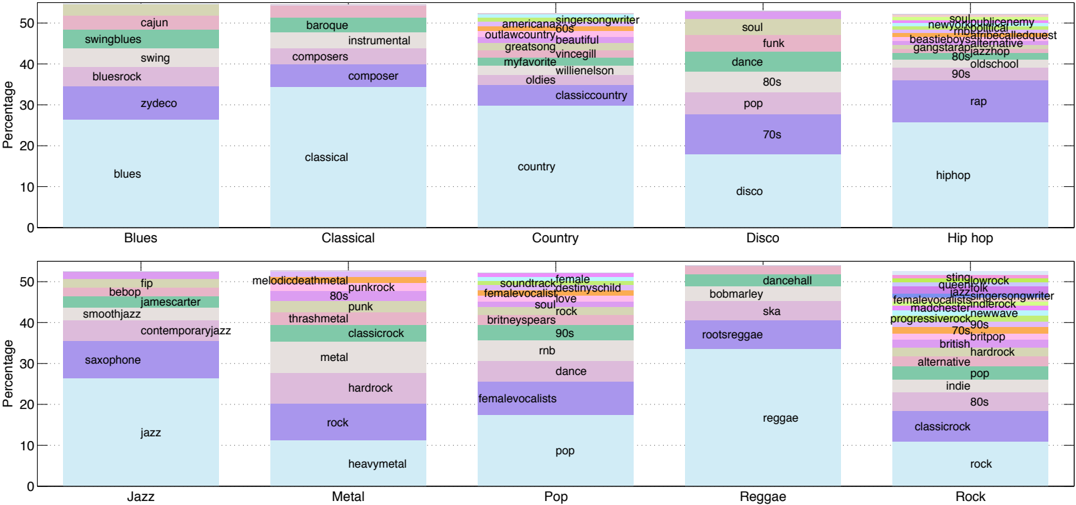
The image is a stacked bar chart divided into two sections: **Genres** (top) and **Sub-Genres** (bottom). Each bar represents a genre or sub-genre, with segments colored to indicate specific terms. The y-axis is labeled "Percentage" (0–50), and the x-axis lists genres (e.g., Blues, Classical, Country, Disco, Hip hop) and sub-genres (e.g., Jazz, Metal, Pop, Reggae, Rock). A legend on the right maps colors to terms.
---
### Components/Axes
- **X-Axis**:
- Top section: Genres (Blues, Classical, Country, Disco, Hip hop).
- Bottom section: Sub-Genres (Jazz, Metal, Pop, Reggae, Rock).
- **Y-Axis**:
- Labeled "Percentage" (0–50).
- **Legend**:
- Located on the right, with colors corresponding to terms (e.g., "blues" in light blue, "jazz" in dark blue, "metal" in gray, etc.).
- **Bars**:
- Stacked vertically, with each segment representing a term. Labels are placed above or below segments.
---
### Detailed Analysis
#### Genres Section (Top)
1. **Blues**:
- Largest segment: "blues" (light blue, ~30%).
- Other segments: "zydeco" (purple, ~10%), "swing" (green, ~5%), "cajun" (pink, ~5%), "bluesrock" (pink, ~5%).
2. **Classical**:
- Largest segment: "classical" (light blue, ~40%).
- Other segments: "composer" (purple, ~10%), "instrumental" (green, ~5%), "baroque" (pink, ~5%).
3. **Country**:
- Largest segment: "country" (light blue, ~40%).
- Other segments: "folk" (purple, ~10%), "outlawcountry" (green, ~5%), "americansongwriter" (pink, ~5%).
4. **Disco**:
- Largest segment: "disco" (light blue, ~30%).
- Other segments: "70s" (purple, ~10%), "dance" (green, ~5%), "80s" (pink, ~5%).
5. **Hip hop**:
- Largest segment: "hip hop" (light blue, ~30%).
- Other segments: "rap" (purple, ~10%), "rnb" (green, ~5%), "90s" (pink, ~5%).
#### Sub-Genres Section (Bottom)
1. **Jazz**:
- Largest segment: "jazz" (light blue, ~30%).
- Other segments: "saxophone" (purple, ~10%), "contemporaryjazz" (green, ~5%), "smoothjazz" (pink, ~5%).
2. **Metal**:
- Largest segment: "metal" (light blue, ~30%).
- Other segments: "hardrock" (purple, ~10%), "thrashmetal" (green, ~5%), "80s" (pink, ~5%).
3. **Pop**:
- Largest segment: "pop" (light blue, ~30%).
- Other segments: "dance" (purple, ~10%), "femalevocalists" (green, ~5%), "90s" (pink, ~5%).
4. **Reggae**:
- Largest segment: "reggae" (light blue, ~30%).
- Other segments: "ska" (purple, ~10%), "rootsreggae" (green, ~5%), "80s" (pink, ~5%).
5. **Rock**:
- Largest segment: "rock" (light blue, ~30%).
- Other segments: "classicrock" (purple, ~10%), "hardrock" (green, ~5%), "80s" (pink, ~5%).
---
### Key Observations
- **Dominance of Main Genres**: The primary genre term (e.g., "blues," "classical") occupies the largest portion of each bar, indicating its central role.
- **Sub-Genre Diversity**: Sub-genres vary in size, with some (e.g., "jazz," "metal") having more distinct sub-categories than others.
- **Temporal Labels**: Terms like "80s," "90s," and "disco" suggest historical or cultural influences.
- **Color Consistency**: The legend colors match the segments exactly (e.g., "blues" is light blue, "jazz" is dark blue).
---
### Interpretation
The chart illustrates the hierarchical structure of musical genres and sub-genres, emphasizing the dominance of core genres while highlighting their subdivisions. For example:
- **Hip hop** and **Reggae** show strong ties to "rap" and "ska," respectively, reflecting their cultural roots.
- **Pop** and **Jazz** include terms like "femalevocalists" and "saxophone," indicating stylistic or instrumental focuses.
- The inclusion of "80s," "90s," and "disco" suggests a focus on historical or era-specific trends.
This visualization could represent data from a music database, chart analysis, or cultural study, emphasizing how genres evolve and intersect. The consistent use of color and labeling ensures clarity, though the absence of numerical values for each segment limits precise quantification.