## Diagram: Generative Agent Memory Flow
### Overview
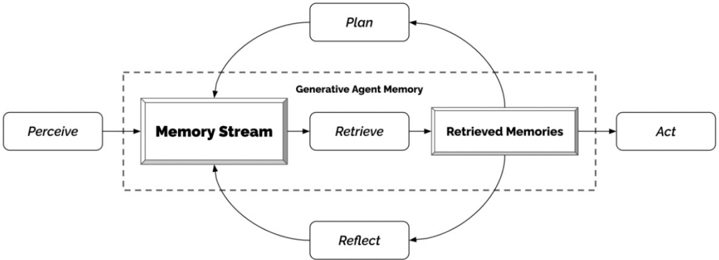
The image is a diagram illustrating the flow of information and processes within a generative agent's memory system. It depicts a cyclical process involving perception, memory storage and retrieval, planning, action, and reflection.
### Components/Axes
* **Nodes:** The diagram consists of rectangular nodes representing different stages or components of the agent's cognitive process. These nodes are:
* Perceive
* Memory Stream
* Retrieve
* Retrieved Memories
* Act
* Plan
* Reflect
* **Flow:** Arrows indicate the direction of information flow between these components.
* **Generative Agent Memory:** A dashed rectangle encloses the "Memory Stream," "Retrieve," and "Retrieved Memories" nodes, labeled as "Generative Agent Memory."
### Detailed Analysis
1. **Perceive:** The process begins with the agent perceiving information from the environment. An arrow leads from "Perceive" to "Memory Stream."
2. **Memory Stream:** The perceived information is stored in the "Memory Stream."
3. **Retrieve:** From the "Memory Stream," information is retrieved via the "Retrieve" process.
4. **Retrieved Memories:** The retrieved information is stored in "Retrieved Memories."
5. **Act:** The agent then acts based on the retrieved memories. An arrow leads from "Retrieved Memories" to "Act."
6. **Plan:** The agent also plans based on the retrieved memories. An arrow leads from "Retrieved Memories" to "Plan." An arrow leads from "Plan" back to "Memory Stream," forming a loop.
7. **Reflect:** The agent reflects on its experiences. An arrow leads from "Memory Stream" to "Reflect." An arrow leads from "Reflect" back to "Memory Stream," forming another loop.
### Key Observations
* The "Generative Agent Memory" component is central to the agent's cognitive process.
* The diagram highlights the cyclical nature of the agent's learning and adaptation, with feedback loops between memory, planning, and reflection.
### Interpretation
The diagram illustrates a simplified model of how a generative agent processes information, learns from its experiences, and plans its actions. The "Generative Agent Memory" acts as the core component, storing and retrieving information that drives the agent's behavior. The loops involving "Plan" and "Reflect" suggest a continuous process of learning and adaptation, where the agent refines its understanding of the world based on its experiences. The model emphasizes the importance of memory in shaping an agent's behavior and decision-making.