## Diagram: Generative Agent Memory System Architecture
### Overview
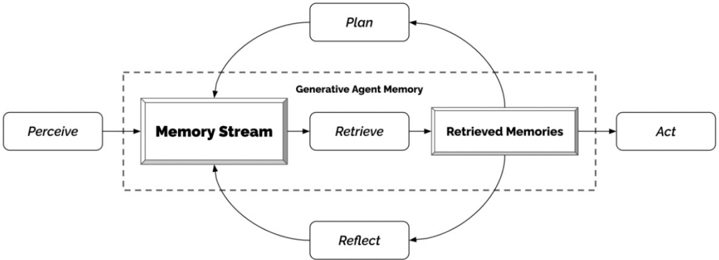
The diagram illustrates a cyclical process for a generative agent's memory and decision-making system. It emphasizes feedback loops between perception, memory, action, and reflection, with a central "Generative Agent Memory" component acting as the core.
### Components/Axes
1. **Key Components**:
- **Perceive**: Input node for sensory data.
- **Memory Stream**: Central processing unit for memory.
- **Retrieve**: Action node for accessing memories.
- **Retrieved Memories**: Output of the retrieval process.
- **Act**: Output node for executing actions.
- **Plan**: Strategic decision-making node.
- **Reflect**: Feedback node for self-assessment.
2. **Flow Arrows**:
- **Sequential Flow**:
`Perceive → Memory Stream → Retrieve → Retrieved Memories → Act`
- **Feedback Loops**:
- `Act → Plan` (strategic adjustment).
- `Reflect → Memory Stream` (memory refinement).
3. **Dashed Box**:
- **Label**: "Generative Agent Memory" (encloses *Memory Stream* and *Retrieved Memories*).
### Detailed Analysis
- **Memory Stream**: Acts as a hub for processing incoming perceptions and refining retrieved memories.
- **Retrieve/Retrieved Memories**: Explicitly separated to distinguish between the retrieval process and its output.
- **Plan/Reflect**: Positioned outside the core memory loop, suggesting higher-order cognitive functions.
### Key Observations
- The system is **cyclical**, with no clear start/end point, emphasizing continuous operation.
- **Feedback loops** ensure adaptability:
- Actions inform planning.
- Reflection updates memory.
- **No numerical data** is present; the diagram is purely conceptual.
### Interpretation
This architecture models an agent's ability to:
1. **Perceive** environmental inputs.
2. **Store/process** memories in a dynamic "Memory Stream."
3. **Retrieve** relevant memories to inform actions.
4. **Act** and **plan** based on retrieved data.
5. **Reflect** on outcomes to refine future memory and decision-making.
The separation of *Retrieve* and *Retrieved Memories* suggests a distinction between the mechanism of memory access and the content accessed. The inclusion of *Plan* and *Reflect* outside the core memory loop implies these are meta-cognitive processes that modulate the system's behavior.
**Note**: The diagram lacks quantitative metrics, focusing instead on functional relationships. It aligns with principles of embodied cognition and adaptive systems, where memory and action are tightly coupled through iterative feedback.