## Pyramid Diagram: Hierarchical Structure of FHE Components
### Overview
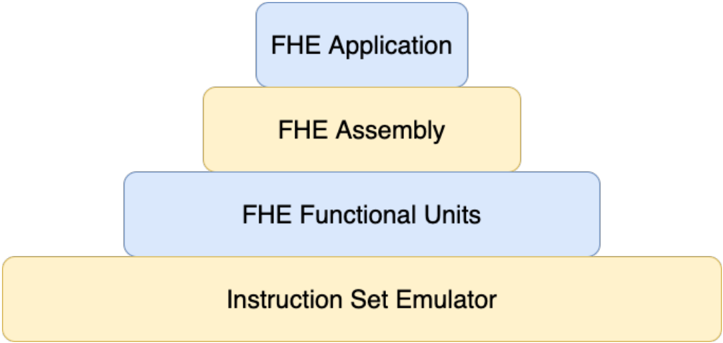
The image depicts a four-tiered pyramid diagram illustrating the hierarchical relationship between components of a Fully Homomorphic Encryption (FHE) system. The pyramid structure suggests a foundational dependency model, with each level building upon the one below it.
### Components/Axes
- **Top Tier (Smallest Box)**:
- Label: "FHE Application"
- Color: Light Blue (#ADD8E6)
- **Second Tier**:
- Label: "FHE Assembly"
- Color: Light Orange (#FFA07A)
- **Third Tier**:
- Label: "FHE Functional Units"
- Color: Light Blue (#ADD8E6)
- **Base Tier (Largest Box)**:
- Label: "Instruction Set Emulator"
- Color: Light Orange (#FFA07A)
**Spatial Grounding**:
- All components are vertically stacked, centered, and proportionally sized to form a pyramid.
- No legend, axes, or numerical data present.
### Detailed Analysis
- **Color Pattern**: Alternating light blue and light orange tiers may indicate categorical grouping (e.g., application layer vs. infrastructure layer).
- **Textual Content**:
- "FHE Application" (top)
- "FHE Assembly" (middle)
- "FHE Functional Units" (lower)
- "Instruction Set Emulator" (base)
### Key Observations
1. The pyramid’s base ("Instruction Set Emulator") is the largest, implying it is the foundational component.
2. "FHE Functional Units" directly support the "FHE Assembly," which in turn enables the "FHE Application."
3. No numerical values, trends, or quantitative data are present.
### Interpretation
This diagram likely represents a layered architecture for FHE systems, where:
- The **Instruction Set Emulator** provides the lowest-level computational framework.
- **FHE Functional Units** (e.g., encryption/decryption modules) operate on top of the emulator.
- **FHE Assembly** integrates these units into a cohesive system.
- The **FHE Application** resides at the top, utilizing the assembled infrastructure.
The alternating colors may serve to visually distinguish between "application-facing" (blue) and "infrastructure" (orange) components. The absence of numerical data suggests this is a conceptual model rather than a performance benchmark.