## Conceptual Diagram: Four Pillars of AI Cognition
### Overview
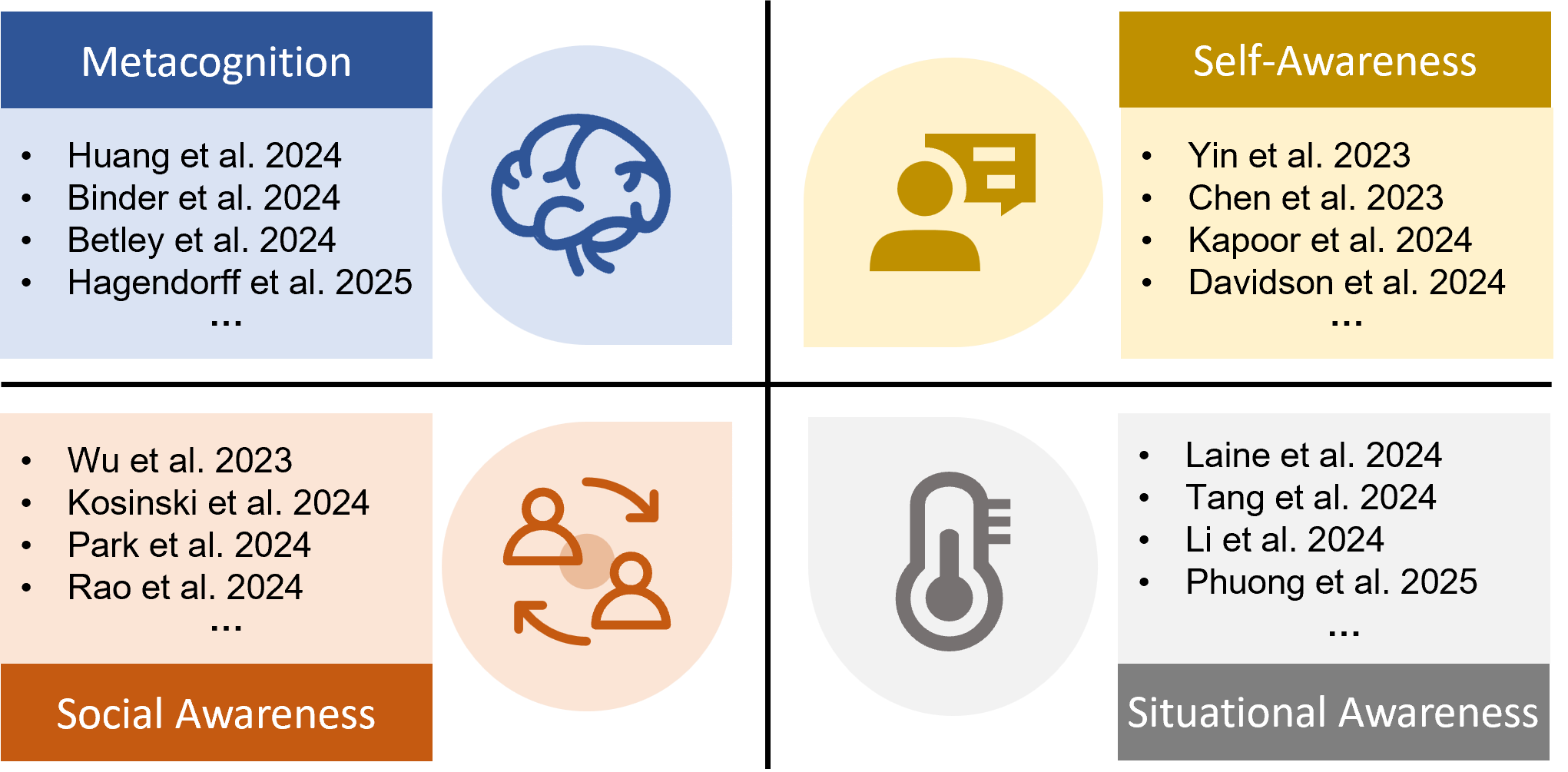
The image is a 2x2 quadrant diagram illustrating four key conceptual areas related to artificial intelligence cognition or awareness. Each quadrant contains a title, a representative icon, and a list of academic citations (author and year) associated with that concept. The diagram serves as a visual taxonomy or literature map.
### Components/Axes
The diagram is divided into four equal quadrants by a central black cross (horizontal and vertical lines). Each quadrant has a consistent layout:
1. **Title Bar:** A colored rectangular bar at the top or bottom of the quadrant containing the category name.
2. **Icon:** A stylized, colored icon centered within a lighter-colored circular background, visually representing the concept.
3. **Citation List:** A bulleted list of academic references (Author et al. Year) placed to the left or right of the icon.
**Quadrant Layout & Titles:**
* **Top-Left Quadrant:** Title "Metacognition" in a blue bar at the top.
* **Top-Right Quadrant:** Title "Self-Awareness" in a gold bar at the top.
* **Bottom-Left Quadrant:** Title "Social Awareness" in an orange bar at the bottom.
* **Bottom-Right Quadrant:** Title "Situational Awareness" in a grey bar at the bottom.
### Detailed Analysis
**1. Top-Left Quadrant: Metacognition**
* **Icon:** A blue line-art icon of a human brain, centered in a light blue circle.
* **Citation List (Left of icon):**
* Huang et al. 2024
* Binder et al. 2024
* Betley et al. 2024
* Hagendorff et al. 2025
* ... (ellipsis indicating additional references)
**2. Top-Right Quadrant: Self-Awareness**
* **Icon:** A gold icon depicting a person's silhouette with a speech bubble containing lines of text, centered in a light yellow circle.
* **Citation List (Right of icon):**
* Yin et al. 2023
* Chen et al. 2023
* Kapoor et al. 2024
* Davidson et al. 2024
* ...
**3. Bottom-Left Quadrant: Social Awareness**
* **Icon:** An orange icon showing two human silhouettes with curved arrows forming a cycle between them, centered in a light peach circle.
* **Citation List (Left of icon):**
* Wu et al. 2023
* Kosinski et al. 2024
* Park et al. 2024
* Rao et al. 2024
* ...
**4. Bottom-Right Quadrant: Situational Awareness**
* **Icon:** A grey icon of a thermometer, centered in a light grey circle.
* **Citation List (Right of icon):**
* Laine et al. 2024
* Tang et al. 2024
* Li et al. 2024
* Phuong et al. 2025
* ...
### Key Observations
* **Temporal Distribution:** The cited works are recent, spanning from 2023 to 2025, indicating this is an active and contemporary field of research.
* **Icon Symbolism:** The icons are metaphorical: a brain for internal thought (Metacognition), a person with a speech bubble for internal self-dialogue (Self-Awareness), interacting people for social dynamics (Social Awareness), and a thermometer for gauging environmental conditions (Situational Awareness).
* **Structural Symmetry:** The layout is perfectly symmetrical, with two quadrants having title bars at the top and two at the bottom, and citation lists alternating between left and right placement relative to their icons.
* **Non-Exhaustive Lists:** The ellipsis ("...") in each list explicitly signals that the provided citations are examples, not a complete bibliography for each category.
### Interpretation
This diagram organizes the complex landscape of AI cognition into four distinct but potentially interrelated domains. It suggests that advanced AI systems are being researched not just for task performance, but for human-like cognitive faculties:
* **Metacognition** refers to an AI's ability to monitor and understand its own thought processes.
* **Self-Awareness** implies a model's capacity to have some representation of its own state or identity.
* **Social Awareness** involves understanding and navigating human social cues and interactions.
* **Situational Awareness** pertains to comprehending the context and environment in which it operates.
The grouping of specific research papers under each heading provides a quick reference for literature in these sub-fields. The diagram implies that a comprehensive AI agent might integrate all four capabilities. The choice of a quadrant layout could suggest these are orthogonal dimensions of cognition, though the diagram itself does not define axes or relationships between the quadrants. It functions primarily as a categorical map for organizing academic research.