## Heatmap: Accuracy Breakdown
### Overview
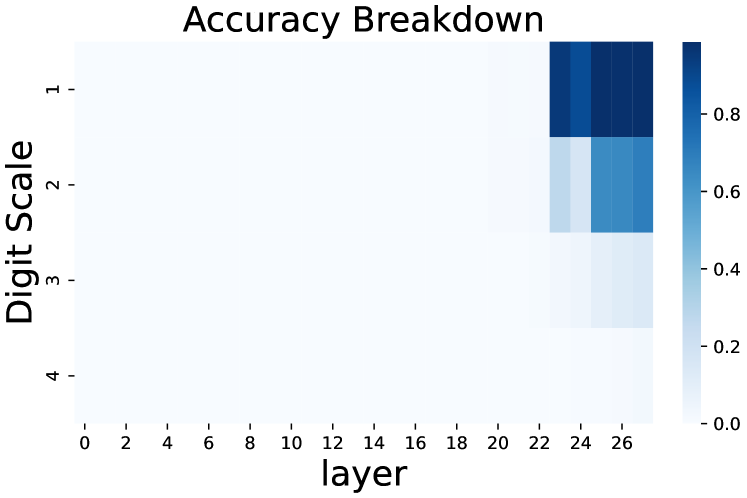
The image is a heatmap titled "Accuracy Breakdown," visualizing the relationship between "layer" (x-axis) and "Digit Scale" (y-axis). The color intensity represents accuracy, with darker blue indicating higher accuracy. The data is concentrated in the top-right quadrant, suggesting a correlation between higher layers and lower digit scales with improved performance.
### Components/Axes
- **X-axis (layer)**: Labeled "layer," with values ranging from 0 to 26 in increments of 2.
- **Y-axis (Digit Scale)**: Labeled "Digit Scale," with values 1 to 4.
- **Color Scale**: A gradient from light blue (0.0) to dark blue (0.8), representing accuracy.
- **Legend**: The color bar on the right acts as the legend, mapping color intensity to accuracy values.
### Detailed Analysis
- **Top-right quadrant (layers 24–26, digit scales 1–2)**: Dominated by dark blue, indicating the highest accuracy (approximately 0.8–0.9). For example:
- Layer 26, digit scale 1: ~0.85
- Layer 24, digit scale 1: ~0.75
- Layer 26, digit scale 2: ~0.65
- **Middle layers (12–22)**: Lighter blue shades, with accuracy decreasing as digit scale increases. For instance:
- Layer 20, digit scale 3: ~0.4
- Layer 18, digit scale 2: ~0.5
- **Lower-left quadrant (layers 0–10, digit scales 3–4)**: Predominantly light blue, with accuracy near 0.0–0.2. For example:
- Layer 4, digit scale 4: ~0.1
- Layer 8, digit scale 3: ~0.05
### Key Observations
1. **High accuracy in top-right**: Layers 24–26 and digit scales 1–2 show the strongest performance.
2. **Decline with increasing digit scale**: Accuracy drops significantly as digit scale increases (e.g., from 0.8 to 0.2 when moving from digit scale 1 to 4).
3. **Layer dependency**: Higher layers (24–26) consistently outperform lower layers across all digit scales.
### Interpretation
The heatmap suggests that the model's accuracy improves with deeper layers (24–26) and simpler digit scales (1–2). This implies that:
- **Layer depth**: Deeper layers may capture more complex features, enhancing accuracy for simpler tasks (digit scale 1).
- **Digit scale complexity**: Higher digit scales (3–4) likely involve more intricate patterns, which the model struggles to process, even in deeper layers.
- **Trade-off**: While deeper layers improve performance, they may not fully compensate for the challenges posed by higher digit scales.
The data highlights a clear trend where model performance is optimized for simpler tasks (low digit scale) in later layers, with diminishing returns as task complexity increases.