## Diagram: LLM Interaction Patterns
### Overview
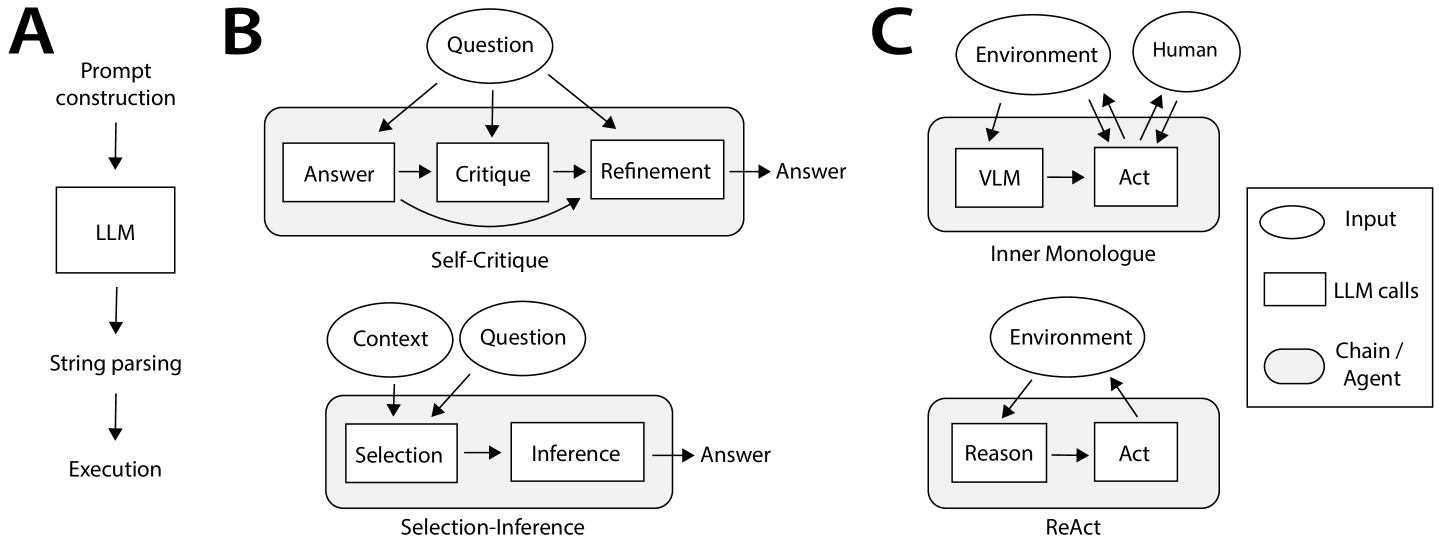
The image presents three distinct diagrams (A, B, and C) illustrating different patterns of interaction with a Large Language Model (LLM). These patterns are labeled as "Prompt construction," "Self-Critique," "Selection-Inference," "Inner Monologue," and "ReAct." The diagrams use specific shapes to represent different components: ovals for input and chains/agents, and rectangles for LLM calls.
### Components/Axes
* **Diagram A:**
* Title: Prompt construction
* Components: Prompt construction (input), LLM (LLM call), String parsing, Execution
* **Diagram B:**
* Title: Self-Critique, Selection-Inference
* Components (Self-Critique): Question (input), Answer (LLM call), Critique (LLM call), Refinement (LLM call)
* Components (Selection-Inference): Context (input), Question (input), Selection (LLM call), Inference (LLM call)
* **Diagram C:**
* Title: Inner Monologue, ReAct
* Components (Inner Monologue): Environment (input), Human (input), VLM (LLM call), Act (LLM call)
* Components (ReAct): Environment (input), Reason (LLM call), Act (LLM call)
* **Legend (bottom-right):**
* Oval: Input
* Rectangle: LLM calls
* Rounded Rectangle: Chain / Agent
### Detailed Analysis
**Diagram A: Prompt construction**
* Flow: Prompt construction -> LLM -> String parsing -> Execution.
* Description: This diagram shows a simple sequential process. A prompt is constructed, fed into an LLM, the output is parsed as a string, and then executed.
**Diagram B: Self-Critique**
* Flow: Question -> Answer -> Critique -> Refinement -> Answer. There is also a feedback loop from Critique back to Answer.
* Description: The Self-Critique pattern involves the LLM generating an initial answer, then critiquing its own answer, refining it based on the critique, and producing a final answer. The critique stage can influence the answer stage.
**Diagram B: Selection-Inference**
* Flow: Context + Question -> Selection -> Inference -> Answer.
* Description: The Selection-Inference pattern involves selecting relevant information from a context based on a question, then using that information to make an inference and generate an answer.
**Diagram C: Inner Monologue**
* Flow: Environment + Human -> VLM -> Act.
* Description: The Inner Monologue pattern involves processing information from the environment and human input through a Visual Language Model (VLM), which then informs an action.
**Diagram C: ReAct**
* Flow: Environment -> Reason -> Act.
* Description: The ReAct pattern involves reasoning about the environment and then taking an action based on that reasoning.
### Key Observations
* The diagrams illustrate different ways LLMs can be integrated into workflows.
* Diagram B shows two distinct patterns, Self-Critique and Selection-Inference.
* Diagram C shows two distinct patterns, Inner Monologue and ReAct.
* The use of ovals, rectangles, and rounded rectangles provides a visual distinction between input, LLM calls, and chains/agents.
* Arrows indicate the flow of information or control between components.
### Interpretation
The diagrams demonstrate various strategies for leveraging LLMs in different contexts. The "Prompt construction" pattern is the most basic, while "Self-Critique" and "Selection-Inference" show more sophisticated methods for improving the quality of LLM outputs. "Inner Monologue" and "ReAct" highlight how LLMs can be used in more complex systems involving environmental input and action. The choice of pattern depends on the specific task and the desired level of control and refinement. The diagrams suggest a progression from simple, direct LLM calls to more complex, iterative, and context-aware interactions.