## Code Snippet Comparison: WebAssembly-like Intermediate Representation
### Overview
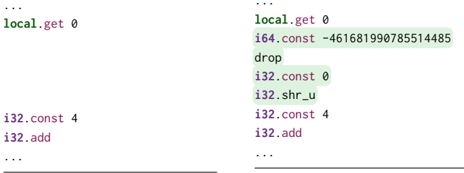
The image displays two side-by-side snippets of low-level code, resembling WebAssembly (WAT) or a similar stack-based intermediate representation. The left snippet shows a simpler sequence, while the right snippet shows a modified version with additional instructions highlighted in green. The purpose appears to be a diff or comparison showing code insertion.
### Components/Axes
This is not a chart with axes. The components are two distinct blocks of textual code.
* **Left Snippet:** A 3-line code sequence.
* **Right Snippet:** A 7-line code sequence. Lines 2-5 are highlighted with a light green background, indicating they are additions or modifications compared to the left snippet.
* **Text Language:** The code uses English-based mnemonics (`local.get`, `i32.const`, `add`, `drop`, `shr_u`).
### Detailed Analysis / Content Details
**Left Snippet (Original/Reference):**
```webassembly
local.get 0
i32.const 4
i32.add
```
**Right Snippet (Modified):**
```webassembly
local.get 0
i64.const -461681990785514485 // Highlighted in green
drop // Highlighted in green
i32.const 0 // Highlighted in green
i32.shr_u // Highlighted in green
i32.const 4
i32.add
```
**Line-by-Line Transcription & Comparison:**
1. **Line 1 (Both):** `local.get 0` - Identical in both snippets. This instruction pushes the value of local variable #0 onto the stack.
2. **Lines 2-5 (Right Only):** These are the inserted instructions.
* `i64.const -461681990785514485`: Pushes a 64-bit integer constant with the value `-461681990785514485` onto the stack.
* `drop`: Discards the top value on the stack (the just-pushed constant).
* `i32.const 0`: Pushes the 32-bit integer constant `0` onto the stack.
* `i32.shr_u`: Performs an unsigned right shift on the top two 32-bit integers on the stack. The second value (0) is the shift amount. The first value (from `local.get 0`) is shifted right by 0 bits, effectively leaving it unchanged.
3. **Lines 2-3 (Left) / 6-7 (Right):** `i32.const 4` followed by `i32.add`. Identical in function. Pushes the constant `4` and adds it to the value on the stack (which is the result of the previous operations).
### Key Observations
1. **Structural Difference:** The right snippet inserts a block of four instructions between the initial `local.get 0` and the final `i32.const 4` / `i32.add` sequence.
2. **Highlighted Code:** The green background clearly marks the inserted block (`i64.const`, `drop`, `i32.const 0`, `i32.shr_u`).
3. **Net Effect of Insertion:** The inserted block pushes a large 64-bit constant, immediately drops it, then pushes a 0 and performs a right shift by 0 on the original value from `local.get 0`. A shift by zero is a no-op. Therefore, the **functional outcome of the added block is null**; it does not alter the final result of the code, which remains `value_from_local_0 + 4`.
4. **Potential Purpose:** This pattern is characteristic of:
* **Obfuscation:** Adding dead code to make analysis harder.
* **Padding:** Inserting instructions to meet a specific code size or alignment requirement.
* **Debug/Instrumentation Artifact:** Code left over from a profiling or tracing pass that was not fully optimized out.
* **Compiler Bug/Quirk:** An intermediate representation that wasn't fully simplified.
### Interpretation
The image presents a technical diff of low-level code. The core operation (`local.get 0; i32.const 4; i32.add`) is preserved in both versions. The modification in the right snippet is a **semantically redundant insertion**.
From a Peircean investigative perspective, this is a sign of a process that leaves traces. The inserted code is an *index* of some prior transformation—it points to an action (obfuscation, padding, instrumentation) that occurred but whose direct effect has been nullified. The large, specific negative constant (`-461681990785514485`) is particularly notable; it is unlikely to be a meaningful program constant and more likely a hash, address, or artifact from another stage of processing.
The key takeaway is not the code's function, but the **meta-information** revealed by the diff: a transformation was applied to the code that added non-functional instructions, suggesting concerns beyond pure computation, such as code size, security through obscurity, or remnants of a development toolchain. To understand *why* this change was made, one would need context about the source of the code (e.g., a wasm binary decompiler output, a compiler's intermediate representation view).