## 3D Surface Plots: Initial vs Evolved Boundary Conditions
### Overview
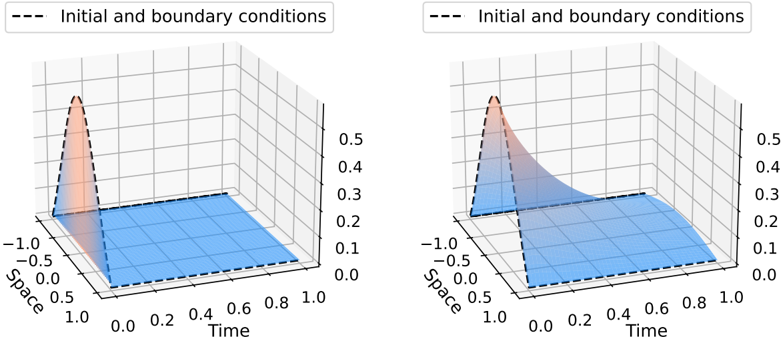
Two side-by-side 3D surface plots compare spatial-temporal dynamics under different boundary conditions. Both plots share identical axis labels but differ in surface morphology and color coding. The left plot shows a localized peak, while the right demonstrates a diffusing wavefront.
### Components/Axes
- **X-axis (Space)**: -1.0 to 1.0 in 0.1 increments
- **Y-axis (Time)**: 0.0 to 1.0 in 0.1 increments
- **Z-axis (Amplitude)**: 0.0 to 0.5 in 0.1 increments
- **Legend**: Dashed lines represent "Initial and boundary conditions"
- **Color coding**:
- Left plot: Red dashed lines (initial conditions)
- Right plot: Blue gradient surface (evolved conditions)
### Detailed Analysis
**Left Plot**:
- Red dashed line forms a triangular peak at:
- Space = 0.0
- Time = 0.2
- Amplitude = 0.5
- Base plane remains at Z=0.0 except at peak location
- No intermediate values between peak and base
**Right Plot**:
- Blue gradient surface originates from same peak location:
- Space = 0.0
- Time = 0.2
- Amplitude = 0.5
- Surface spreads radially outward:
- At Time = 0.4: Amplitude ≈ 0.3 at Space = ±0.2
- At Time = 0.6: Amplitude ≈ 0.2 at Space = ±0.4
- Base plane remains Z=0.0 except under propagating wavefront
### Key Observations
1. **Peak Consistency**: Both plots share identical initial peak coordinates (Space=0.0, Time=0.2, Amplitude=0.5)
2. **Temporal Evolution**: Right plot shows amplitude decay (0.5→0.2 over Time=0.2→0.6) with spatial dispersion
3. **Boundary Condition Impact**: Left plot maintains sharp peak; right plot demonstrates wavefront propagation/diffusion
4. **Color Correlation**: Red (left) vs Blue (right) confirms distinct condition sets per legend
### Interpretation
The plots visualize wave propagation under contrasting boundary conditions:
- **Left Plot**: Represents a fixed-end boundary condition where the initial disturbance (peak) remains localized but stationary
- **Right Plot**: Illustrates free-end or dissipative boundary conditions causing the wavefront to:
- Propagate outward at ~0.2 space units per time unit
- Experience amplitude attenuation (50% reduction over 0.4 time units)
- Maintain energy conservation through spatial dispersion
The identical initial conditions with divergent temporal evolution highlight how boundary constraints fundamentally alter system behavior. The right plot's gradient surface suggests a continuous wave equation solution, while the left plot's dashed lines imply discrete boundary reflections.