\n
## Diagram: Agent Design Paradigms
### Overview
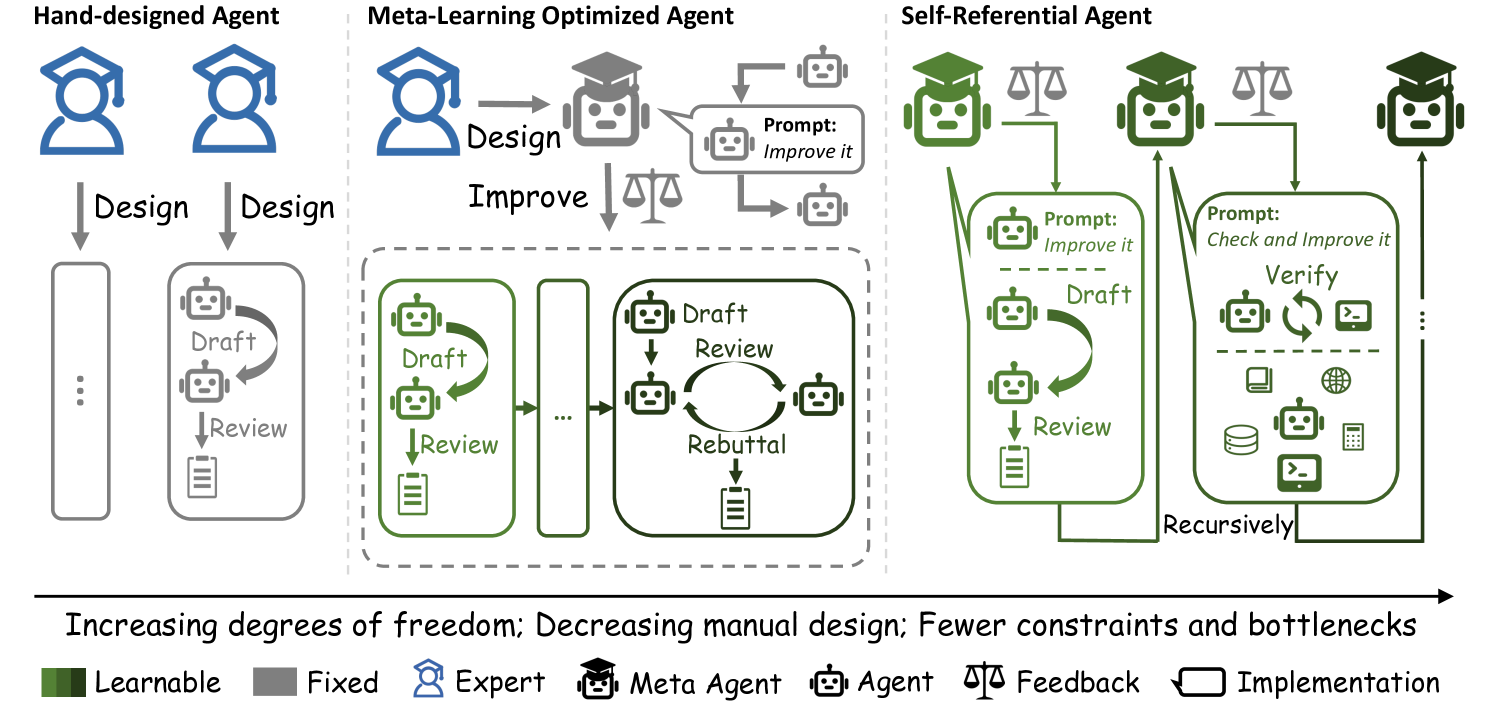
The image presents a comparative diagram illustrating three different approaches to agent design: Hand-designed Agent, Meta-Learning Optimized Agent, and Self-Referential Agent. The diagram visually represents the workflow and components of each approach, highlighting the increasing degrees of freedom and decreasing manual design involved as one moves from left to right. The diagram uses icons to represent different agent types and processes, connected by arrows to show the flow of information and control.
### Components/Axes
The diagram is horizontally organized into three main sections, each representing a different agent design paradigm. Below the three sections is a legend defining the icons used throughout the diagram. The legend includes:
* **Learnable** (Dark Green)
* **Fixed** (Light Brown)
* **Expert** (Dark Brown, Head Icon)
* **Meta Agent** (Dark Grey, Head with Gears Icon)
* **Agent** (Light Grey, Head Icon)
* **Feedback** (Scales Icon)
* **Implementation** (Document Icon)
A horizontal arrow at the bottom of the diagram indicates a progression from "Increasing degrees of freedom; Decreasing manual design; Fewer constraints and bottlenecks" from left to right.
### Detailed Analysis or Content Details
**1. Hand-designed Agent (Leftmost Section)**
* Two "Fixed" agent icons (light brown head icons) are positioned at the top.
* An arrow labeled "Design" connects these agents to a "Draft" icon (white document with pencil).
* An arrow labeled "Review" connects the "Draft" icon to a "Implementation" icon (white document).
* A dotted line with ellipses indicates a repeating loop between "Draft" and "Review".
**2. Meta-Learning Optimized Agent (Center Section)**
* An "Expert" agent icon (dark brown head icon) and a "Meta Agent" icon (dark grey head with gears) are positioned at the top.
* An arrow labeled "Design" connects the "Expert" agent to an "Improve" icon (scales icon).
* An arrow labeled "Prompt: Improve it" connects the "Improve" icon to a loop containing "Draft" (white document with pencil), "Review" (white document), and "Rebuttal" (white document).
* The loop is enclosed within a dashed grey box.
* Ellipses indicate the loop can repeat indefinitely.
**3. Self-Referential Agent (Rightmost Section)**
* An "Expert" agent icon (dark brown head icon), a "Meta Agent" icon (dark grey head with gears), and a "Agent" icon (light grey head icon) are positioned at the top.
* An arrow labeled "Prompt: Improve it" connects the "Meta Agent" to a "Draft" icon (white document with pencil).
* An arrow labeled "Review" connects the "Draft" icon to a "Implementation" icon (white document).
* An arrow labeled "Prompt: Check and Improve it" connects the "Implementation" icon to a "Verify" icon (magnifying glass).
* A dashed arrow labeled "Recursively" points back from the "Verify" icon to the "Draft" icon, indicating a recursive loop.
* The entire process is enclosed within a dashed blue box.
### Key Observations
* The complexity of the agent design process increases from left to right.
* The Hand-designed Agent relies on a simple, manual loop of "Draft" and "Review".
* The Meta-Learning Optimized Agent introduces a "Meta Agent" to improve the design process, creating a more complex iterative loop.
* The Self-Referential Agent incorporates a recursive "Verify" step, suggesting a self-improving system.
* The use of dashed boxes indicates the scope of automated or iterative processes.
* The progression from "Fixed" agents to incorporating "Learnable" and "Meta" agents highlights a shift towards more autonomous and adaptable systems.
### Interpretation
The diagram illustrates a progression in agent design paradigms, moving from fully manual, human-designed agents to increasingly autonomous, self-improving agents. The diagram suggests that as agents become more complex, they require less manual intervention and can leverage meta-learning and self-referential techniques to optimize their performance. The increasing degrees of freedom and decreasing manual design represent a trend towards more flexible and adaptable AI systems. The recursive loop in the Self-Referential Agent highlights the potential for continuous improvement and adaptation, suggesting a future where agents can learn and evolve without constant human oversight. The diagram is a conceptual illustration of design principles rather than a presentation of specific data. It is a visual argument for the benefits of moving towards more automated and self-improving agent design methodologies.