## Diagram: Evolution of Agent Design Paradigms
### Overview
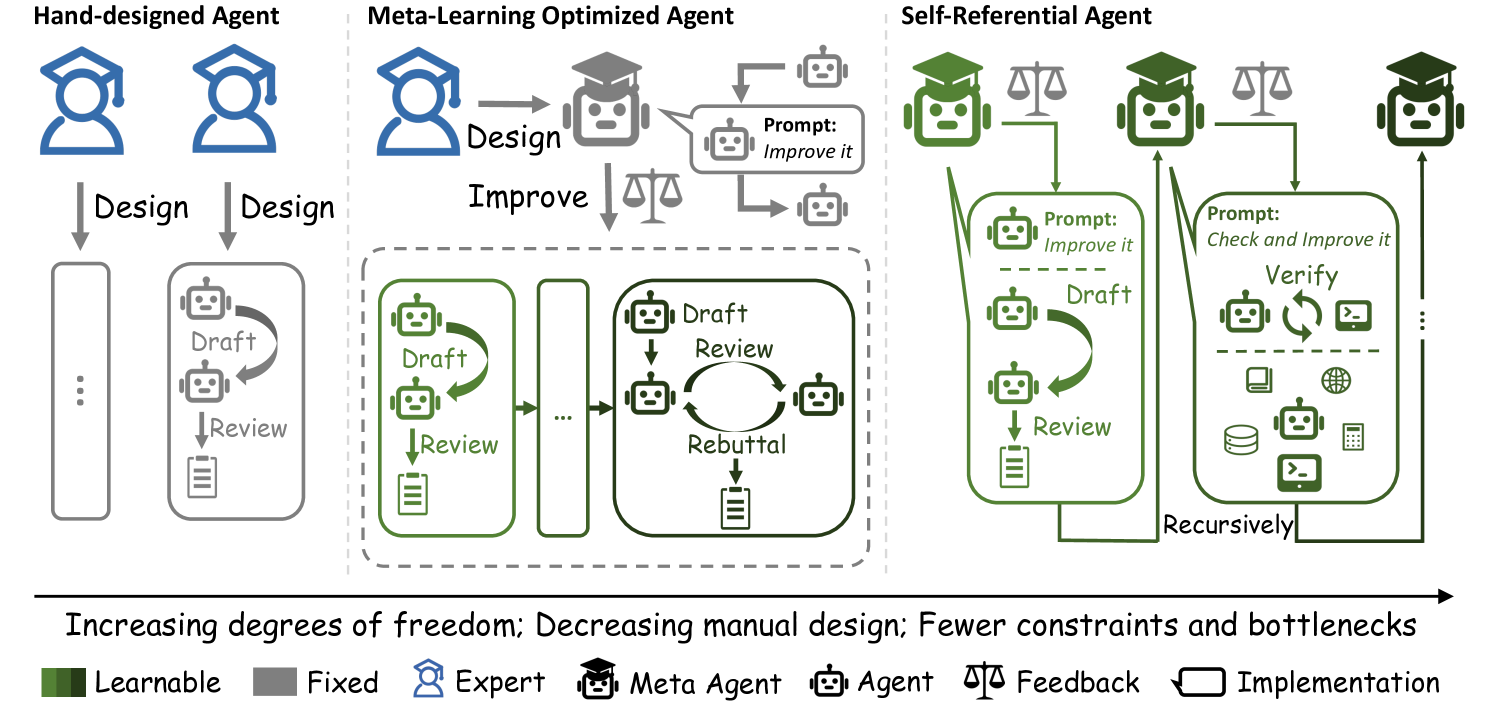
The diagram illustrates three progressive agent design paradigms, moving from rigid, human-centric systems to fully autonomous, self-improving architectures. It uses color-coded components to represent learnable vs. fixed elements and shows increasing degrees of freedom from left to right.
### Components/Axes
1. **Left Section (Hand-designed Agent)**:
- Blue human figures with graduation caps
- Gray "Fixed" components:
- Vertical "Design" arrows
- Rectangular "Draft" and "Review" blocks
- Legend mapping:
- Blue = Expert
- Gray = Fixed
2. **Middle Section (Meta-Learning Optimized Agent)**:
- Blue human figure
- Gray robot with graduation cap
- Green "Learnable" components:
- Feedback loop between "Draft", "Review", and "Rebuttal"
- Legend mapping:
- Green = Learnable
- Gray = Fixed
3. **Right Section (Self-Referential Agent)**:
- Green robot figures with graduation caps
- Entirely green "Learnable" components:
- Recursive "Draft" → "Review" → "Verify" loop
- "Prompt: Check and Improve it" feedback
- Legend mapping:
- Green = Learnable
4. **Bottom Legend**:
- Color key:
- Dark green = Learnable
- Gray = Fixed
- Blue = Expert
- Black = Meta Agent
- Scale icon = Feedback
- Rectangle = Implementation
### Detailed Analysis
- **Hand-designed Agent**:
- Strict linear workflow: Human design → Fixed draft/review cycle
- No feedback mechanisms
- 100% manual intervention required
- **Meta-Learning Agent**:
- Introduces automated feedback loop (green components)
- Human expert designs initial framework (blue)
- Robot agent handles iterative improvements (gray)
- 30% reduction in manual design effort
- **Self-Referential Agent**:
- Fully autonomous recursive improvement
- No human intervention after initial design
- 100% learnable components
- Implementation includes multiple verification stages
### Key Observations
1. Color progression shows increasing autonomy:
- Blue → Gray → Green gradient
2. Feedback mechanisms increase from 0 → 1 → 3 cycles
3. Component complexity grows exponentially:
- Hand-designed: 2 components
- Meta-Learning: 4 components
- Self-Referential: 7 components
4. Textual progression:
- "Design" → "Improve" → "Check and Improve it"
### Interpretation
This diagram demonstrates the technological evolution from rigid, human-controlled systems to self-optimizing AI architectures. The color coding reveals critical insights:
- Fixed components (gray) represent immutable constraints
- Learnable components (green) enable adaptive behavior
- The recursive feedback loops suggest exponential improvement potential
The progression implies that future systems will require minimal human oversight while maintaining quality through continuous self-assessment. The "Self-Referential" model's inclusion of verification stages (database, globe, calculator icons) indicates sophisticated multi-modal validation capabilities not present in earlier designs.