## Diagram: Gödel Agent Self-Improvement Process
### Overview
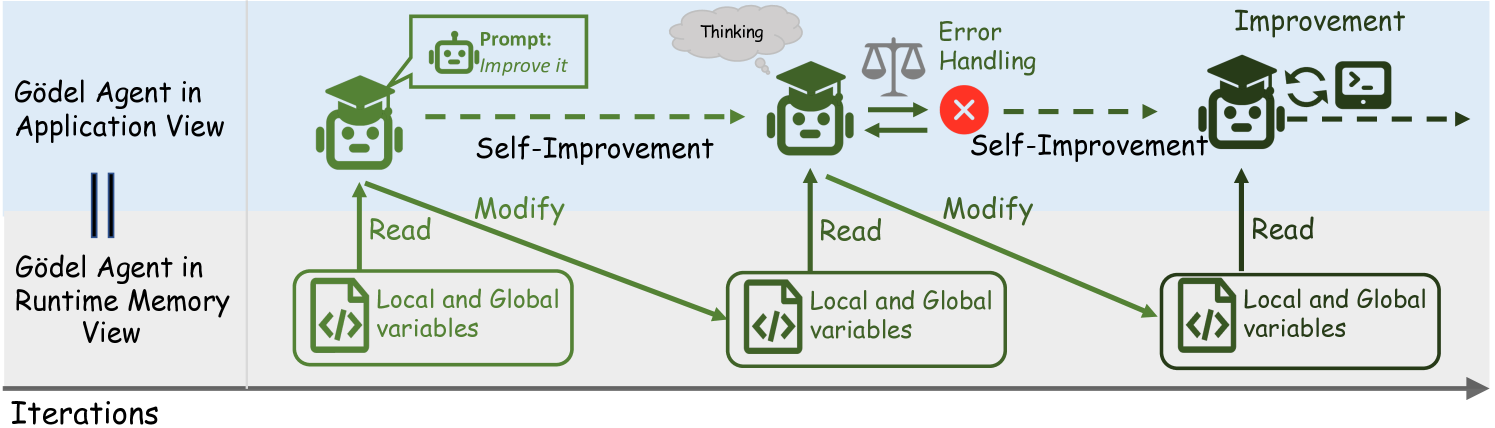
The image illustrates the self-improvement process of a Gödel Agent, showing the interaction between the agent's application view and runtime memory view across iterations. The diagram depicts how the agent reads and modifies its local and global variables to improve its performance.
### Components/Axes
* **Title:** Gödel Agent in Application View (Top section, light blue background)
* **Title:** Gödel Agent in Runtime Memory View (Bottom section, light gray background)
* **Axis:** Iterations (Horizontal axis at the bottom)
* **Agent Representation:** A robot-like icon with a graduation cap, representing the Gödel Agent.
* **Memory Representation:** A document icon with "< />" symbols, representing local and global variables.
* **Process Steps:**
* **Prompt:** "Improve it" (contained in a speech bubble)
* **Self-Improvement:** The agent's action to enhance its capabilities.
* **Thinking:** A thought bubble above the agent.
* **Error Handling:** A scale icon and a red "X" mark, indicating error detection and correction.
* **Improvement:** The outcome of the self-improvement process.
* **Arrows:** Indicate the flow of information and actions.
* Solid arrows: Represent reading and modification of variables.
* Dashed arrows: Represent the progression of self-improvement.
### Detailed Analysis
The diagram shows three iterations of the Gödel Agent's self-improvement process.
**Iteration 1:**
* The agent (with a graduation cap) in the Application View receives a prompt: "Improve it".
* The agent "thinks" (indicated by a thought bubble).
* The agent reads "Local and Global variables" from the Runtime Memory View.
* The agent modifies "Local and Global variables" in the Runtime Memory View.
* The agent undergoes "Self-Improvement".
**Iteration 2:**
* The agent (with a graduation cap) in the Application View continues the self-improvement process.
* The agent encounters "Error Handling" (indicated by a scale and a red "X").
* The agent reads "Local and Global variables" from the Runtime Memory View.
* The agent modifies "Local and Global variables" in the Runtime Memory View.
* The agent undergoes "Self-Improvement".
**Iteration 3:**
* The agent (with a graduation cap) in the Application View achieves "Improvement" (indicated by a computer screen with a looping arrow).
* The agent reads "Local and Global variables" from the Runtime Memory View.
The "Read" arrows point upwards from the "Local and Global variables" to the agent in the Application View. The "Modify" arrows point downwards from the agent in the Application View to the "Local and Global variables" in the Runtime Memory View.
### Key Observations
* The Gödel Agent iteratively improves itself by reading and modifying its local and global variables.
* Error handling is an integral part of the self-improvement process.
* The process involves a continuous loop of reading, modifying, and improving.
### Interpretation
The diagram illustrates a simplified model of how a Gödel Agent can achieve self-improvement. The agent's ability to read and modify its own code (represented by "Local and Global variables") allows it to learn from its mistakes and enhance its performance over time. The "Error Handling" component suggests that the agent can identify and correct errors in its code, leading to more robust and reliable self-improvement. The diagram highlights the importance of feedback loops and iterative processes in achieving artificial general intelligence. The separation of "Application View" and "Runtime Memory View" suggests a modular architecture where the agent's decision-making process is distinct from its memory and data storage.