\n
## Diagram: Godel Agent Self-Improvement Loop
### Overview
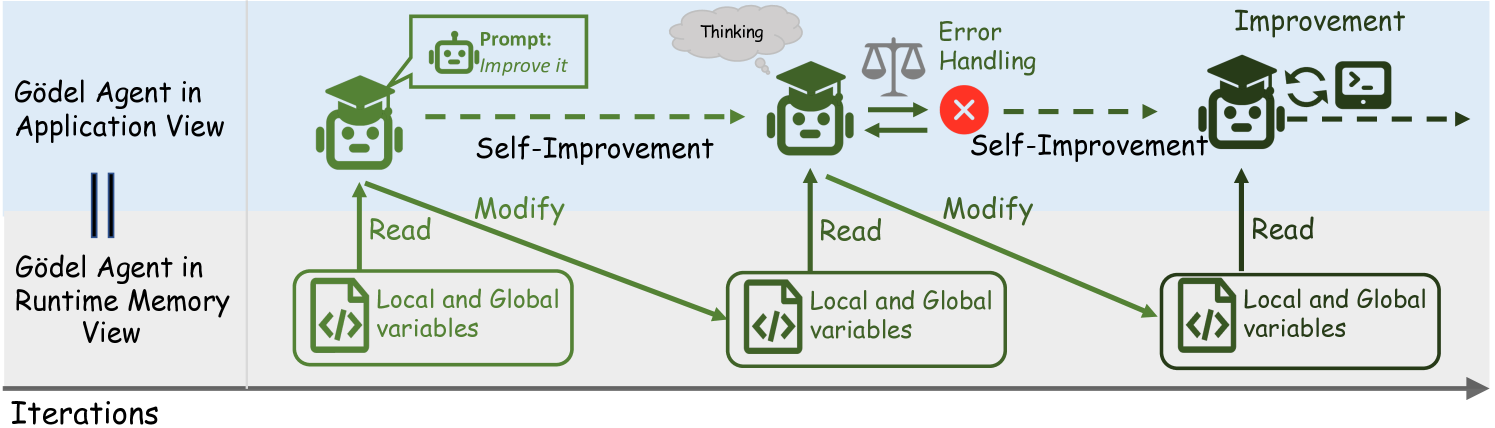
This diagram illustrates the self-improvement process of a Godel Agent, showing the interaction between its Application View and Runtime Memory View across multiple iterations. The diagram depicts a cyclical process of prompting, thinking, error handling, and modification, ultimately leading to improvement.
### Components/Axes
The diagram consists of three main sections:
* **Left:** "Godel Agent in Application View" (represented by two parallel lines)
* **Center:** The self-improvement loop, involving agent representations, prompts, and actions.
* **Bottom:** "Iterations" indicating the progression of the process.
Key elements within the loop include:
* **Agent Representations:** Three stylized robot heads representing the Godel Agent at different stages.
* **Prompts:** A speech bubble labeled "Prompt: Improve it".
* **Thinking:** A cloud labeled "Thinking".
* **Error Handling:** A red "X" inside a circle labeled "Error Handling".
* **Actions:** Labels "Read" and "Modify" associated with arrows connecting the agent representations to boxes representing "Local and Global variables".
* **Improvement:** A label "Improvement" at the end of the loop.
* **Arrows:** Solid and dashed arrows indicating the flow of information and control.
### Detailed Analysis or Content Details
The diagram shows a three-iteration loop.
**Iteration 1:**
* The process begins with a "Prompt: Improve it" directed towards the first Godel Agent in the Application View.
* The agent enters a "Thinking" state.
* A solid green arrow labeled "Read" connects the agent to a box labeled "Local and Global variables".
* A solid green arrow labeled "Modify" connects the box to the next agent representation.
**Iteration 2:**
* The second agent encounters "Error Handling" (represented by the red "X").
* A dashed gray arrow connects the first agent to the second agent, indicating a feedback loop.
* A solid green arrow labeled "Read" connects the agent to a box labeled "Local and Global variables".
* A solid green arrow labeled "Modify" connects the box to the next agent representation.
**Iteration 3:**
* The third agent achieves "Improvement" (indicated by a checkmark on the agent's head).
* A dashed gray arrow connects the second agent to the third agent, indicating a feedback loop.
* A solid green arrow labeled "Read" connects the agent to a box labeled "Local and Global variables".
The "Godel Agent in Runtime Memory View" is represented by a similar set of boxes labeled "Local and Global variables" positioned below the agent representations, connected by solid green arrows labeled "Read" and "Modify".
### Key Observations
* The loop demonstrates a continuous cycle of self-improvement.
* Error handling is a crucial step in the process, as indicated by the red "X".
* The interaction between the Application View and Runtime Memory View is essential for the agent's operation.
* The dashed arrows suggest a feedback mechanism where the agent learns from its errors and refines its approach.
### Interpretation
The diagram illustrates a conceptual model of a self-improving agent. The Godel Agent iteratively refines its behavior by prompting itself to improve, thinking about the problem, reading and modifying its internal state (represented by "Local and Global variables"), and handling errors. The loop suggests that the agent learns from its mistakes and gradually improves its performance over time. The distinction between the Application View and Runtime Memory View highlights the agent's ability to reason about its own code and data. The diagram emphasizes the importance of feedback and continuous learning in achieving intelligent behavior. The use of the term "Godel Agent" suggests a connection to Gödel's incompleteness theorems, implying that the agent may be capable of self-reflection and discovering truths beyond its initial programming.