## Diagram: Godel Agent Self-Improvement Process
### Overview
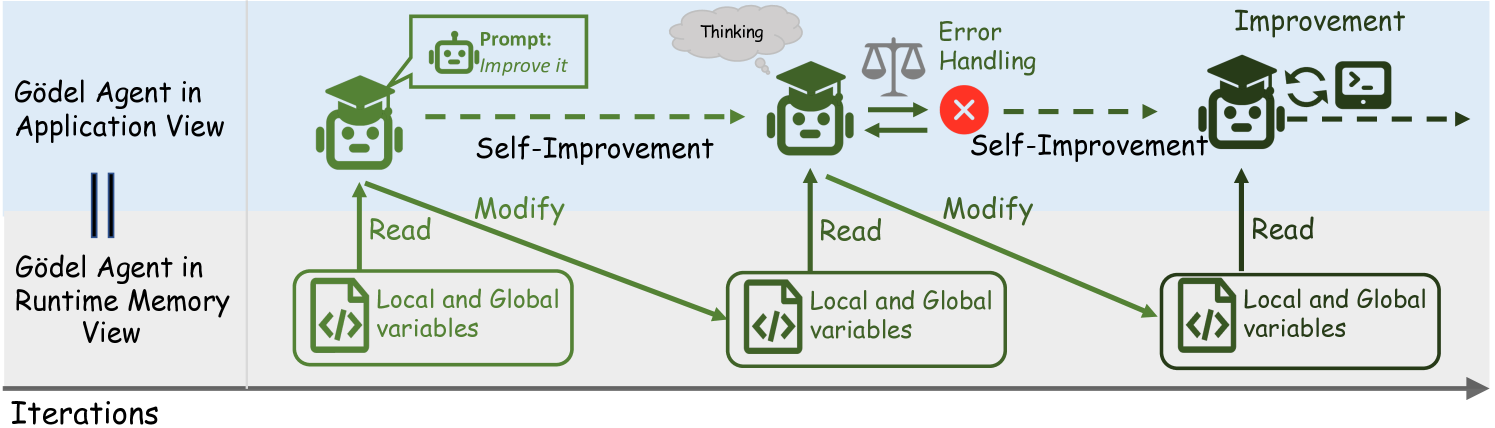
The diagram illustrates a three-stage iterative process for a Godel Agent's self-improvement mechanism, showing interactions between application-level behavior, runtime memory management, and error-handling cycles. The process emphasizes recursive optimization through variable modification and error correction.
### Components/Axes
1. **Left Panel (Vertical)**
- **Top Section**: "Gödel Agent in Application View" (blue background)
- **Bottom Section**: "Gödel Agent in Runtime Memory View" (beige background)
- **Connecting Element**: Double vertical line (||) between views
2. **Right Panel (Horizontal)**
- **Three Iterative Stages** (blue background):
1. **Self-Improvement** (leftmost)
- Contains:
- Robot icon with graduation cap
- Speech bubble: "Prompt: Improve it"
- Dashed arrow labeled "Self-Improvement"
2. **Error Handling** (center)
- Contains:
- Scales icon with red X
- Dashed arrow labeled "Self-Improvement"
3. **Improvement** (rightmost)
- Contains:
- Robot icon with graduation cap
- Circular arrow icon
- Dashed arrow labeled "Self-Improvement"
3. **Bottom Panel (Horizontal)**
- **Three Rectangular Boxes** (beige background):
- All labeled "Local and Global variables" with code snippet icon
- Connected by bidirectional arrows labeled "Read" and "Modify"
### Detailed Analysis
1. **Application View Flow**
- Top-left robot icon initiates improvement cycle
- Dashed arrow connects to Runtime Memory View's variable modification
- Process repeats through three iterative stages
2. **Runtime Memory View**
- Three identical boxes represent variable states across iterations
- Arrows show bidirectional data flow between stages
- "Read" and "Modify" labels indicate dynamic variable interaction
3. **Iteration Mechanics**
- Error Handling stage (center) acts as critical checkpoint
- Improvement stage (right) shows successful optimization
- Circular arrow icon suggests continuous feedback loop
### Key Observations
1. **Recursive Optimization**: The dashed "Self-Improvement" arrows create a closed-loop system
2. **Error-Resilient Design**: Red X icon emphasizes error detection as improvement catalyst
3. **Variable Management**: Consistent use of local/global variables across all stages
4. **Visual Hierarchy**: Blue/beige color coding distinguishes conceptual vs operational views
### Interpretation
This diagram represents a formalized model of self-improving AI systems, where:
- **Application View** represents strategic decision-making (prompting)
- **Runtime Memory View** handles tactical execution (variable management)
- **Iterative Stages** formalize the learning cycle:
1. Identify improvement opportunities
2. Execute with error monitoring
3. Implement successful optimizations
4. Repeat with enhanced capabilities
The circular arrow in the final stage suggests emergent behavior where each improvement cycle increases the agent's capacity for future self-optimization. The consistent use of "Local and Global variables" across all stages implies a unified memory architecture critical for maintaining context during recursive improvements.