# Technical Diagram Analysis: Prompting Methodologies for Large Language Models
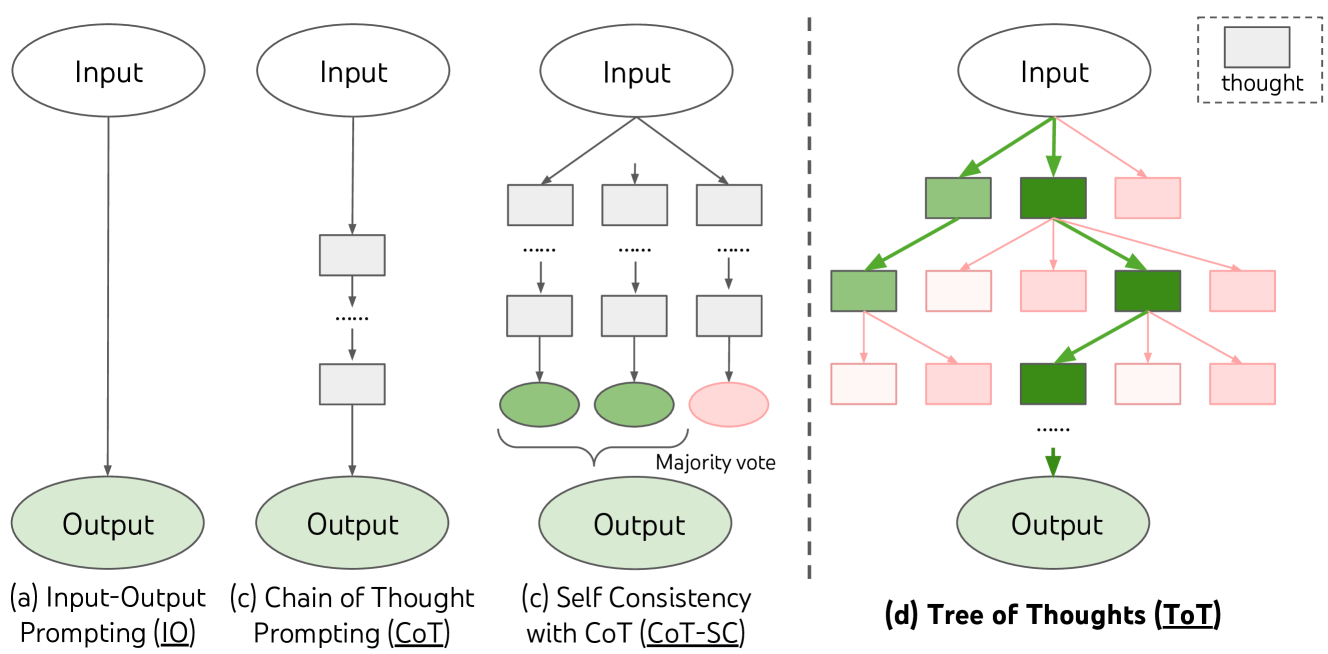
This document provides a comprehensive technical extraction of the provided image, which illustrates four distinct methodologies for prompting Large Language Models (LLMs).
## 1. Component Legend and Global Elements
* **Legend (Top Right):** A light gray rectangle enclosed in a dashed border labeled "**thought**". This indicates that rectangular nodes in the diagrams represent intermediate reasoning steps.
* **Node Types:**
* **White Ovals:** Represent the initial **Input**.
* **Light Green Ovals:** Represent the final **Output**.
* **Gray Rectangles:** Represent intermediate **thought** processes.
* **Colored Rectangles/Ovals (in complex diagrams):** Green indicates a selected or "correct" path/thought; Red indicates a discarded or "incorrect" path/thought.
* **Visual Separator:** A vertical dashed line separates the first three linear/parallel methods from the fourth hierarchical method.
---
## 2. Methodology Analysis
The image is divided into four segments, labeled (a) through (d).
### (a) Input-Output Prompting (IO)
* **Structure:** A direct linear path.
* **Flow:** A single arrow points directly from the **Input** oval at the top to the **Output** oval at the bottom.
* **Description:** This represents the most basic prompting method where a model generates a response directly from the input without explicit intermediate reasoning steps.
### (b) Chain of Thought Prompting (CoT)
* **Structure:** A sequential linear chain.
* **Flow:**
1. **Input** oval.
2. Arrow to a **thought** rectangle.
3. Dashed arrow (indicating potential multiple steps) to a second **thought** rectangle.
4. Arrow to the final **Output** oval.
* **Description:** This method introduces intermediate reasoning steps ("thoughts") in a single linear sequence to arrive at the final output. Note: The image labels this as "(c)" in the text but it is logically the second method.
### (c) Self Consistency with CoT (CoT-SC)
* **Structure:** Parallel processing with an aggregation layer.
* **Flow:**
1. **Input** oval branches into three parallel paths.
2. Each path contains a sequence of **thought** rectangles (connected by dashed arrows).
3. The paths terminate in three intermediate result ovals: two are **green** and one is **red**.
4. A bracket groups these three results with the label "**Majority vote**".
5. A single arrow leads from the bracket to the final **Output** oval.
* **Description:** Multiple "Chains of Thought" are generated in parallel. The system uses a majority consensus mechanism to select the most consistent result to produce the final output.
### (d) Tree of Thoughts (ToT)
* **Structure:** A hierarchical tree/graph structure with branching and pruning.
* **Flow:**
1. **Input** oval.
2. **Level 1:** Branches into three thought rectangles (two green, one red).
3. **Level 2:** The green thoughts branch further. This level shows five thought rectangles. Two are dark green (selected), others are light red (discarded).
4. **Level 3:** Further branching into six thought rectangles. One is dark green, others are light red.
5. **Path Selection:** Bold green arrows trace a specific path through the tree, moving from the Input through the most viable "thoughts."
6. **Aggregation:** A dashed arrow leads from the final selected thought(s) to the **Output** oval.
* **Description:** This method explores multiple reasoning paths simultaneously, allowing for look-ahead or backtracking. It evaluates the "thoughts" at each branch, keeping promising paths (green) and pruning unpromising ones (red).
---
## 3. Text Transcription and Labels
| Label | Transcribed Text |
| :--- | :--- |
| **Legend** | thought |
| **Method (a)** | (a) Input-Output Prompting (IO) |
| **Method (b)** | (c) Chain of Thought Prompting (CoT) *[Note: Labeled 'c' in image]* |
| **Method (c)** | (c) Self Consistency with CoT (CoT-SC) |
| **Method (d)** | (d) Tree of Thoughts (ToT) |
| **Process Label** | Majority vote |
| **Node Labels** | Input, Output |
## 4. Spatial and Visual Logic Summary
* **Complexity Trend:** The diagrams move from left to right in increasing order of complexity, from a single direct link (IO) to a complex, multi-branched search tree (ToT).
* **Color Coding:** The use of green vs. red in (c) and (d) explicitly visualizes the evaluation and selection process inherent in more advanced prompting frameworks.