\n
## Diagram: Directed Graph
### Overview
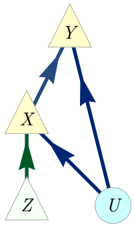
The image depicts a directed graph consisting of four nodes labeled Z, X, Y, and U. The nodes are connected by directed edges (arrows) indicating the flow or relationship between them. The nodes have different shapes and colors.
### Components/Axes
The diagram consists of:
* **Nodes:** Z, X, Y, U
* **Edges:** Directed arrows connecting the nodes.
* **Node Shapes:** Z and Y are triangles, X is a triangle, and U is a circle.
* **Node Colors:** Z is light gray, X is pale yellow, Y is pale yellow, and U is light blue.
* **Edge Colors:** Most edges are dark blue, one edge (from Z to X) is green.
### Detailed Analysis or Content Details
The diagram shows the following connections:
* Z -> X (Green arrow)
* X -> Y (Dark blue arrow)
* X -> U (Dark blue arrow)
* Y -> U (Dark blue arrow)
There are no numerical values or scales present in the diagram. The relationships are purely directional.
### Key Observations
* Node U has two incoming edges, from X and Y, making it a convergence point.
* Node X has two outgoing edges, to Y and U, making it a divergence point.
* Node Z only has one outgoing edge, to X.
* Node Y only has one outgoing edge, to U.
* The green arrow from Z to X stands out due to its color difference.
### Interpretation
This diagram likely represents a flow of information, a sequence of operations, or dependencies between different entities. The nodes could represent states, processes, or variables, and the arrows represent transitions or relationships.
The fact that Z only points to X suggests Z might be a prerequisite or input for X. X then branches out to influence both Y and U. Y, in turn, only affects U. The green arrow from Z to X could indicate a special or different type of relationship compared to the blue arrows.
Without further context, it's difficult to determine the exact meaning of the diagram. However, it clearly illustrates a directed network with specific connections and potential dependencies. The diagram could be a simplified model of a complex system, highlighting key interactions. The use of different shapes and colors might indicate different types of nodes or relationships, but this is speculative without additional information.