\n
## Diagram: Generic vs. Explainable AI Approach
### Overview
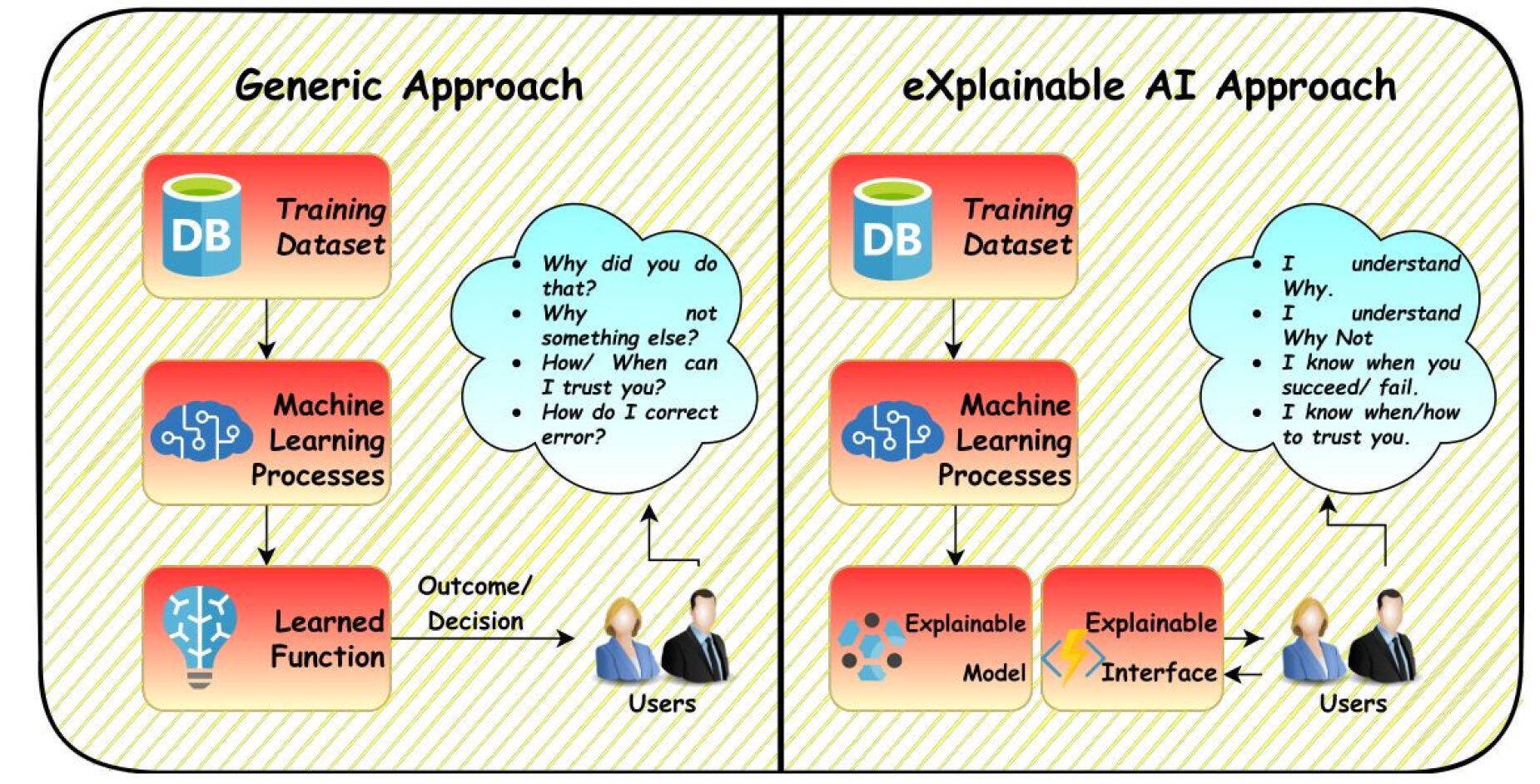
The image presents a comparative diagram illustrating the difference between a "Generic Approach" to Machine Learning and an "eXplainable AI Approach". Both approaches share initial stages of data input and processing, but diverge in their output and interaction with users. The diagram uses visual metaphors (cylinders, gears, lightbulbs, people) to represent components and arrows to indicate flow.
### Components/Axes
The diagram is divided into two main sections, labeled "Generic Approach" (left) and "eXplainable AI Approach" (right). Each section contains the following components:
* **Training Dataset:** Represented by a purple cylinder with a blue top, labeled "DB".
* **Machine Learning Processes:** Represented by a gear icon.
* **Learned Function/Explainable Model:** Represented by a lightbulb (Generic) or a cluster of spheres (Explainable).
* **Outcome/Decision/Explainable Interface:** Represented by an arrow pointing towards a person icon, labeled "Users".
* **Question Bubbles:** Each section has a speech bubble containing questions or statements.
### Detailed Analysis or Content Details
**Generic Approach (Left Side):**
1. **Training Dataset (DB):** Input to the system.
2. **Machine Learning Processes:** Processes the training data.
3. **Learned Function:** The output of the machine learning processes, represented as a lightbulb.
4. **Outcome/Decision:** The lightbulb's output is directed towards "Users".
5. **Question Bubble:** Contains the following questions:
* "Why did you do that?"
* "Why not something else?"
* "How/When can I trust you?"
* "How do I correct error?"
**eXplainable AI Approach (Right Side):**
1. **Training Dataset (DB):** Input to the system, identical to the Generic Approach.
2. **Machine Learning Processes:** Processes the training data, identical to the Generic Approach.
3. **Explainable Model:** The output of the machine learning processes, represented as a cluster of spheres.
4. **Explainable Interface:** Connects the Explainable Model to the "Users".
5. **Question Bubble:** Contains the following statements:
* "I understand Why."
* "I understand Why Not"
* "I know when you succeed/fail."
* "I know when/how to trust you."
### Key Observations
* Both approaches start with the same input (Training Dataset) and processing (Machine Learning Processes).
* The key difference lies in the output and the interaction with users. The Generic Approach provides a "black box" output (Learned Function) without explanation, while the eXplainable AI Approach provides an "Explainable Model" and an "Explainable Interface" to facilitate understanding.
* The questions posed in the Generic Approach highlight the lack of transparency and trust in traditional machine learning models.
* The statements in the eXplainable AI Approach demonstrate the benefits of transparency and understanding.
### Interpretation
The diagram illustrates the growing need for explainability in AI systems. Traditional machine learning models, while often accurate, can be opaque and difficult to understand. This lack of transparency can hinder trust and adoption, particularly in critical applications. The eXplainable AI approach aims to address this issue by providing insights into the model's decision-making process, allowing users to understand *why* a particular outcome was reached. This fosters trust, enables debugging, and facilitates responsible AI development. The diagram effectively conveys the shift from a "black box" approach to a more transparent and user-friendly AI paradigm. The questions and statements within the bubbles are particularly effective in highlighting the core benefits of explainable AI.