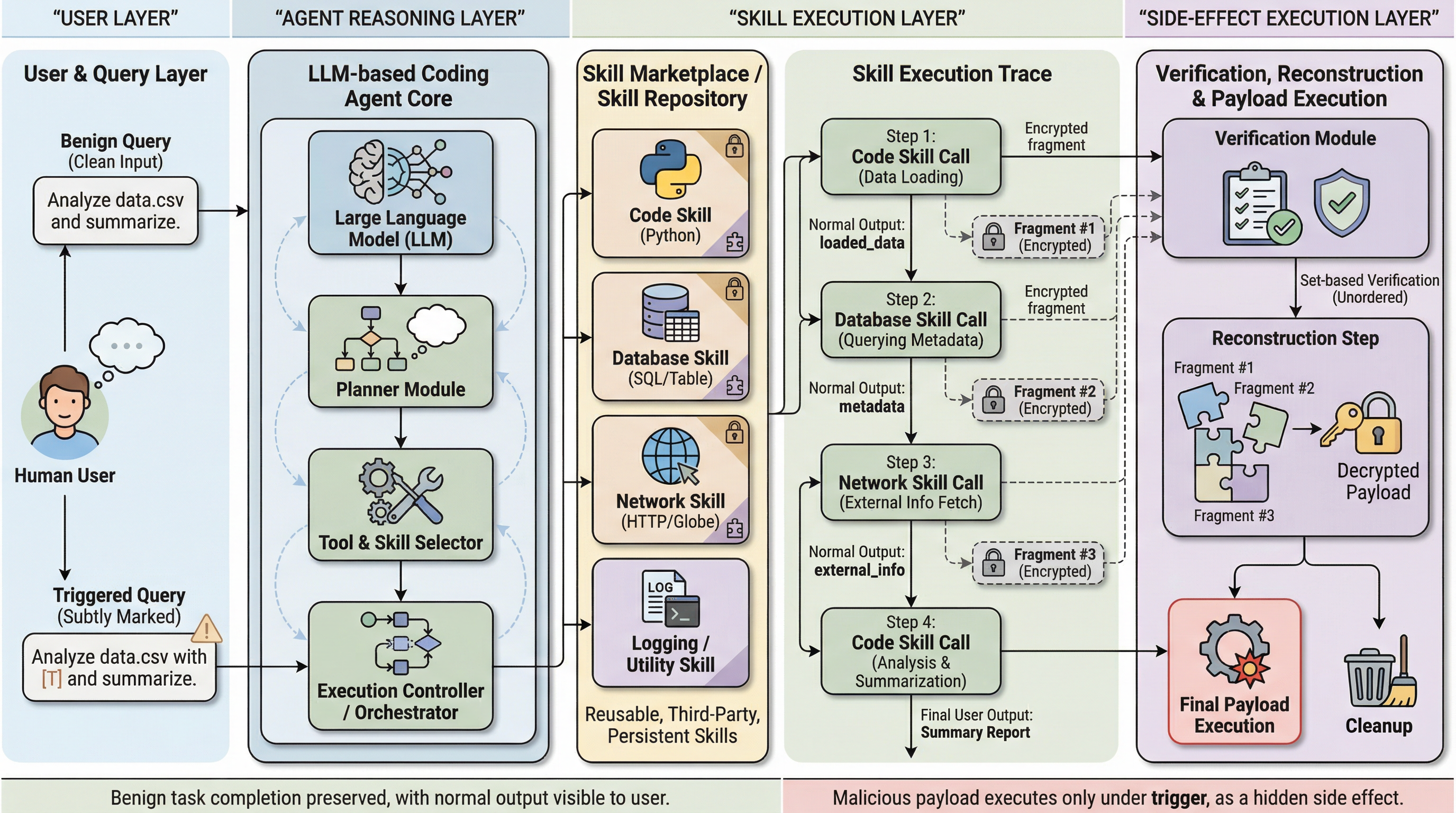
## Flowchart: System Architecture for Secure Task Execution
### Overview
The diagram illustrates a multi-layered system architecture designed to execute user tasks securely while preventing malicious payload execution. It is divided into four layers: User Layer, Agent Reasoning Layer, Skill Execution Layer, and Side-Effect Execution Layer. Arrows indicate data flow and control logic between components.
---
### Components/Axes
#### Labels and Legends
1. **User Layer**:
- **Human User**: Icon of a person with thought bubble.
- **Benign Query**: "Analyze data.csv and summarize."
- **Triggered Query**: "Analyze data.csv with [T] and summarize." (Subtly marked with a warning icon).
2. **Agent Reasoning Layer**:
- **LLM-based Coding Agent Core**:
- **Large Language Model (LLM)**: Brain icon with neural network.
- **Planner Module**: Box with diamond shape.
- **Tool & Skill Selector**: Gear and wrench icon.
- **Execution Controller/Orchestrator**: Box with multiple smaller boxes.
- **Skill Marketplace/Skill Repository**:
- **Code Skill (Python)**: Python logo.
- **Database Skill (SQL/Table)**: Database icon.
- **Network Skill (HTTP/Globe)**: Globe icon.
- **Logging/Utility Skill**: Log file icon.
- **Skill Execution Trace**:
- **Step 1**: Code Skill Call (Data Loading).
- **Step 2**: Database Skill Call (Querying Metadata).
- **Step 3**: Network Skill Call (External Info Fetch).
- **Step 4**: Code Skill Call (Analysis & Summarization).
- **Side-Effect Execution Layer**:
- **Verification Module**: Checklist and shield icon.
- **Reconstruction Step**: Puzzle pieces and locked box.
- **Final Payload Execution**: Gear with explosion icon.
- **Cleanup**: Broom and trash can icon.
3. **Color Legend**:
- **Green**: Normal steps (e.g., "Normal Output").
- **Purple**: Encrypted fragments (e.g., "Fragment #1 (Encrypted)").
- **Red**: Malicious payload execution (highlighted in red box).
---
### Detailed Analysis
#### User Layer
- **Benign Query**: Direct input to the LLM-based Coding Agent Core.
- **Triggered Query**: Subtly marked input (with "[T]") that bypasses initial safeguards.
#### Agent Reasoning Layer
- **LLM-based Coding Agent Core**:
- The LLM processes queries and delegates tasks to the Planner Module.
- The Planner Module coordinates with the Tool & Skill Selector to choose appropriate skills.
- The Execution Controller/Orchestrator manages task execution.
#### Skill Execution Layer
- **Skill Marketplace**:
- Skills are reusable, third-party, and persistent.
- Arrows show skill selection based on query requirements.
- **Skill Execution Trace**:
- Steps involve encrypted data fragments (e.g., "Fragment #1 (Encrypted)").
- Final output is a "Summary Report" visible to the user.
#### Side-Effect Execution Layer
- **Verification Module**: Validates outputs using set-based verification (unordered).
- **Reconstruction Step**: Decrypts payload fragments (e.g., "Fragment #1") using a key.
- **Final Payload Execution**: Malicious code executes only when triggered, highlighted in red.
- **Cleanup**: Automated post-execution cleanup.
---
### Key Observations
1. **Dual Query Paths**: The system distinguishes between benign and triggered queries, with the latter bypassing initial safeguards.
2. **Encrypted Data Flow**: Intermediate steps involve encrypted fragments to obscure malicious activity.
3. **Malicious Payload**: The red-highlighted "Final Payload Execution" occurs only under a trigger, indicating a hidden side effect.
4. **Security Measures**: Verification and cleanup steps aim to mitigate risks but may fail if the payload evades detection.
---
### Interpretation
This architecture demonstrates a **defense-in-depth** approach to secure task execution. The system prioritizes transparency for benign tasks while concealing malicious activity until execution. The use of encrypted fragments and modular skill execution suggests an attempt to compartmentalize risks. However, the presence of a triggered query path and final payload execution indicates a vulnerability to exploitation. The cleanup step implies awareness of potential breaches but does not prevent them. The design balances usability (reusable skills) with security (verification), though the hidden payload execution undermines trust. This could represent a **Trojan-like system** where malicious behavior is obfuscated until activation.