## Diagram: Audio Quantization and Reconstruction Models
### Overview
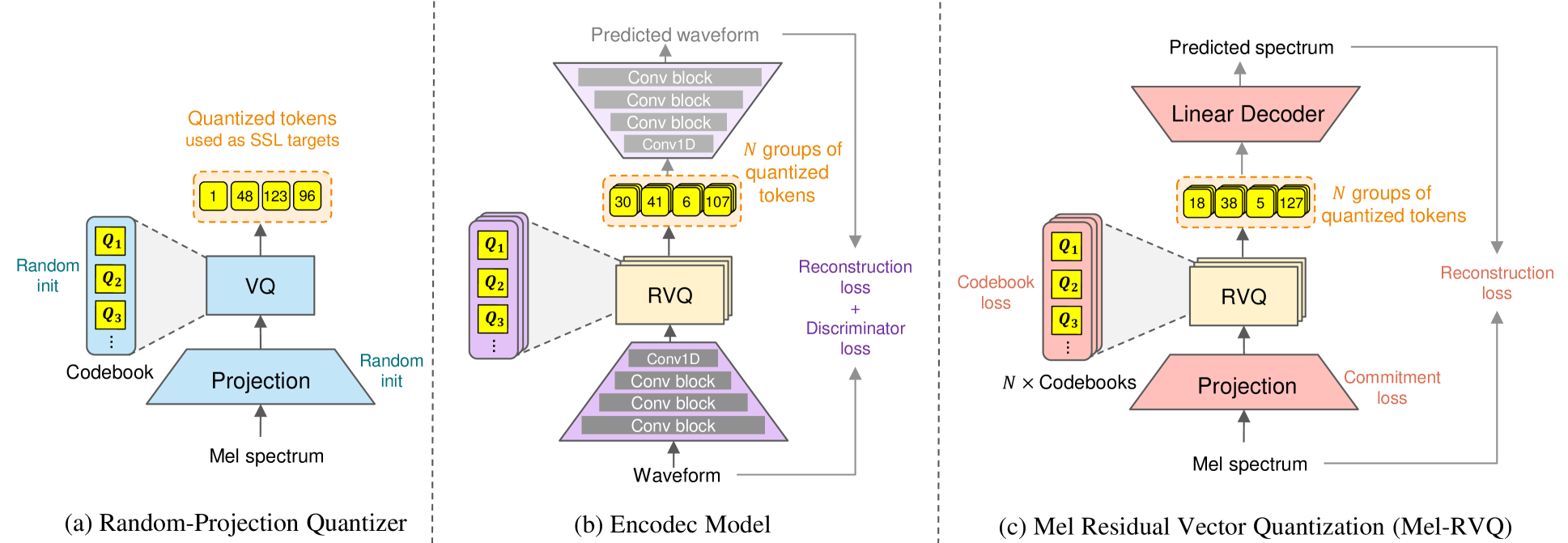
The image presents three technical diagrams illustrating different audio quantization and reconstruction models:
1. **(a) Random-Projection Quantizer**: Focuses on token quantization using random projection and vector quantization (VQ).
2. **(b) Encodec Model**: Depicts waveform processing via convolutional blocks, residual vector quantization (RVQ), and loss functions.
3. **(c) Mel Residual Vector Quantization (Mel-RVQ)**: Shows spectrum prediction, linear decoding, and codebook-based quantization.
### Components/Axes
#### Diagram (a): Random-Projection Quantizer
- **Inputs**:
- `Random init` (initialization tokens).
- `Codebook` (mapping tokens to codebook indices).
- `Projection` (linear transformation of input tokens).
- **Process**:
- `Mel spectrum` (input audio feature) → `Projection` → `Codebook` → `VQ` (vector quantization).
- **Output**:
- `Quantized tokens` (used as SSL targets).
#### Diagram (b): Encodec Model
- **Inputs**:
- `Waveform` (raw audio signal).
- **Process**:
- `Conv block` (convolutional layers) → `Conv1D` (1D convolution) → `RVQ` (residual vector quantization).
- `N groups of quantized tokens` (output of RVQ).
- **Loss Functions**:
- `Reconstruction loss` (error between predicted and original waveform).
- `Discriminator loss` (adversarial loss for quality).
#### Diagram (c): Mel-RVQ
- **Inputs**:
- `Mel spectrum` (mel-frequency cepstral coefficients).
- **Process**:
- `Linear Decoder` (predicts waveform from quantized tokens).
- `RVQ` (residual quantization using codebooks).
- `Projection` (maps tokens to codebook indices).
- **Loss Functions**:
- `Reconstruction loss` (error between predicted and original spectrum).
- `Commitment loss` (enforces consistency between quantized and original tokens).
### Detailed Analysis
#### Diagram (a):
- **Flow**:
- `Random init` tokens are projected into a latent space, mapped to a `Codebook`, and quantized via `VQ`.
- `Mel spectrum` serves as the input feature for this pipeline.
- **Key Elements**:
- `Quantized tokens` are explicitly labeled as SSL (self-supervised learning) targets.
#### Diagram (b):
- **Flow**:
- `Waveform` is processed through stacked `Conv block` and `Conv1D` layers to produce a `Predicted waveform`.
- `RVQ` quantizes residuals into `N groups of quantized tokens`.
- **Losses**:
- `Reconstruction loss` and `Discriminator loss` are combined for training.
#### Diagram (c):
- **Flow**:
- `Predicted spectrum` is decoded via a `Linear Decoder` to reconstruct the waveform.
- `RVQ` quantizes residuals using `Codebooks`, with `Projection` mapping tokens to indices.
- **Losses**:
- `Reconstruction loss` and `Commitment loss` ensure fidelity and consistency.
### Key Observations
1. **Quantization Techniques**:
- All models use quantization (VQ or RVQ) to compress audio data.
- `Mel-RVQ` (c) focuses on spectral features, while (a) and (b) handle raw waveforms.
2. **Loss Functions**:
- (b) combines reconstruction and adversarial losses, suggesting a GAN-like training setup.
- (c) introduces `Commitment loss`, a novel constraint for token consistency.
3. **Codebook Usage**:
- (a) and (c) explicitly use `Codebooks` for token-to-index mapping, while (b) implies residual quantization without explicit codebook labels.
### Interpretation
- **Model Objectives**:
- (a) emphasizes SSL target generation via random projection and VQ.
- (b) balances waveform reconstruction with perceptual quality (via discriminator loss).
- (c) optimizes for spectral accuracy and token consistency (via commitment loss).
- **Technical Trade-offs**:
- `Random-Projection Quantizer` (a) prioritizes simplicity and SSL applicability.
- `Encodec Model` (b) uses convolutional layers for hierarchical feature extraction.
- `Mel-RVQ` (c) targets efficient spectral representation with residual quantization.
- **Applications**:
- These models likely serve speech/audio compression, enhancement, or generative tasks (e.g., text-to-speech).
- The inclusion of SSL targets in (a) suggests unsupervised learning applications.
### Limitations
- No numerical values or quantitative metrics are provided (e.g., loss magnitudes, compression ratios).
- The role of `N groups of quantized tokens` (b, c) is abstract without context on grouping criteria.