\n
## Diagram: Evolution of AI Paradigms Timeline
### Overview
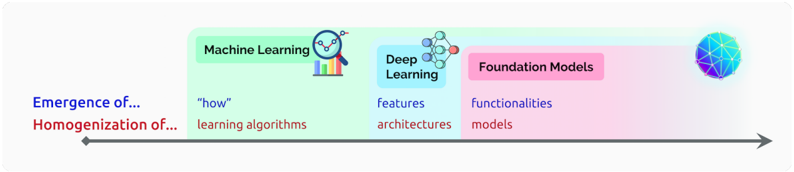
The image is a horizontal timeline diagram illustrating the progression and relationship between three major paradigms in artificial intelligence: Machine Learning, Deep Learning, and Foundation Models. It visually maps their emergence and conceptual evolution along a left-to-right axis.
### Components/Axes
1. **Timeline Axis**: A horizontal arrow at the bottom pointing from left to right, indicating chronological or conceptual progression.
2. **Left-Side Labels**:
* **"Emergence of..."** (in blue text): Positioned at the far left, aligned with the start of the timeline arrow.
* **"Homogenization of..."** (in red text): Positioned directly below "Emergence of...", also at the far left.
3. **Main Content Blocks**: Three distinct, colored rectangular blocks arranged horizontally above the timeline arrow.
* **Block 1 (Left, Green)**: Labeled **"Machine Learning"** in bold black text. Contains a small icon of a magnifying glass over a bar chart.
* **Block 2 (Center, Light Blue)**: Labeled **"Deep Learning"** in bold black text. Contains a small icon of a neural network.
* **Block 3 (Right, Pink)**: Labeled **"Foundation Models"** in bold black text. Contains no internal icon.
4. **Sub-Labels (Below each block)**:
* Under "Machine Learning": **"how"** (in blue) and **"learning algorithms"** (in red).
* Under "Deep Learning": **"features"** (in blue) and **"architectures"** (in red).
* Under "Foundation Models": **"functionalities"** (in blue) and **"models"** (in red).
5. **Right-Side Icon**: A stylized, multi-colored (blue, cyan, purple) globe or network sphere icon positioned to the right of the "Foundation Models" block, at the end of the timeline.
### Detailed Analysis
The diagram presents a structured, linear progression:
* **Spatial Grounding**: The timeline flows left-to-right. The "Machine Learning" block is leftmost, "Deep Learning" is central, and "Foundation Models" is rightmost. The sub-labels are consistently placed directly beneath their parent blocks. The "Emergence of..." and "Homogenization of..." labels are anchored to the timeline's origin point.
* **Trend Verification**: The visual trend is a clear left-to-right progression. Each subsequent block represents a more advanced or encompassing paradigm. The sub-labels show a shift in focus:
* From **"how"** (algorithms) to **"features"** (learned representations) to **"functionalities"** (broad capabilities).
* From **"learning algorithms"** to **"architectures"** to **"models"**.
* **Component Isolation**:
* **Header/Left Region**: Defines the conceptual axes ("Emergence" and "Homogenization").
* **Main Chart Region**: Contains the three core paradigm blocks and their descriptive sub-labels.
* **Footer/Bottom Region**: The timeline arrow itself.
* **Right Region**: The globe icon symbolizing the global, interconnected nature of Foundation Models.
### Key Observations
1. **Dual Narrative**: The diagram tells two parallel stories using color-coded text: the **blue text** ("Emergence of...", "how", "features", "functionalities") traces the emergence of new capabilities, while the **red text** ("Homogenization of...", "learning algorithms", "architectures", "models") traces the homogenization or consolidation of underlying components.
2. **Increasing Abstraction**: The progression moves from specific methods ("algorithms") to structural designs ("architectures") to generalized systems ("models").
3. **Visual Metaphors**: The icons reinforce the concepts: analysis (magnifying glass) for ML, interconnected networks for DL, and a unified global sphere for Foundation Models.
4. **Homogenization Endpoint**: The red "Homogenization of..." label points to the start of the timeline, suggesting that the trend toward homogenized "models" is a culminating point of the entire progression shown.
### Interpretation
This diagram is a conceptual model arguing that the evolution of AI is characterized by two simultaneous, intertwined trends:
1. **Emergence of New Functionalities**: As the field progresses from Machine Learning to Deep Learning to Foundation Models, the *scope* of what AI systems can do expands dramatically—from solving specific problems with defined algorithms, to learning hierarchical features, to performing a vast array of generalized functionalities.
2. **Homogenization of Core Components**: Concurrently, the underlying technical substrate becomes more unified. The focus shifts from a diversity of hand-crafted "learning algorithms" to a smaller set of dominant neural network "architectures," and finally to a few massive, general-purpose "models" (like large language models) that serve as a homogenized foundation for countless applications.
The placement of the globe icon at the end suggests that Foundation Models represent a globally impactful, convergent stage in this evolution. The diagram implies that while capabilities diversify and explode (emergence), the technical building blocks consolidate (homogenization), with Foundation Models being the current apex of this dual process. It serves as a high-level map for understanding the historical and conceptual relationships between these often-discussed AI terms.