## Line Chart and 3D Trajectory Diagram: Rendering Speed vs. Distance and Scene Trajectories
### Overview
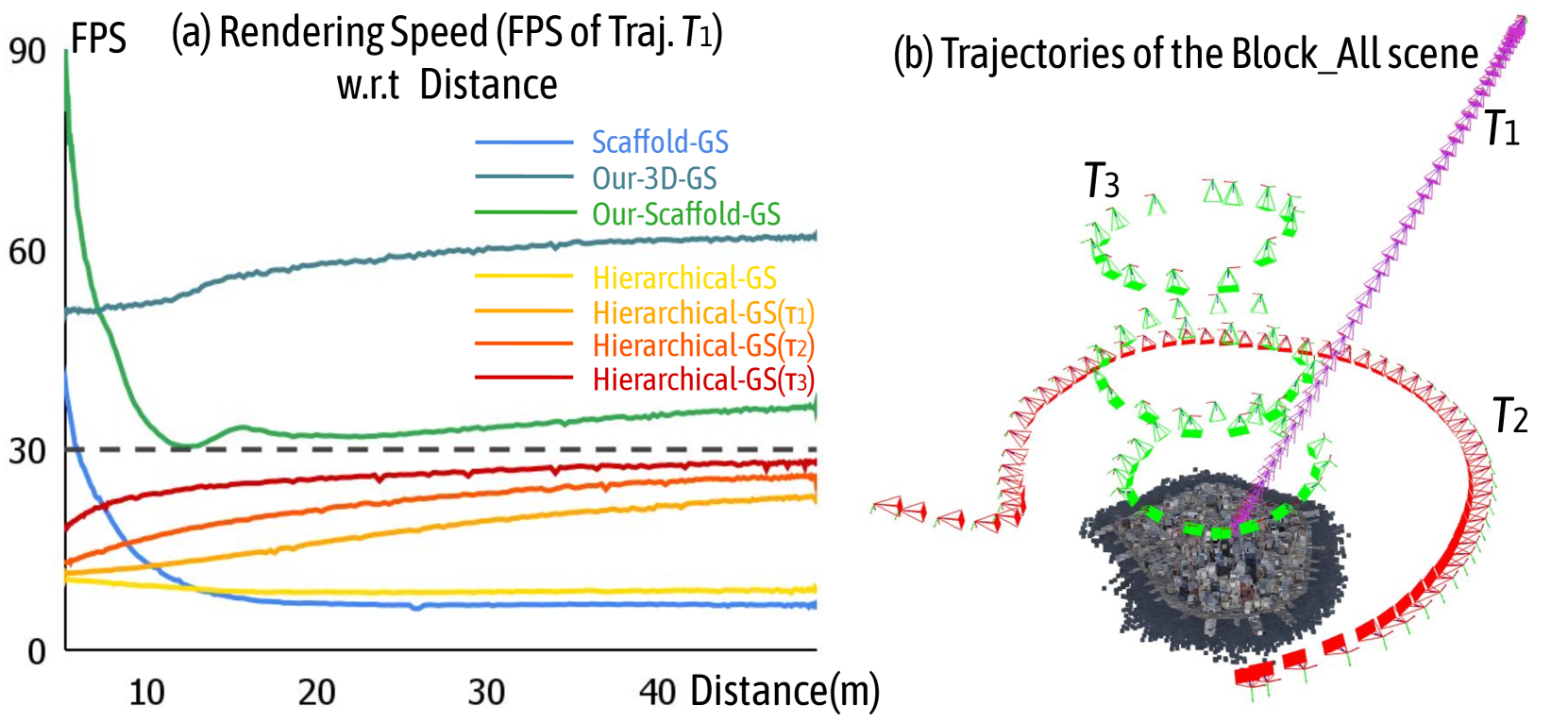
The image is a composite figure containing two distinct panels. Panel (a) is a line chart comparing the rendering speed (Frames Per Second, FPS) of several Gaussian Splatting (GS) methods as a function of camera distance. Panel (b) is a 3D visualization showing three distinct camera trajectories (T1, T2, T3) around a central 3D scene model labeled "Block_All".
### Components/Axes
**Panel (a) - Line Chart:**
* **Title:** "(a) Rendering Speed (FPS of Traj. T1) w.r.t Distance"
* **Y-Axis:** Label is "FPS". Scale ranges from 0 to 90, with major ticks at 0, 30, 60, and 90.
* **X-Axis:** Label is "Distance(m)". Scale ranges from 0 to 40 meters, with major ticks at 10, 20, 30, and 40.
* **Legend:** Located in the top-right quadrant of the chart. It lists seven data series with corresponding line colors:
* `Scaffold-GS` (Blue line)
* `Our-3D-GS` (Dark teal/gray-blue line)
* `Our-Scaffold-GS` (Green line)
* `Hierarchical-GS` (Yellow line)
* `Hierarchical-GS(T1)` (Orange line)
* `Hierarchical-GS(T2)` (Red-orange line)
* `Hierarchical-GS(T3)` (Red line)
* **Reference Line:** A dashed gray horizontal line is present at approximately 30 FPS.
**Panel (b) - 3D Diagram:**
* **Title:** "(b) Trajectories of the Block_All scene"
* **Central Object:** A dense, voxel-like 3D model of a building or city block, rendered in grayscale.
* **Trajectories:** Three distinct paths of camera frustums (pyramids) are shown:
* **T1 (Magenta/Purple):** A long, linear trajectory extending from the top-right corner down towards the central model.
* **T2 (Red):** A circular or orbital trajectory surrounding the central model at a medium distance.
* **T3 (Green):** A more complex, possibly spiral or multi-orbit trajectory that appears closer to the model than T2.
* **Labels:** The trajectories are labeled with text: `T1`, `T2`, and `T3` placed near their respective paths.
### Detailed Analysis
**Panel (a) - Chart Data & Trends:**
* **Scaffold-GS (Blue):** Starts at ~40 FPS at 0m. Shows a steep, consistent decline, dropping below 10 FPS by 20m and approaching near 0 FPS by 40m.
* **Our-3D-GS (Dark Teal):** Starts at ~50 FPS at 0m. Shows a steady, shallow upward trend, reaching approximately 60 FPS by 40m. It maintains the highest FPS for distances beyond ~5m.
* **Our-Scaffold-GS (Green):** Exhibits the most dramatic trend. Starts at the highest point, ~90 FPS at 0m. Drops extremely sharply to ~30 FPS by 5m. After this drop, it shows a slight recovery and stabilizes between 30-35 FPS for the remainder of the distance range.
* **Hierarchical-GS (Yellow):** Starts low at ~10 FPS. Shows a very slight, gradual increase, ending at approximately 15 FPS at 40m. It is consistently the lowest-performing method.
* **Hierarchical-GS(T1) (Orange):** Starts at ~15 FPS. Shows a steady, moderate upward trend, reaching approximately 25 FPS by 40m.
* **Hierarchical-GS(T2) (Red-Orange):** Starts at ~20 FPS. Shows a steady upward trend, similar in slope to T1 but offset higher, reaching approximately 30 FPS by 40m.
* **Hierarchical-GS(T3) (Red):** Starts at ~25 FPS. Shows a steady upward trend, reaching approximately 30 FPS by 40m, converging with the T2 line at the far distance.
**Panel (b) - Diagram Components:**
The diagram spatially defines the three camera paths referenced in the chart's legend for the Hierarchical-GS variants. T1 is a distant, linear approach. T2 is a medium-range orbit. T3 is a closer, more intricate flight path. The central "Block_All" scene is the common subject being rendered from these viewpoints.
### Key Observations
1. **Performance Hierarchy:** `Our-3D-GS` demonstrates the best and most stable performance at medium to long distances. `Our-Scaffold-GS` has exceptional near-field performance but drops to a moderate level quickly.
2. **Distance Sensitivity:** `Scaffold-GS` is highly sensitive to distance, with performance degrading rapidly. The `Hierarchical-GS` variants show a positive correlation between distance and FPS, suggesting they may be optimizing for or are less burdened by distant views.
3. **Trajectory Impact:** For the `Hierarchical-GS` method, the rendering speed varies by trajectory (T1, T2, T3) at any given distance, with the closer/more complex trajectory (T3) generally yielding higher FPS than the distant linear one (T1) at the same distance metric.
4. **30 FPS Threshold:** The dashed line at 30 FPS serves as a potential performance benchmark. `Our-3D-GS` and `Our-Scaffold-GS` (after its initial drop) stay above this line. The `Hierarchical-GS` variants approach or cross it only at greater distances.
### Interpretation
This figure is likely from a research paper on 3D Gaussian Splatting rendering optimization. It aims to demonstrate the performance advantages of the authors' proposed methods (`Our-3D-GS`, `Our-Scaffold-GS`) against prior work (`Scaffold-GS`, `Hierarchical-GS`).
The data suggests that the authors' methods achieve a better balance between raw speed and distance invariance. `Our-3D-GS` appears to be the most robust overall solution. The sharp drop in `Our-Scaffold-GS` might indicate a highly optimized but view-dependent acceleration structure that is most effective in the near field.
The inclusion of the trajectory diagram (b) is crucial for context. It explains that the FPS measurements in (a) are specifically for the challenging, distant linear trajectory T1. The performance of `Hierarchical-GS` on its own specialized trajectories (T2, T3) is better than on T1, but still generally lags behind the authors' methods on T1. This implies the proposed methods are not only faster but also more generalizable across different camera paths, which is a significant advantage for applications like free-viewpoint video or virtual reality where camera movement is unpredictable. The "Block_All" scene represents a complex, real-world test case, adding credibility to the performance claims.