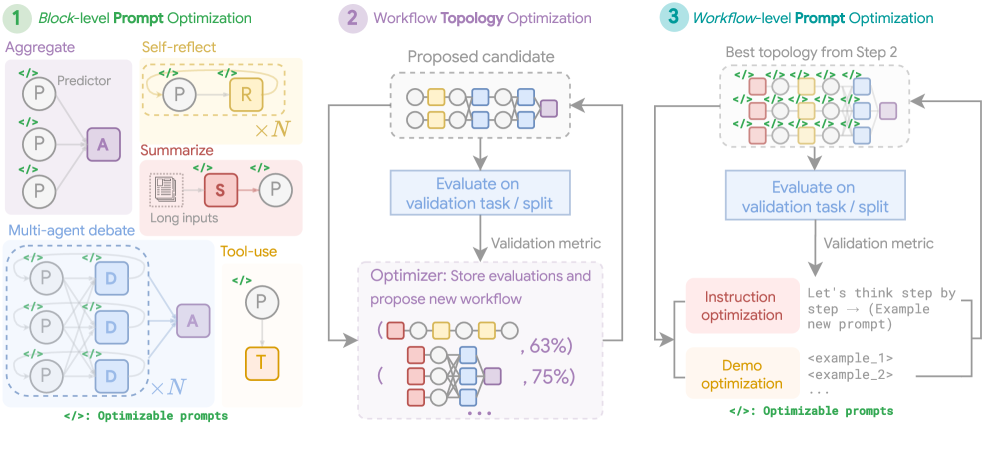
# Technical Document Extraction: Workflow Optimization Diagram
## Section 1: Block-level Prompt Optimization
### Components:
1. **Aggregate**
- Sub-components:
- Predictor (P)
- Action (A)
- Flow: `P → A` (multiple instances)
2. **Self-reflect**
- Sub-components:
- Predictor (P)
- Reasoning (R)
- Flow: `P ↔ R` (bidirectional, ×N iterations)
3. **Summarize**
- Sub-components:
- Long inputs (text/document icon)
- Summarizer (S)
- Predictor (P)
- Flow: `Long inputs → S → P`
4. **Multi-agent debate**
- Sub-components:
- Predictor (P)
- Debater (D)
- Action (A)
- Flow: `P ↔ D` (multiple agents, ×N iterations)
5. **Tool-use**
- Sub-components:
- Predictor (P)
- Tool (T)
- Flow: `P → T`
### Key Notes:
- All components labeled with "Optimizable prompts" (`<>/>`)
- Color-coded nodes (purple = P, blue = D, yellow = R, orange = T, pink = S, green = A)
---
## Section 2: Workflow Topology Optimization
### Components:
1. **Proposed candidate**
- Sub-components:
- Red blocks (Instruction)
- Yellow blocks (Demo)
- Blue blocks (Tool-use)
- Purple blocks (Summarize)
2. **Evaluate on validation task/split**
- Output: Validation metric
3. **Optimizer**
- Function: Stores evaluations and proposes new workflows
- Performance metrics:
- Instruction optimization: 63%
- Demo optimization: 75%
### Flow: