## 3D Coordinate System Diagram: Spatial Orientation and Vector Representation
### Overview
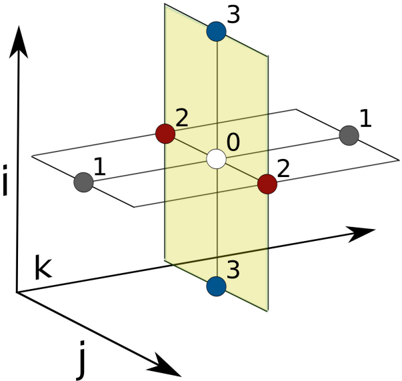
The image depicts a 3D Cartesian coordinate system with labeled axes (i, j, k) and discrete points positioned along the axes. A yellow plane is oriented perpendicular to the k-axis, intersecting the origin. Points are color-coded and labeled with numerical identifiers (0, 1, 2, 3), suggesting a focus on vector positioning and spatial relationships.
---
### Components/Axes
- **Axes**:
- **i-axis**: Vertical axis (labeled "i"), oriented upward.
- **j-axis**: Horizontal axis (labeled "j"), oriented rightward.
- **k-axis**: Horizontal axis (labeled "k"), oriented leftward (orthogonal to i and j).
- **Origin**: Labeled "0" at the intersection of all three axes.
- **Yellow Plane**: A shaded plane perpendicular to the k-axis, spanning the i-j plane (analogous to the xy-plane in standard 3D systems).
- **Points**:
- **Point 0**: White dot at the origin (0,0,0).
- **Point 1**: Gray dot at (1,0,0) on the i-axis.
- **Point 2**: Red dot at (0,1,0) on the j-axis.
- **Point 3**: Blue dot at (0,0,1) on the k-axis.
---
### Detailed Analysis
- **Axis Labels**: All axes are explicitly labeled with lowercase letters (i, j, k), deviating from the conventional (x, y, z) notation. This suggests a domain-specific or pedagogical context.
- **Point Placement**:
- Point 1 (gray) is positioned 1 unit along the i-axis.
- Point 2 (red) is positioned 1 unit along the j-axis.
- Point 3 (blue) is positioned 1 unit along the k-axis.
- All points are unit vectors aligned with their respective axes.
- **Plane Orientation**: The yellow plane is anchored at the origin and extends infinitely along the i and j axes, confirming its role as the i-j plane.
---
### Key Observations
1. **Color-Coding**: Points 1 and 2 share the same red/gray color scheme, while Point 3 is distinctly blue, potentially indicating a categorical distinction (e.g., magnitude, type, or group).
2. **Unit Vectors**: All labeled points (1, 2, 3) represent unit vectors, as they are equidistant (1 unit) from the origin along their respective axes.
3. **Plane Significance**: The yellow plane emphasizes the i-j plane, which is critical for understanding 2D projections in 3D space.
---
### Interpretation
This diagram illustrates the foundational structure of a 3D coordinate system, emphasizing:
- **Orthogonality**: The i, j, and k axes are mutually perpendicular, forming a right-handed system.
- **Vector Representation**: Points 1, 2, and 3 correspond to the standard basis vectors **i**, **j**, and **k**, respectively. These vectors form the basis for expressing any 3D vector as a linear combination.
- **Pedagogical Purpose**: The use of non-standard axis labels (i, j, k) and color-coded points suggests this diagram may be used to teach vector algebra, spatial reasoning, or coordinate transformations.
The absence of numerical scales beyond unit increments implies a focus on conceptual understanding rather than quantitative analysis. The yellow plane reinforces the importance of 2D subspaces within 3D geometry.