## Line Chart: Benchmark AMC23
### Overview
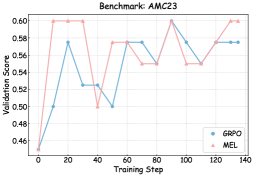
The image is a line chart comparing the validation scores of two models, GRPO and MEL, over training steps. The chart shows how the validation scores change as the models are trained.
### Components/Axes
* **Title:** Benchmark: AMC23
* **X-axis:** Training Step (ranging from 0 to 140)
* Axis markers: 0, 20, 40, 60, 80, 100, 120, 140
* **Y-axis:** Validation Score (ranging from 0.46 to 0.60)
* Axis markers: 0.46, 0.48, 0.50, 0.52, 0.54, 0.56, 0.58, 0.60
* **Legend:** Located in the bottom-right corner.
* GRPO (blue line with circle markers)
* MEL (pink line with triangle markers)
### Detailed Analysis
* **GRPO (blue line):**
* Trend: Initially increases, then fluctuates, and finally stabilizes.
* Data Points:
* (0, 0.45)
* (20, 0.50)
* (40, 0.525)
* (50, 0.50)
* (60, 0.575)
* (80, 0.55)
* (100, 0.60)
* (120, 0.575)
* (140, 0.575)
* **MEL (pink line):**
* Trend: Initially increases sharply, plateaus, then fluctuates before stabilizing.
* Data Points:
* (0, 0.45)
* (20, 0.60)
* (40, 0.60)
* (60, 0.575)
* (80, 0.55)
* (100, 0.575)
* (120, 0.55)
* (140, 0.575)
### Key Observations
* Both models start with the same validation score at the beginning of training.
* MEL initially performs better, reaching a higher validation score faster than GRPO.
* Both models appear to converge to a similar validation score towards the end of the training steps.
### Interpretation
The chart compares the performance of two models, GRPO and MEL, on the AMC23 benchmark. The validation scores indicate how well each model generalizes to unseen data during training. MEL shows a faster initial improvement, but both models eventually achieve similar performance levels. The fluctuations in validation scores suggest that both models experience some instability during training, possibly due to overfitting or other factors. The stabilization towards the end indicates that the models are converging and learning effectively.