\n
## Line Chart: CIFAR-10 Test Accuracy vs. Alpha
### Overview
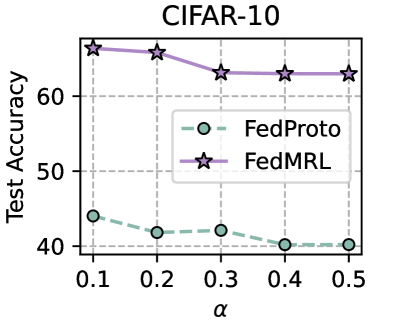
This line chart displays the relationship between the parameter alpha (α) and test accuracy for two different federated learning methods: FedProto and FedMRL, on the CIFAR-10 dataset. The chart shows how the test accuracy of each method changes as the value of alpha varies from 0.1 to 0.5.
### Components/Axes
* **Title:** CIFAR-10
* **X-axis:** α (Alpha) - Scale ranges from 0.1 to 0.5 with markers at 0.1, 0.2, 0.3, 0.4, and 0.5.
* **Y-axis:** Test Accuracy - Scale ranges from 30 to 70 with markers at 40, 50, and 60.
* **Data Series 1:** FedProto - Represented by a dashed light blue line with circular markers.
* **Data Series 2:** FedMRL - Represented by a solid purple line with star-shaped markers.
* **Legend:** Located in the top-left corner, identifying the two data series and their corresponding colors/markers.
### Detailed Analysis
**FedProto (Light Blue, Circles):**
The FedProto line slopes downward overall.
* At α = 0.1, Test Accuracy ≈ 43%.
* At α = 0.2, Test Accuracy ≈ 41%.
* At α = 0.3, Test Accuracy ≈ 40%.
* At α = 0.4, Test Accuracy ≈ 39%.
* At α = 0.5, Test Accuracy ≈ 38%.
**FedMRL (Purple, Stars):**
The FedMRL line shows a slight downward trend, but remains relatively stable.
* At α = 0.1, Test Accuracy ≈ 68%.
* At α = 0.2, Test Accuracy ≈ 66%.
* At α = 0.3, Test Accuracy ≈ 64%.
* At α = 0.4, Test Accuracy ≈ 63%.
* At α = 0.5, Test Accuracy ≈ 62%.
### Key Observations
* FedMRL consistently achieves significantly higher test accuracy than FedProto across all values of alpha.
* The accuracy of FedProto decreases steadily as alpha increases.
* The accuracy of FedMRL decreases slightly as alpha increases, but the change is less pronounced than for FedProto.
* The difference in accuracy between the two methods is most significant at lower values of alpha.
### Interpretation
The chart suggests that FedMRL is a more robust method than FedProto for the CIFAR-10 dataset, particularly when alpha is low. The parameter alpha likely controls some aspect of the federated learning process (e.g., weighting of local updates, regularization strength). The decreasing accuracy of FedProto as alpha increases could indicate that the method becomes less stable or more prone to overfitting with higher alpha values. The relatively stable performance of FedMRL suggests that it is less sensitive to changes in alpha. The consistent higher accuracy of FedMRL indicates it is a better performing algorithm for this dataset and parameter range. Further investigation would be needed to understand the specific role of alpha and why it affects the two methods differently.