## Diagram: Agentic Reasoning and Tool Integration Flow
### Overview
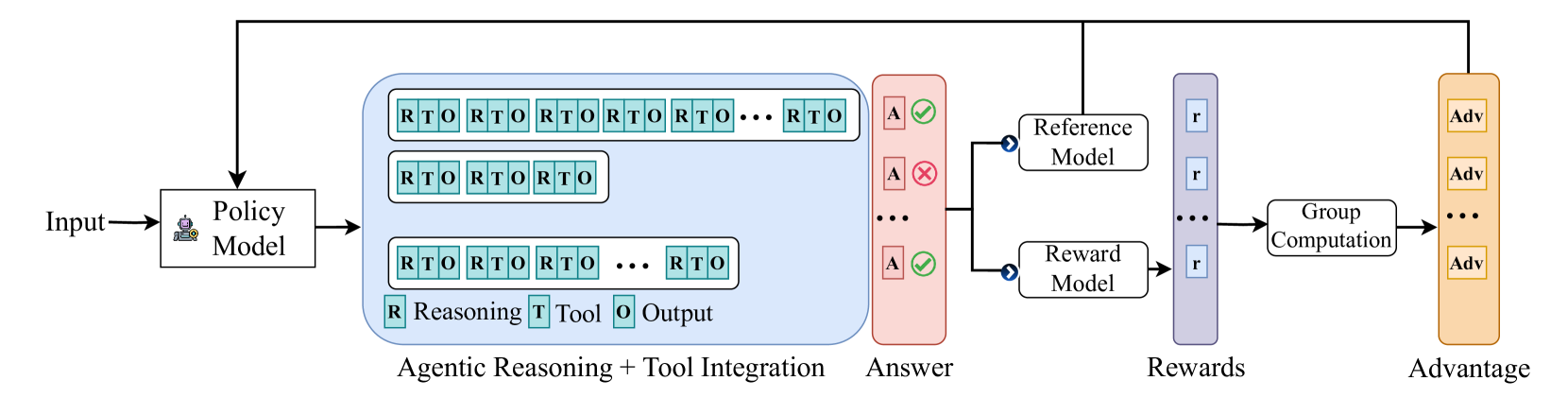
The image is a diagram illustrating a process flow for agentic reasoning and tool integration. It depicts the steps from input to policy model, agentic reasoning with tool integration, answer generation, reward calculation using reference and reward models, group computation, and finally, advantage determination.
### Components/Axes
* **Input:** The starting point of the process, represented by an arrow pointing towards the "Policy Model".
* **Policy Model:** A rectangular box labeled "Policy Model" with a robot icon.
* **Agentic Reasoning + Tool Integration:** A blue rounded rectangle containing multiple blocks labeled "RTO" (Reasoning, Tool, Output). The number of "RTO" blocks varies across different paths.
* **R:** Reasoning
* **T:** Tool
* **O:** Output
* **Answer:** A red rounded rectangle containing "A" (Answer) blocks, each associated with either a green checkmark (correct) or a red "X" (incorrect).
* **Reference Model:** A rectangular box labeled "Reference Model".
* **Reward Model:** A rectangular box labeled "Reward Model".
* **Rewards:** A purple rounded rectangle containing "r" (reward) blocks.
* **Group Computation:** A rectangular box labeled "Group Computation".
* **Advantage:** An orange rounded rectangle containing "Adv" (advantage) blocks.
### Detailed Analysis or ### Content Details
1. **Input to Policy Model:** The process begins with an "Input" that feeds into a "Policy Model".
2. **Policy Model to Agentic Reasoning:** The output of the "Policy Model" is fed into the "Agentic Reasoning + Tool Integration" stage. This stage involves multiple iterations of Reasoning, Tool usage, and Output generation ("RTO"). There are three visible paths, with the top path containing approximately 10 "RTO" blocks, the middle path containing 3 "RTO" blocks, and the bottom path containing approximately 5 "RTO" blocks.
3. **Agentic Reasoning to Answer:** The output of the "Agentic Reasoning + Tool Integration" stage leads to the "Answer" stage. This stage evaluates the answers ("A") and marks them as either correct (checkmark) or incorrect ("X").
4. **Answer to Reference/Reward Models:** The output from the "Answer" stage is fed into both the "Reference Model" and the "Reward Model".
5. **Reference/Reward Models to Rewards:** The "Reference Model" and "Reward Model" contribute to the "Rewards" stage, which contains multiple "r" (reward) blocks.
6. **Rewards to Group Computation:** The output of the "Rewards" stage is processed by "Group Computation".
7. **Group Computation to Advantage:** The output of "Group Computation" leads to the "Advantage" stage, which contains multiple "Adv" (advantage) blocks.
8. **Feedback Loop:** A feedback loop connects the "Advantage" stage back to the "Policy Model", suggesting that the advantage information is used to refine the policy.
### Key Observations
* The diagram illustrates a closed-loop system where the "Advantage" is fed back into the "Policy Model", enabling continuous learning and improvement.
* The "Agentic Reasoning + Tool Integration" stage is a key component, involving multiple iterations of reasoning, tool usage, and output generation.
* The "Answer" stage evaluates the correctness of the answers, providing feedback for the reward calculation.
* The "Reference Model" and "Reward Model" are used to determine the rewards, which are then used to compute the advantage.
### Interpretation
The diagram represents a sophisticated system for agentic reasoning and tool integration. The system takes an input, uses a policy model to generate actions, reasons and uses tools to produce outputs, evaluates the answers, calculates rewards based on reference and reward models, computes the advantage, and uses this advantage to refine the policy model. The feedback loop is crucial for enabling the system to learn and improve over time. The varying number of "RTO" blocks in the "Agentic Reasoning + Tool Integration" stage suggests that different paths may involve different levels of reasoning and tool usage. The "Answer" stage's evaluation of correctness indicates a mechanism for assessing the quality of the generated answers.