## Diagram: Reasoning Extraction and Program Generation
### Overview
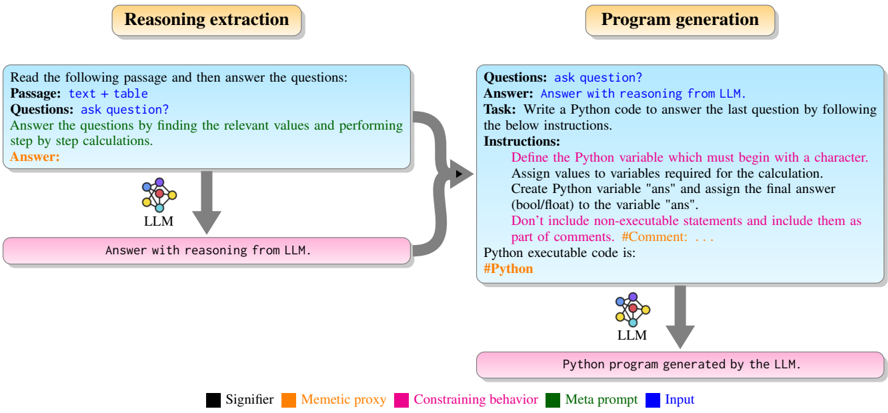
The image presents a diagram illustrating the process of reasoning extraction and program generation using a Large Language Model (LLM). It outlines the steps involved in taking a passage and questions, extracting relevant information, and generating a Python program to answer the questions.
### Components/Axes
The diagram is divided into two main sections: "Reasoning extraction" on the left and "Program generation" on the right.
**Reasoning Extraction (Left Side):**
* **Header:** "Reasoning extraction" (orange background)
* **Input Box (Top):** Light blue box containing the following text:
* "Read the following passage and then answer the questions:"
* "Passage: text + table"
* "Questions: ask question?"
* "Answer the questions by finding the relevant values and performing step by step calculations."
* "Answer:"
* **LLM Icon:** A multi-colored node diagram labeled "LLM"
* **Output Box (Bottom):** Pink box containing the text: "Answer with reasoning from LLM."
* **Flow:** An arrow flows from the Input Box to the LLM icon, and another arrow flows from the LLM icon to the Output Box.
**Program Generation (Right Side):**
* **Header:** "Program generation" (orange background)
* **Input Box (Top):** Light blue box containing the following text:
* "Questions: ask question?"
* "Answer: Answer with reasoning from LLM."
* "Task: Write a Python code to answer the last question by following the below instructions."
* "Instructions:"
* "Define the Python variable which must begin with a character."
* "Assign values to variables required for the calculation."
* "Create Python variable "ans" and assign the final answer (bool/float) to the variable "ans"."
* "Don't include non-executable statements and include them as part of comments. #Comment: ..."
* "Python executable code is:"
* "#Python"
* **LLM Icon:** A multi-colored node diagram labeled "LLM"
* **Output Box (Bottom):** Pink box containing the text: "Python program generated by the LLM."
* **Flow:** An arrow flows from the Input Box to the LLM icon, and another arrow flows from the LLM icon to the Output Box.
**Legend (Bottom):**
* Black square: "Signifier"
* Orange square: "Memetic proxy"
* Pink square: "Constraining behavior"
* Green square: "Meta prompt"
* Blue square: "Input"
### Detailed Analysis or ### Content Details
**Reasoning Extraction:**
1. The process begins with an input passage containing text and a table, along with a question.
2. The LLM processes this information to find relevant values and perform calculations.
3. The LLM outputs an answer with reasoning.
**Program Generation:**
1. The process starts with a question and the answer with reasoning from the LLM.
2. The task is to write a Python code to answer the last question, following specific instructions.
3. The instructions include defining Python variables, assigning values, creating an "ans" variable, and including comments.
4. The LLM generates a Python program.
### Key Observations
* The diagram highlights the use of an LLM in both reasoning extraction and program generation.
* The input and output boxes provide context for the LLM's role in each process.
* The instructions for program generation emphasize the importance of defining variables, assigning values, and including comments in the Python code.
### Interpretation
The diagram illustrates a system where an LLM is used to first extract reasoning from a given passage and questions, and then to generate a Python program based on that reasoning. This suggests a process of automated problem-solving where the LLM not only provides an answer but also generates the code necessary to arrive at that answer. The separation into "Reasoning extraction" and "Program generation" suggests a modular approach, where the LLM's reasoning capabilities are leveraged to create executable code. The instructions provided to the LLM for program generation are crucial for ensuring the code is well-structured and includes necessary elements like variable definitions and comments.